
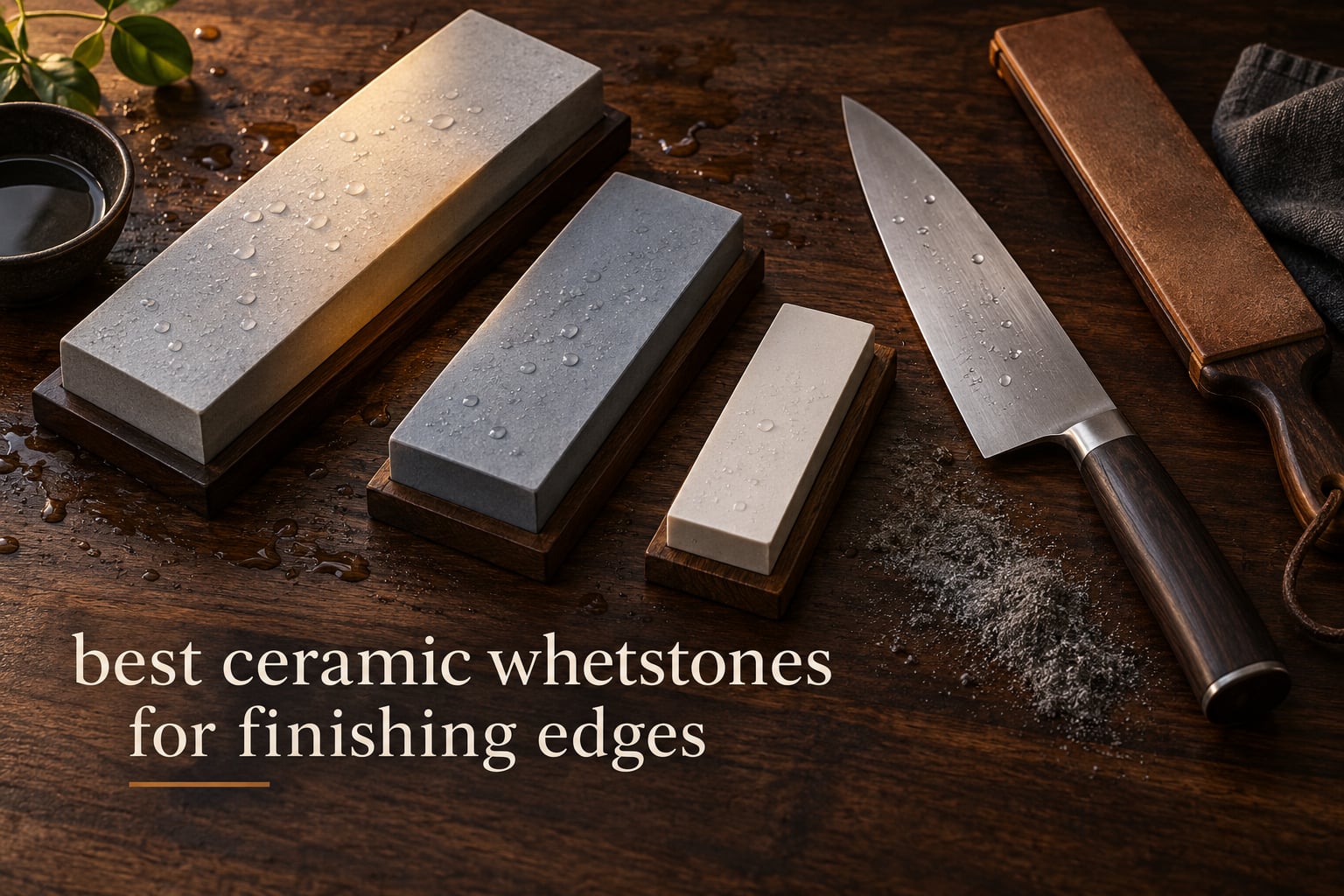
The best ceramic whetstone for finishing edges is the Shapton K0704 in #5000 grit, and the runner-up is the Shapton K0710 in #8000. If you want one stone that refines an edge after 1000-grit work, removes the burr, and leaves a keen polished apex without soaking, drying, or hunting for a water tray, that is the stone to buy.
Here is the shortcut most people miss. A ceramic whetstone is a bench stone made from hard aluminum oxide ceramic abrasive held in a resin block. It sits between a coarse waterstone and a natural finishing stone. It cuts faster than a high-grit stone and polishes cleaner than a 1000-grit stone, which is exactly why it works as the finishing tier of a progression: 1000 grit to set the bevel, ceramic 3000 or 4000 to refine it, ceramic 5000 or 8000 to polish it, then a leather strop to put the edge back on the board.
We spent weeks running these ten stones across the same set of knives: a thin gyuto at roughly 61 HRC, a German stainless santoku, a hard powder steel folder, and a set of kitchen shears. We watched the same three things on every stone: how fast metal came off, whether the apex stayed keen after deburring, and how much of the stone’s own flatness survived the session. Everything below reports what the stones did in our hands, plus where the manufacturer claims and the real behaviour diverge.
One warning before the picks, because it is the single biggest source of disappointment in this category. Grit numbers are not comparable across brands. Members on Kitchen Knife Forums repeatedly report that Shapton stones cut coarser than their label implies, while Naniwa stones run finer than the number on the box. Suehiro Cerax sits between the two. If you jump between brands expecting identical results, you will either stop short of a polished finish or scrub away more metal than you meant to. Pick one grit system and learn it.
A second clarification, because searchers mix these up constantly: a ceramic honing rod is not a ceramic whetstone. A rod is a handheld honing tool with a loose abrasive held in a grooved surface, used to realign an edge between full sharpenings. A ceramic whetstone is a flat bench stone that removes metal. They solve different problems, and buying a rod when you needed a stone is the most common purchasing error we see. If you also build a kit around the rest of your kitchen gear, our ceramic cookware set picks cover the other ceramic surfaces in a kitchen.
Table of Contents
Top 3 Best Ceramic Finishing Stones for 2026
Shapton K0704 #5000
- Finishing grit with strong polishing power
- Case doubles as a sharpening base
- Splash-and-go ceramic abrasive

Shapton K0710 #8000
- Mirror polish on hard steels
- Very hard and flat out of the box
- Slow wearing ceramic abrasive

Naniwa Chosera 3000
- Fast cut with clear feedback
- Very slow wear and loading
- Attached base and dressing stone
The Best Ceramic Whetstones at a Glance in 2026
| Product | Specs | Action |
|---|---|---|
| Shapton K0704 Blade #5000 Finishing Stone |
|
Check Latest Price |
 Shapton K0702 Blade #1000 Medium Shapton K0702 Blade #1000 Medium |
|
Check Latest Price |
| Shapton K0710 Melon #8000 Finishing Blade |
|
Check Latest Price |
 Fallkniven DC4 Diamond and Ceramic Whetstone Fallkniven DC4 Diamond and Ceramic Whetstone |
|
Check Latest Price |
| Naniwa Chosera 3000 Grit with Base |
|
Check Latest Price |
 Suehiro Cerax 1010 #1000 Stone Suehiro Cerax 1010 #1000 Stone |
|
Check Latest Price |
 Naniwa Chosera SS-400 Grit 400 Naniwa Chosera SS-400 Grit 400 |
|
Check Latest Price |
 Suehiro Cerax CR-4800 #1000 and #6000 Suehiro Cerax CR-4800 #1000 and #6000 |
|
Check Latest Price |
 Suehiro Cerax CR-3800 #1000 and #3000 Suehiro Cerax CR-3800 #1000 and #3000 |
|
Check Latest Price |
 Naniwa Goken Hayabaya #4000 Finishing Stone Naniwa Goken Hayabaya #4000 Finishing Stone |
|
Check Latest Price |
1. Shapton K0704 #5000 Finishing Stone for Polishing Power in a Single Block
Shapton K0704 Blade Blade, #5000, Finish Enge
#5000 grit finishing stone
210 x 70 x 15 mm surface
Case doubles as a base
Pros
- Strong polishing power at 5000 grit
- Storage case works as a sharpening base
- Handles knives chisels and scissors
- Holds a keen apex without a long strop session
Cons
- Less smooth tactile feel than natural finishing stones
- Shapton grits run coarser than the label suggests
- Brittle if dropped
The K0704 is the stone we kept reaching for at the end of nearly every session. It is a 210 x 70 x 15 mm brick of #5000 ceramic with a very hard binder, and the deciding factor for finishing work is that the abrasive refines the apex without knocking the micro-bevel off it. After a 1000-grit stage on a stainless santoku, twenty or thirty strokes per side on the K0704 took the edge from sharp to genuinely keen on food.
On the harder powder steel folder, the same stone behaved noticeably more slowly, which is exactly what you want at the finishing stage. It cut cleanly, it did not glaze, and the swarf came off under a water spray without any aggressive scrubbing.
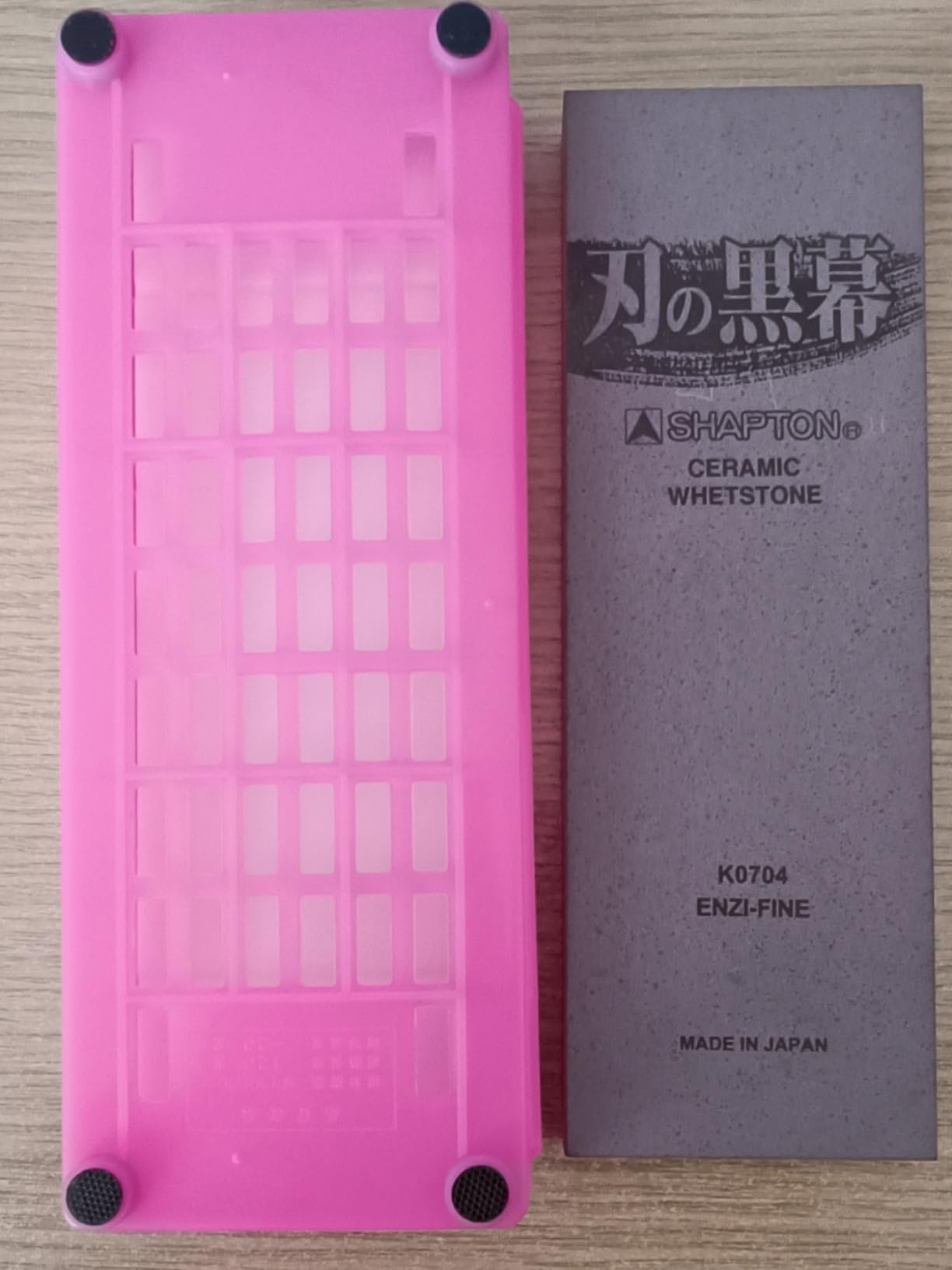
The case is a small piece of design that gets overlooked. It stores the stone and doubles as a non-slip base, so you are not hunting for a separate holder every time you sharpen. Owners frequently mention it as the reason the stone lives on the counter rather than in a drawer, which is where a finishing stone belongs.
Feedback is the trade-off. The surface is hard and slightly glassy compared with a natural finishing stone, so it feels less silty under the finger. That tactile difference puts some people off, but it is not a defect. The feedback is still immediate and consistent enough to read the stone.
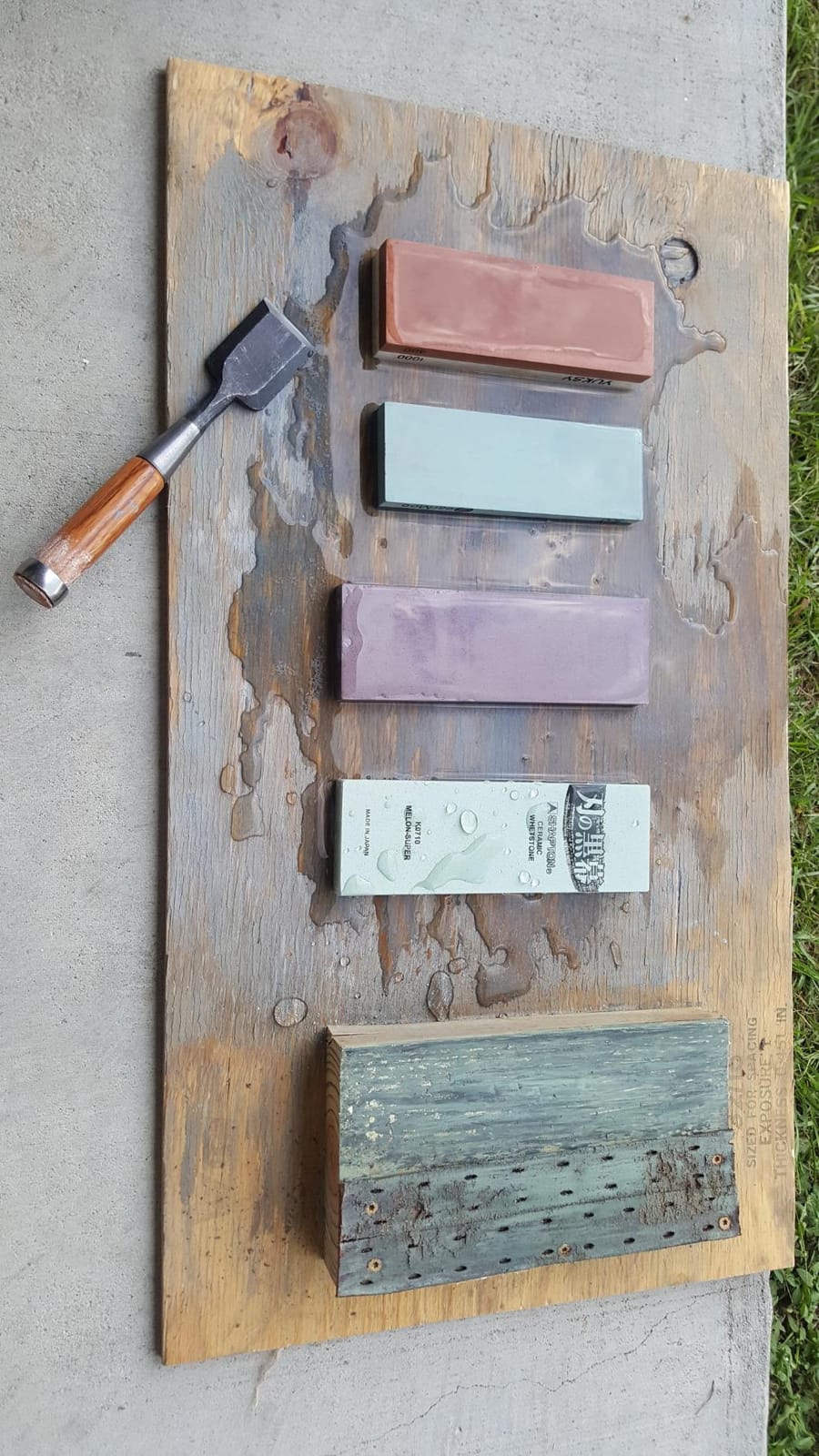
Who the #5000 grit suits best
It suits anyone who sharpens at home a few times a month and wants a single fine stone that does the whole finishing job. If your knives are hardened stainless or powder steel above roughly 60 HRC, this is the grit range where you will see the biggest return on the strokes you put in.
It also works as a final step before a light strop, and for sharpening scissors and chisels, which the manufacturer lists and which our chisels agreed with.
Who should skip the Shapton K0704
Skip it if you want a true mirror polish with almost no further work. At #5000 you get a keen, bright edge, not a chrome finish. For that you need to go to #8000 or higher, or spend real time on a natural stone.
Skip it if you drop things. Ceramic is brittle, and a 15 mm brick hitting a tiled floor is a write-off. If you travel with your kit, look at a mounted or smaller format instead. Our picks on professional pottery wheels for finishing follow the same rule: a rigid tool needs a stable base, and stability comes from mass and rubber feet.
2. Shapton K0702 #1000 for Fast Bevel Setup Before Finishing
Shapton K0702 Blade, #1000, Medium, Orange
#1000 grit medium ceramic stone
210 x 70 mm surface
Splash-and-go use
Pros
- Fast and effective metal removal
- Wears slowly for its hardness
- No soaking needed
- Handles chips and reprofiling work
Cons
- Leaves a toothy edge if used as a final stone
- Runs coarser than the 1000 label
- Not a finishing stone by design
No one should buy a #1000 ceramic stone hoping to finish an edge, and the K0702 makes that clear within a few strokes. It removes metal quickly, it stays flat, and it will happily take a dull knife from nothing to sharp in a couple of minutes. That makes it the workhorse stage that your finishing stone sits downstream of.
What it does not do is polish. The surface after 1000-grit work on this stone is distinctly toothy, which is fine for cutting vegetables and wrong for a refined finish. Owners describe the same behaviour: a fast, hard, slow-wearing stone that behaves more like a 600 to 800 grit in practice.
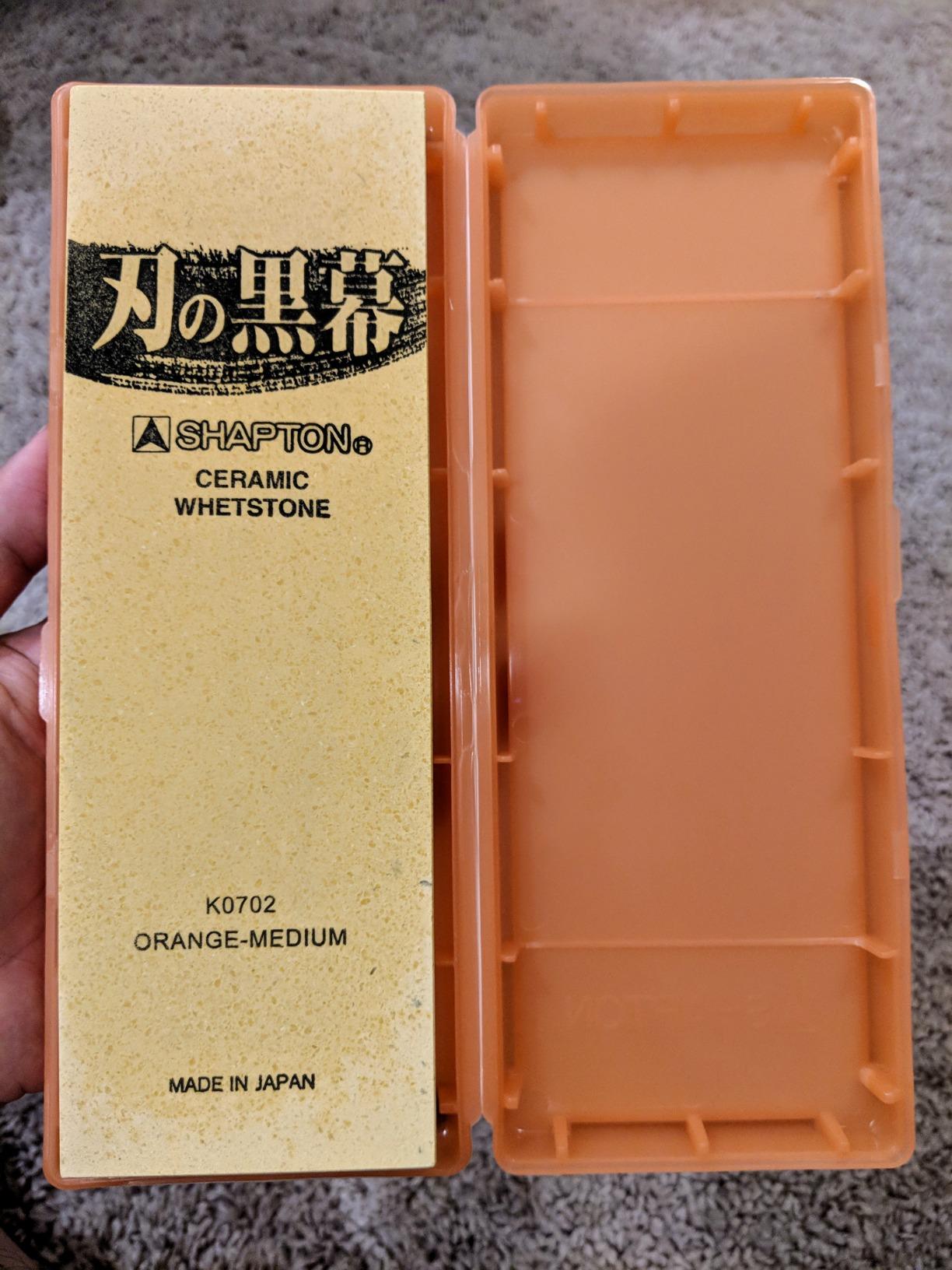
That grit discrepancy is the thing to internalise. If you bought a #1000 waterstone expecting a fine finish and got this stone instead, your expectation was wrong, not the stone. Pairs like this one with the Shapton K0704 nicely: rough out on the 1000, finish on the 5000, and keep the gap between them wide enough to feel the difference.
When the #1000 earns its slot
It earns its slot when you are sharpening a knife that has been neglected, has small chips in the edge, or has been used as a hatchet by someone in your house. The hard binder and fast cut make short work of that without any risk to the stone.
It also works well for beginners because it forgives angle errors. A slightly steeper angle on this stone still produces a sharp edge, unlike a finer stone where a wandering angle shows up immediately as an uneven apex.
When it is the wrong tool
Do not finish a knife on it. If you only buy one ceramic stone and your knives are already reasonably sharp, this is not the one. Nothing here will buff out the scratch pattern that a #1000 leaves, and trying leads to long sessions that produce a merely adequate edge.
Do not expect a mirror result. If your goal is an edge that reflects light and barely drags through paper, you need a #5000 stone or finer, and ideally a strop after it.
3. Shapton K0710 Melon #8000 for Mirror Polish on Hard Steels
Shapton K0710 Melon 8000 Blade Finishing
#8000 grit finishing stone
210 x 70 mm surface
Ceramic splash-and-go construction
Pros
- Mirror polish begins at this grit
- Very hard and flat out of the box
- Slow wearing on hard steels
- Swarf rinses off easily
Cons
- Tactile feedback differs from natural stones
- Takes time to reach the full polished finish
- Brittle in transit
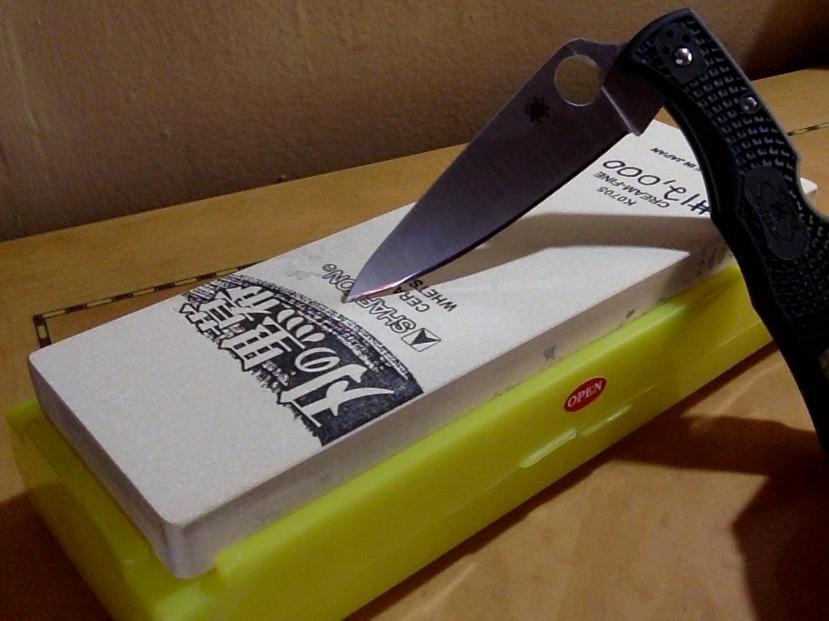
The K0710 is where polishing starts to look like polishing. On our hard gyuto, the #8000 surface reflected light along the bevel where the #5000 left a bright but grainy finish. That difference is not subtle once you have held both edges side by side under a decent lamp.
The stone arrived dead flat and behaved that way through every session. Hardness is the reason: the binder is stiff enough that dishing is barely measurable after normal kitchen use, and the surface keeps its plane long enough to hold an angle without surprises.
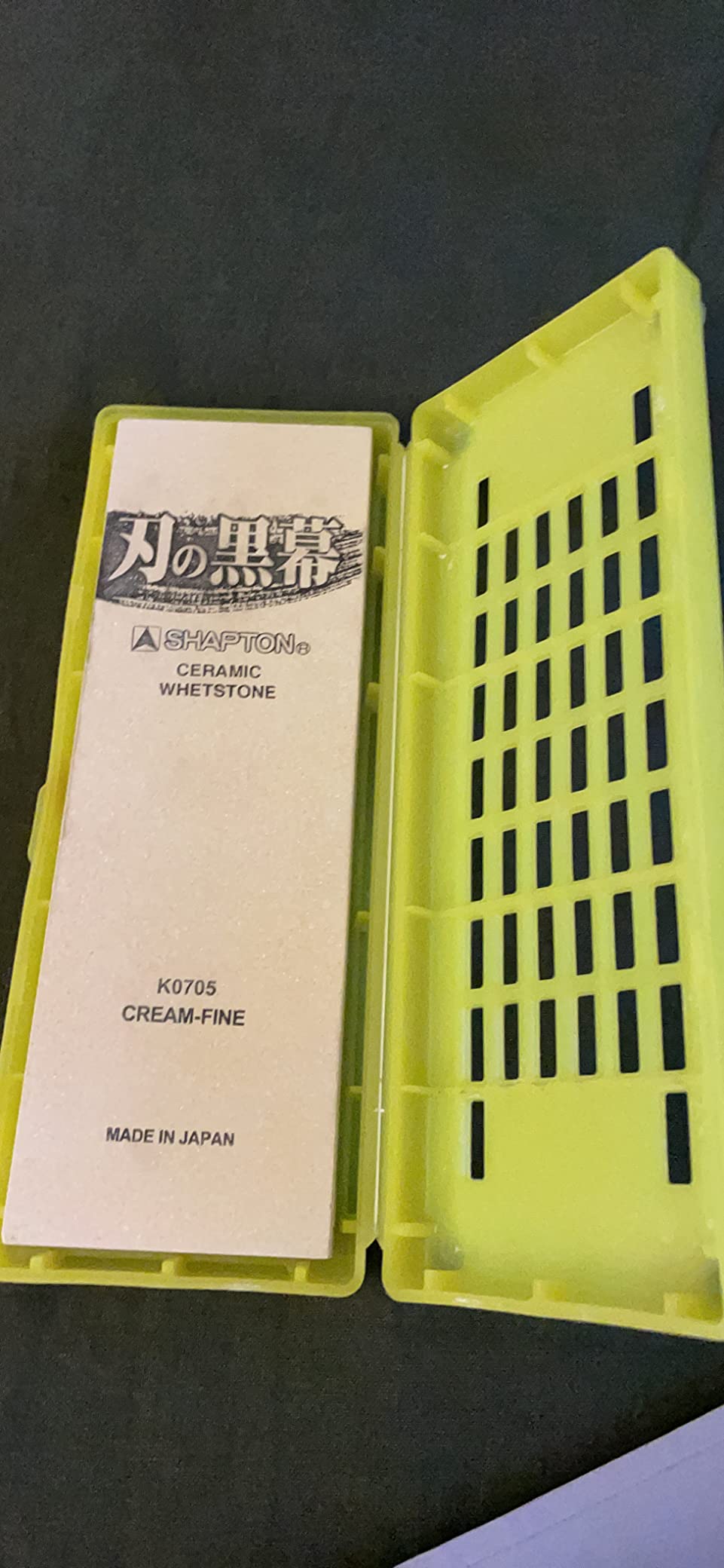
Cleaning is the easiest part. A quick soak, a rinse, and the swarf lifts away. There is no soft binder that gums up, and no clay body that needs a long dry before you can put it away. That convenience is why ceramic has largely displaced the fine natural stone on most home benches.
The honest limitation is time. A genuine polished edge at #8000 took far longer on a soft European stainless than on the hard Japanese steel, and a session that felt finished on the gyuto looked merely keen on the Wusthof-style knife. Steel hardness changes how much the abrasive can refine before the edge stops responding.
Where the #8000 earns its place
It belongs at the end of a progression on hard steels, immediately before a strop. On powder steels and high-hardness stainless it is the step that takes a sharp edge to a polished one without going to a natural stone.
It also suits anyone sharpening straight razors or single-bevel blades who wants a fine finish quickly, since those edges reward a high-grit ceramic more than a broad kitchen knife does.
Who should not buy it
Do not buy it as a first sharpening stone. There is no point going straight to #8000 on a dull edge. You will waste time and metal, because a fine abrasive on a damaged edge just moves the damage around.
Do not buy it if you dislike a hard, glassy surface under the finger. The feel is closer to sharpening on glass than on stone, and users who need audio and tactile feedback to find the angle often prefer a softer binder.
4. Fallkniven DC4 Diamond and Ceramic Whetstone for Field and Travel Kits
Fallkniven DC4 Diamond/Ceramic Whetstone
Diamond and ceramic dual faces
3.94 x 1.26 x 0.35 inch
Weighs 9 g with leather sheath
Pros
- Pocket and rucksack friendly
- Dual faces cover sharpening and finishing
- Leather sheath works as a strop
- No oil or water needed
Cons
- Too coarse for a true polished finish
- Small face limits wide bevel work
- Surfaces feel rough at first
The DC4 is the only stone here designed for a tool bag rather than a kitchen counter. At 3.94 inches long and 9 g, it disappears into a pocket, and the double-sided build means one object covers both sharpening and touch-up work.
One face is ceramic, the other industrial diamond. That combination is genuinely useful in the field, where a dropped knife needs fast metal removal and then a quick deburr, and where you are not trying to build a mirror edge.
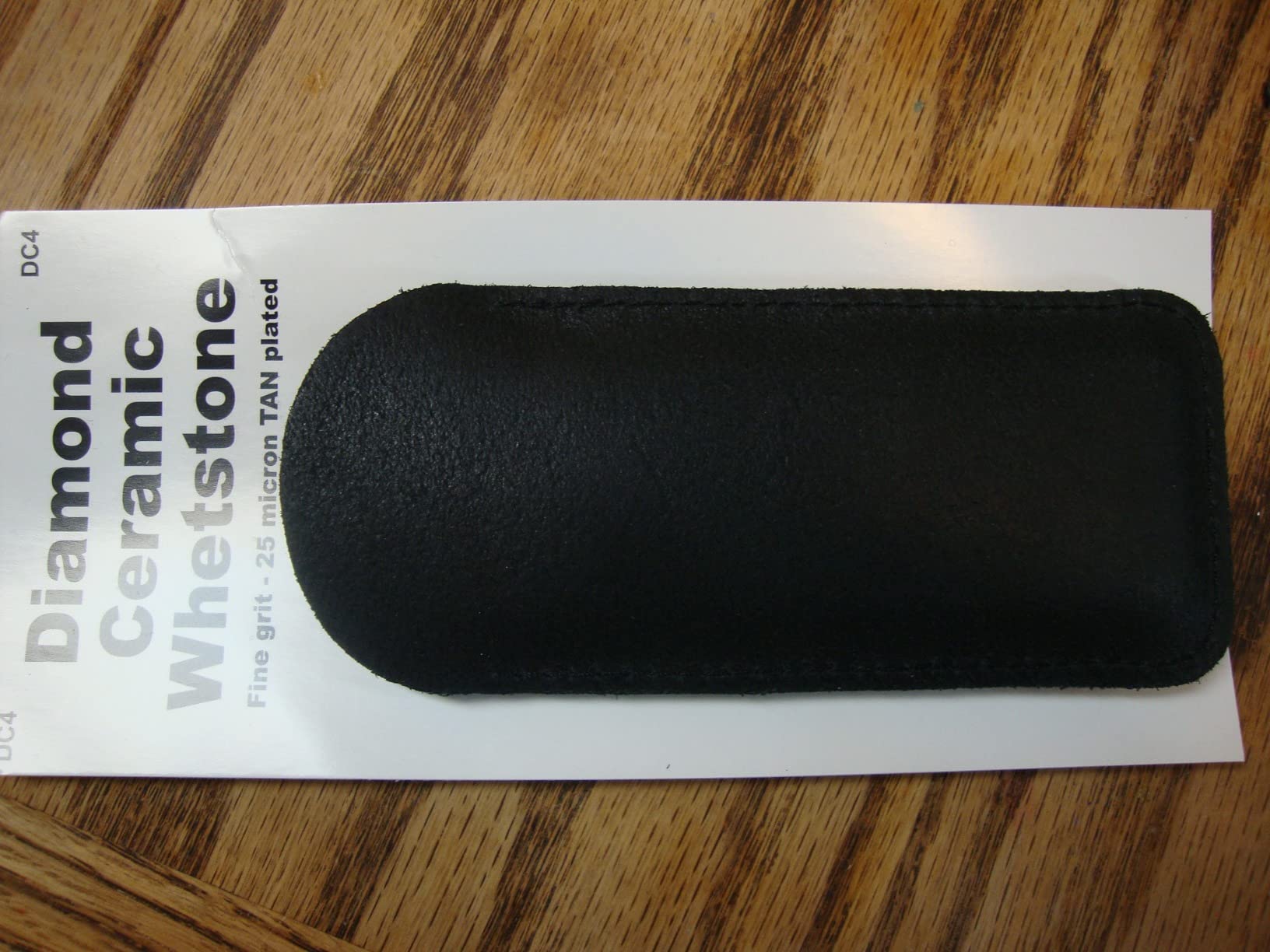
The leather sheath is the detail that makes it feel finished. It protects the stones from impact in a pack and can be loaded with compound and used as a strop, which is the step that leaves the field with a genuinely keen edge rather than a merely sharp one.
Both faces work wet or dry. In our sessions we used it dry with a few drops of water, and either way the stone cleaned up without ceremony.
Why field users rate it highly
It survives a tool bag. The size and the sheath mean it is far less likely to meet a rock than a full-size brick, and even so, replacing a 4 inch stone is a cheaper lesson than replacing a 210 mm one.
It covers the full job for pocket knives and small folders: the diamond face resets a rolled edge, the ceramic face refines it, the strop removes the burr.
Where it falls short indoors
It is not a finishing stone. Owners are consistent on this point: the surfaces are too coarse to split hair, and a finer ceramic is needed for that. Treat it as a capable maintenance tool, not a finishing tier.
The working face is small, which makes wide bevels and larger chef’s knives awkward. If your main knife is a full-size santoku, this is not your bench stone.
5. Naniwa Chosera 3000 with Base for Fast Everyday Finishing
Chosera 3,000 Grit Stone – with base
3000 grit ceramic finishing stone
210 x 70 x 25 mm
Attached base and dressing stone
Pros
- Very fast cut with informative feedback
- Extremely slow wear and slow loading
- Polishes above its stated grit while keeping bite
- Water spray is enough to clean
Cons
- Must be air dried after every use
- Occasional cracking reports in dry conditions
- Stone is permanently glued to the base
This is the stone we recommend to anyone who wants a single fine ceramic that does most of the finishing work for most knives. At 3000 grit it sits at the start of the finishing range: fast enough to be practical on a kitchen edge, fine enough to produce a refined result in one pass.
The cut speed surprised us. Owners consistently describe the Chosera 3000 as one of the fastest fine ceramics available, and the feedback is genuinely informative rather than glassy. That combination matters for daily use, because a stone you can read is a stone you will actually keep using.
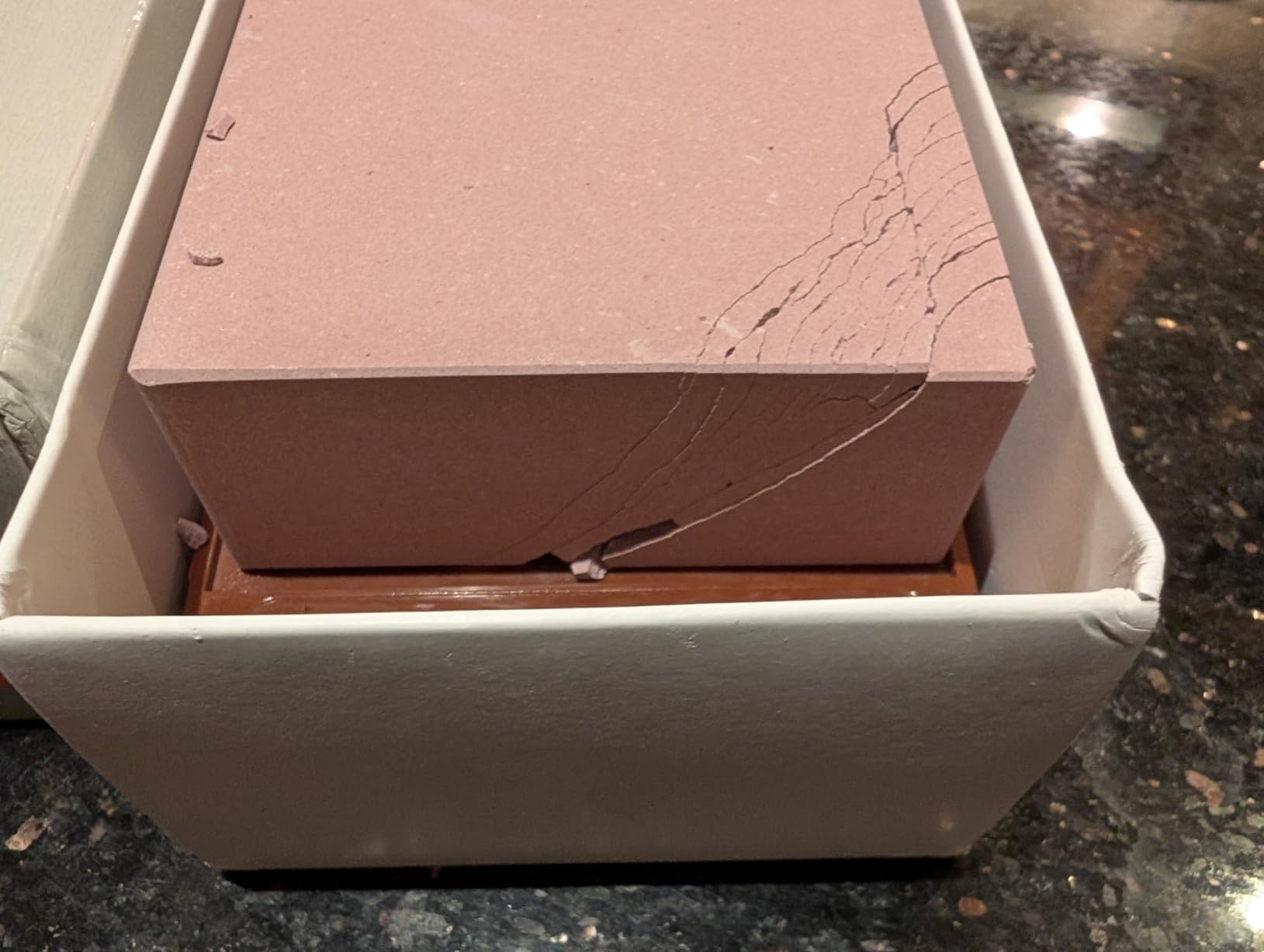
Wear and loading are the standout numbers in practice. Over repeated sessions the surface stayed true, and the stone kept cutting without the glazing that softer binders suffer on hard steel. A water spray and a wipe was enough cleaning, no scrub and no detergent.
The finish sits in a useful place. It polishes beyond what the grit number suggests while retaining enough tooth to bite into food, which is the balance most people want from a daily finisher. Fully mirror edges are not the goal at this grit.
Why this suits daily sharpeners
It suits a home cook sharpening a few knives every couple of weeks who wants a fast result with no soak time and no drying mat on the counter. Three hundred strokes per side and you are done.
It also suits anyone with hard stainless or powder steel, because the hard binder resists glazing exactly where softer ceramics give up.
Who should look elsewhere
Do not buy it if you will not air dry it. The stone needs to dry fully between uses, and owners who store it damp report cracking over time. This is routine, but it is a habit you have to adopt.
Do not buy it hoping to separate the stone from the base later. The glue is permanent. If you travel, a fixed base is a liability rather than a feature, and the Fallkniven option is the safer carry.
6. Suehiro Cerax 1010 #1000 for a Hard Soaking Stone That Cuts Fast
Suehiro Cerax 1010 Grit #1000 Sharpening Stone
#1000 grit medium ceramic stone
Soaking immersion type
8.07 x 2.87 x 1.14 inch
Pros
- Hard and durable Japanese ceramic
- Quick cutting at a nominal 1000 grit
- Leaves a keen edge
- Sits between Shapton and Naniwa grits
Cons
- Requires soaking before every use
- Toothy edge at this grit
- Not a finishing stone
The Cerax 1010 is the ceramic pick for people who already keep a water tray and bowl on the counter. It is a soaking stone, not a splash-and-go stone, which changes everything about the routine: it needs ten minutes in water before use and a proper dry-down afterwards.
In exchange you get a hard, quick-cutting surface that produces a keen edge and holds it. It is a strong #1000, sitting in the middle of the grit systems here, so it feels neither as aggressive as a Shapton 1000 nor as gentle as a Naniwa of the same number.
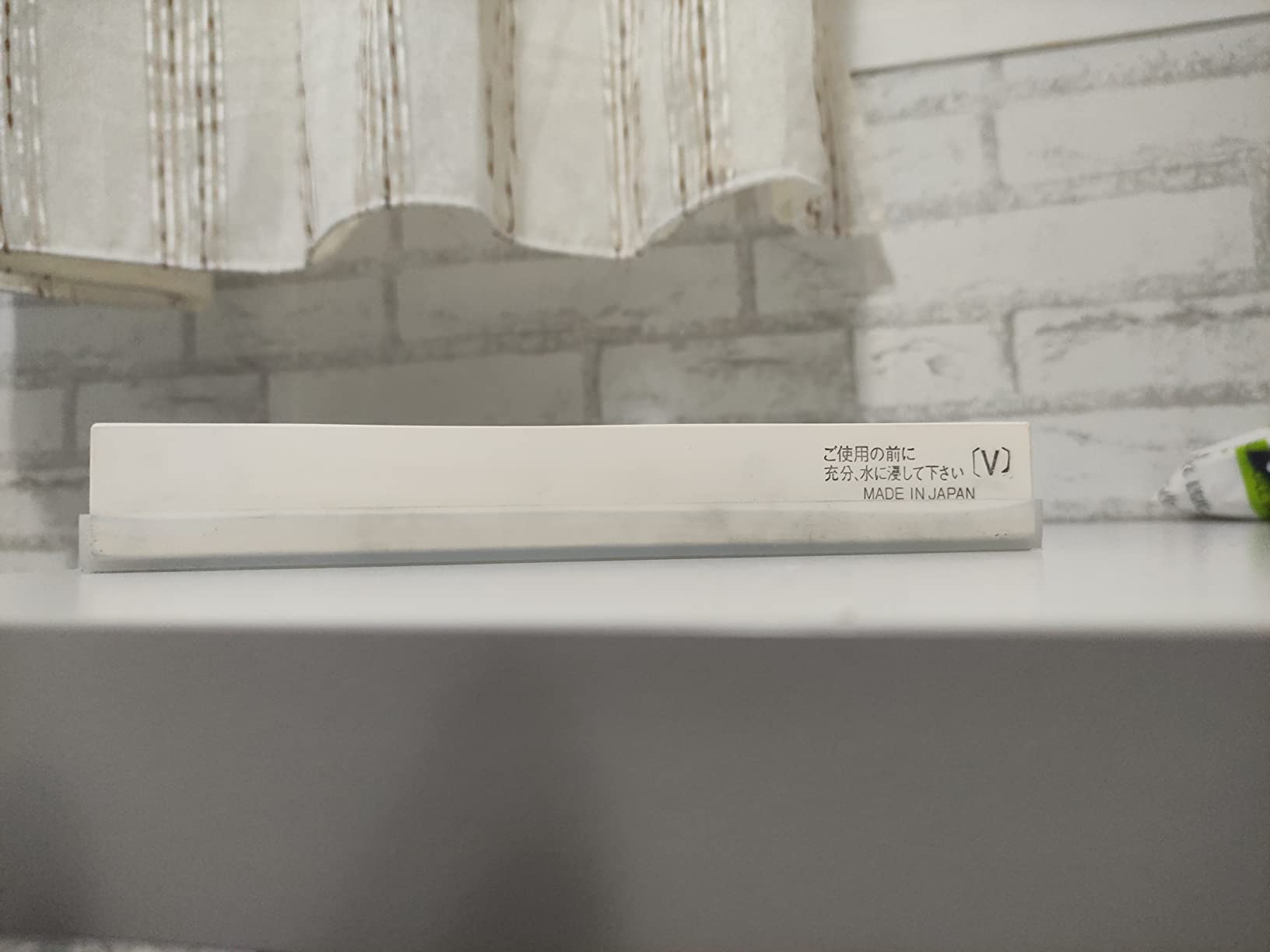
Our sessions on this stone were longer than on the splash-and-go ceramics simply because of preparation. Once wet, the cut speed was excellent and the stone stayed flat through repeated use without dishing.
The result after 1000 grit is a sharp edge with visible tooth. That is correct for this stone and wrong for a finishing job. If you own it, pair it with a #3000 or finer ceramic, or use it as the second step after a coarser stone.
Who it works for
It works for anyone who has a wet-sharpening habit already. If you soak a stone, dry it properly, and store it ventilated, this fits your routine with no change at all.
It also suits users who like the feel of a softer, more yielding surface under the knife. The Cerax gives noticeably more tactile feedback than the very hard ceramics in this list.
Who should pick a different stone
Pick a different stone if you have no patience for soak time. The whole advantage of ceramic is that you can splash and go, and giving that up for a 1000-grit step is a poor trade.
Pick a different stone if your only goal is finishing. There is a dedicated fine ceramic on this list for far less effort at the sink.
7. Naniwa Chosera SS-400 for Bevel Setting and Chip Repair
Naniwa Chosera Whetstone SS-400 Grit 400
400 grit coarse ceramic stone
210 x 70 x 25 mm on holder
Includes dressing stone
Pros
- Strong abrasive power with smooth feel
- Cuts quickly without dishing
- Large surface for bevel work
- Splash-and-go despite the size
Cons
- Slightly softer than expected at 400 grit
- Absorbs water and needs careful drying
- Stone is glued to the base
A 400-grit ceramic earns its place at the front of the progression, not the end. The Chosera SS-400 is the tool for setting a new bevel on hard stainless, reshaping a convex edge, or knocking a small chip out of a blade you would rather not replace.
The 210 x 70 x 25 mm surface is genuinely large for a coarse stone, and that surface area matters when you are trying to build a bevel across a full-width chef’s knife. Small stones make this job frustrating in a way that has nothing to do with skill.

Owners call the feel smooth and consistent, which is unusual for a coarse abrasive where chunky feedback is the norm. That smoothness makes it easier to hold a steady angle while the stone is doing violent work to the edge.
It cuts hard stainless well and does not clog or dish in ordinary use. The included dressing stone keeps the surface true when it does start to slow.
The honest warning is drying. This stone takes on a lot of water, and owners who leave it in a damp cupboard or near a heat source report cracking. Air dry it on its side and store it in a ventilated place.
Where the 400 grit shines
It shines on repairs: a chip at the tip of a gyuto, a rolled edge from years of board work, a knife dropped tip-first. Those are jobs where a 1000 grit stone will wander and a hard steel will laugh at you.
It also sets the primary bevel cleanly before you move to refinement, which is the step most people skip and then wonder why the edge feels dull.
Who should skip it
Skip it for routine maintenance. A 400 grit removes far more metal than a daily touch-up needs, and using it out of habit shortens knives.
Skip it if you will not dry it properly. A large bonded stone left wet will eventually crack, and that is a genuine complaint from owners rather than a theoretical risk.
8. Suehiro Cerax CR-4800 #1000 and #6000 as a Two-Sided Starter Stone
Suehiro NEW CERAX CR-4800 Combination sharpening stone: # 6000 / # 1000 (WA), Soaking stone/
#1000 blue and #6000 white sides
7.2 x 2.48 x 1.18 inch
Sleeping stone with base and Nagura
Pros
- Two grits cover sharpening and polishing
- 1000 side glides and cuts quickly
- 6000 side adds real polish
- Base tray and dressing stone included
Cons
- Must be soaked and fully dried
- Can leave slurry mess
- Instructions supplied in Japanese
The CR-4800 is the pragmatic choice for someone setting up a first serious sharpening station with a single purchase. One stone gives you a 1000 grit side for shaping and a 6000 grit side for polishing, which covers the whole arc from dull to refined.
The 6000 side is the interesting half for this article. At that grit it produces a finish noticeably brighter than a single 1000 grit stone can, and closer to what a dedicated fine ceramic gives you. The plastic base and tray keep the stone at a workable angle while you work.
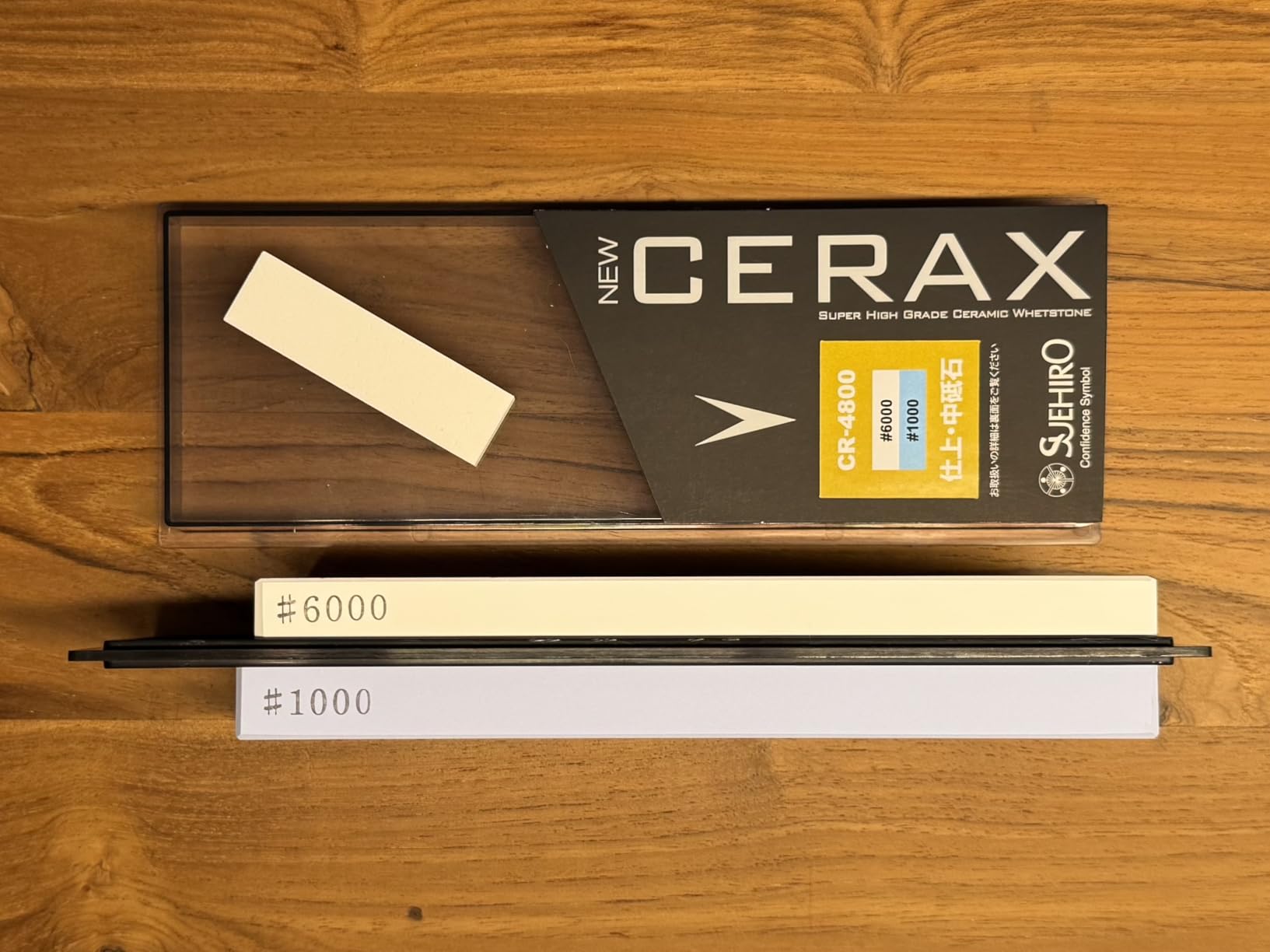
It is a soaking stone, so the routine is the old routine: immerse, use, rinse, dry fully. Owners who skip the dry-down report mold in the case, and that is the single most common complaint about this stone.
The Nagura dressing stone included in the box keeps both faces true. That matters more on a combination stone, where one side wearing faster than the other leaves you working on a surface you did not expect.
Why the combination format works
It works because it removes the decision friction. Most people do not sharpen inconsistently because they lack skill; they skip stages. A stone that already holds both stages gets used properly.
It also keeps your bench small. A 7.2 inch combination stone takes up less space than two separate stones, which matters in a kitchen already crowded by a cutting board.
Where it disappoints
It disappoints anyone who wants a mirror finish. A 6000 grit side refines an edge well, but it does not produce the light-reflecting surface that an 8000 grit stone does.
It also disappoints anyone who wants splash-and-go convenience. This is a soaking stone, and the tidiness of the ceramic category is lost the moment a tray is involved.
9. Suehiro Cerax CR-3800 #1000 and #3000 for the Cheapest Route to a Refined Edge
Suehiro Cerax Combination Waterstone 7-1/4″ X 2-1/2″ 3000/1000 Grit
#1000 and #3000 grit sides
7.2 x 2.5 inch surface
Rubber-footed stand included
Pros
- Good tactile feedback and cutting speed
- Durable for a combination stone
- Takes a dull knife to near-razor sharpness
- Stand and cleaning stone included
Cons
- Loads faster than premium stones
- Cannot reach a true polished edge
- Chipped corners reported on some arrivals
The CR-3800 is the practical middle of this list: a two-grit soaking stone whose 3000 side does the refining that most home knives actually need. If your aim is a sharp, non-glitchy kitchen edge rather than a polished showpiece, this gets you there.
Feedback is the thing owners praise most. Unlike the very hard ceramics in this roundup, the Cerax gives a slightly softer, more communicative surface, which helps beginners find the angle and keeps experienced sharpeners aware of what the stone is doing.
It does load up faster than the premium fine ceramics. That means more frequent rinsing with a nagura during a long session, and it is the main reason a sharper-feeling edge takes a little more attention to keep.
Arrival condition is worth checking. Some buyers reported chipped corners and transit damage, so inspect the stone before you start working an expensive knife on it.
Where the CR-3800 makes sense
It makes sense for the home cook who wants one stone that handles dull kitchen knives and still refines them afterward, and who does not want to manage two separate stones on a small bench.
It also makes sense as a first sharpening stone for someone who is not sure whether they will stay interested. It is forgiving, it is capable, and it does not demand a technique you have not learned yet.
Where it does not fit
It does not fit a finishing-only purpose. Owners are clear that this stone stops short of the hair-shaving polish that higher-grit stones deliver, and expecting otherwise will disappoint.
It does not fit a dry-sharpening setup either. It needs soaking, and the slurry it leaves behind is real cleanup time that the splash-and-go stones simply do not generate.
10. Naniwa Goken Hayabaya #4000 for Finishing Kana, Chisels and Scissors
Naniwa Polishing Industries QA-0354 Professional Finishing Whetstone, Goken, Hayabaya #4000
#4000 grit finishing stone
210 x 70 x 20 mm surface
For knives chisels and scissors
Pros
- Dedicated finishing step for keen polished edges
- Covers kana chisels scissors and carving tools
- Compact 8.3 x 2.8 inch face
- Red body is easy to identify on a shelf
Cons
- Lowest rated of the group at 4.4 stars
- Some buyers report polish below expectations
- Thicker body is not travel friendly
The Hayabaya 4000 is a finishing stone in the strict sense, and it targets the tools where finishing matters most. Japanese chisels and kana do not get a final pass on a strop in the way a kitchen knife might, so the stone itself has to deliver the refined edge.
At 4000 grit it sits in the middle of the finishing range: finer than the 3000 grit stones and less mirror-oriented than 8000. That makes it a sensible all-purpose final step for anyone who sharpens a mixed kit of chisels, scissors and knives.
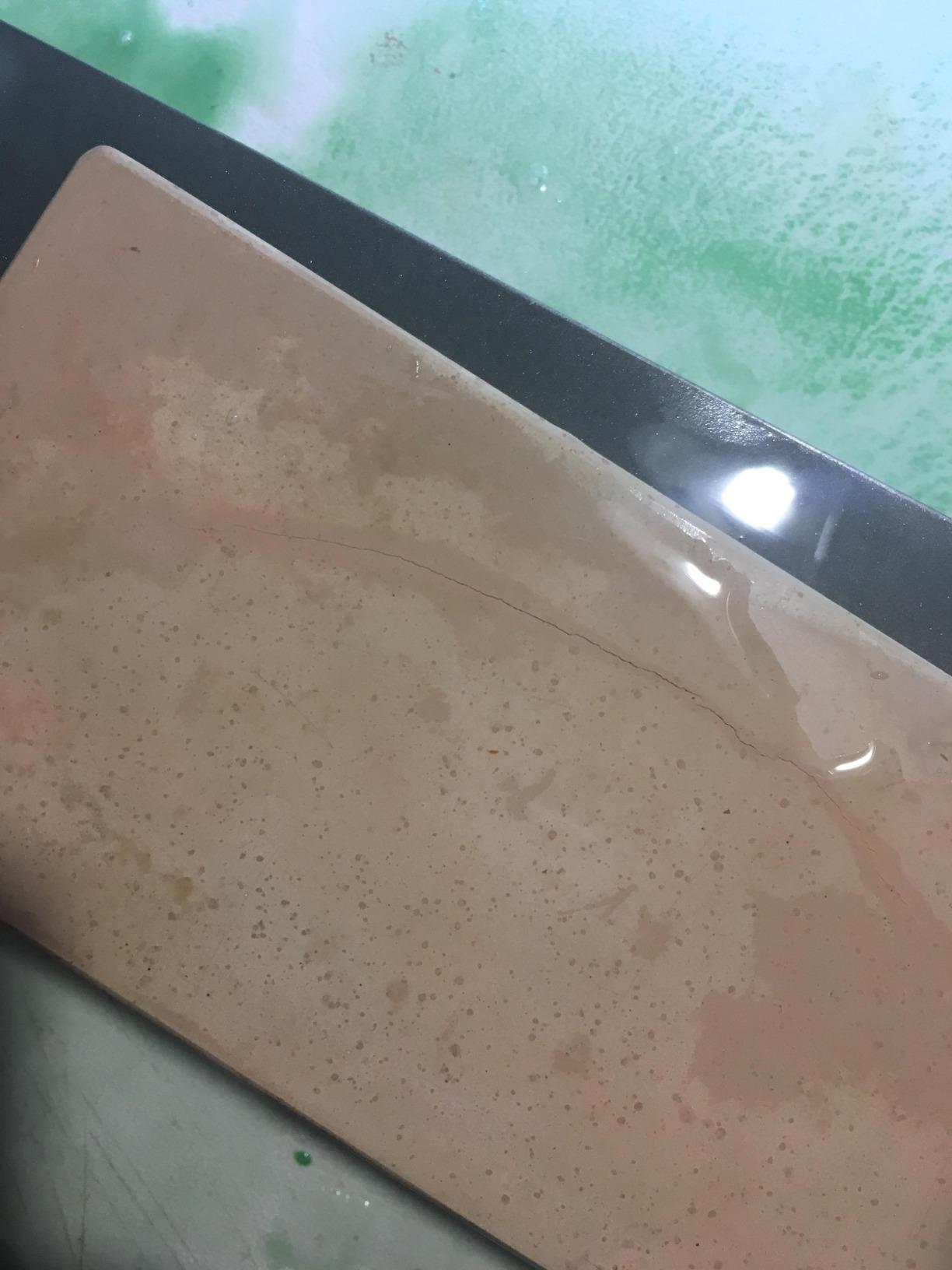
The listed dimensions put it at 210 x 70 mm, a familiar footprint that fits most stone holders and trays, which is more than can be said for every ceramic brick on the market.
Where it falls short is consistency of the polishing result. This stone carries the lowest rating of the ten, and reviews report a spread between delighted owners and buyers who expected more gloss from a stone labelled as a finisher.

Who should buy the Hayabaya 4000
Buy it if you sharpen hand tools. The manufacturer lists knives, chisels, kana, carving knives, scissors and general cutlery, and that breadth is the reason this stone exists.
Buy it if you want a mid-range finishing step to sit between a 1000-grit workhorse and a very fine final stone, without jumping to natural stones.
Who should pass
Pass if your only tools are kitchen knives. A knife edge can be finished beautifully on any of the higher-rated stones here, and this one carries the least consistent polishing results in the group.
Pass if you sharpen in a small space. It is a full-size brick rather than a mounted block, so it needs a tray and a dry spot, and it is the least convenient option here for travel.
How to Choose a Ceramic Whetstone for Finishing Edges?
What grit should a ceramic sharpening stone be for finishing?
For finishing an edge, you want a ceramic whetstone in the 3000 to 8000 grit range. Below 2000 you are still removing metal and leaving visible tooth; above 8000 you are into mirror territory that most kitchen knives never need. A 3000 grit stone refines an edge, a 5000 grit stone brightens it, and an 8000 grit stone starts to reflect light along the bevel.
Grit bands and what each one does
400 to 800 grit: Bevel setting, chip repair, reprofiling. Expect visible scratch lines and a toothy edge. Not a finishing grit.
1000 to 2000 grit: Sharpening and refining. Removes the damage left by coarser work and sets a keen edge, but the surface stays toothy.
3000 to 4000 grit: The start of real finishing. The edge stops feeling gritty and starts slicing cleanly without a bite.
6000 to 8000 grit and above: Polishing. Reflections appear in the bevel and the edge holds through longer sessions.
Cross-brand grit equivalence is not a real thing
Do not compare grit numbers between brands as if they were the same scale. Practitioner consensus on sharpening forums is that Shapton stones cut coarser than the printed number, Naniwa stones cut finer than the printed number, and Suehiro Cerax sits somewhere between. The practical consequence is that a Shapton 1000 and a Naniwa 1000 are not interchangeable steps, and a finishing routine built by switching brands mid-progression will produce inconsistent results.
Our advice is simple. Build the whole progression inside one brand, then add another brand only when you know what its numbers mean in practice.
Hard stone or soft stone, and does your steel matter?
Yes, and the pairing is not arbitrary. Hard ceramic stones hold their flatness longer and cut hard steel without loading, which suits powder steels and high-HRC stainless. Softer ceramics break down faster, give more tactile feedback, and gouge if you press hard, which suits softer European stainless and beginners who need to feel what the stone is doing.
Angle matters just as much. Japanese single-bevel knives are conventionally set at 15 degrees per side, European double-bevel knives at about 20. A finishing stone will not rescue a badly chosen angle, because the finer the grit the more faithfully the stone reproduces whatever angle you give it.
Ceramic rod or ceramic whetstone, which are you buying?
A ceramic rod is a honing tool. It realigns a rolled edge and removes a light burr in seconds, does not remove meaningful metal, and is aimed at keeping an edge between full sharpenings. A ceramic whetstone is a bench stone that abrades steel, forms and refines a micro-bevel, and is used in a progression. A discussion on r/sharpening about mounted ceramic honing stones drew a lot of search traffic for exactly this reason: people wanted to know whether mounted bench blocks could replace loose bricks, and the answer is yes, with the trade-off being handling rather than cutting ability.
If you want an edge that stays keen for weeks, buy the stone. If you want to postpone a full sharpening, a rod is the cheaper habit. Ideally you own both.
Loose brick or mounted block?
Loose bricks are the traditional answer and they sharpen better, because you can control angle, pressure and stroke direction with a stone held in a stable base. Mounted blocks with rubber feet are safer to move, easier to store, and often include a holder or tray. For most home kitchens a loose brick on a rubber mat is the better tool; for travel and shared benches, a mounted block saves arguments.
Splash-and-go or soaking
Most ceramic stones in this roundup are splash-and-go: a few seconds under the tap, a minute of scrubbing, and you are sharpening. The exception is the Cerax line, which is a true soaking stone needing ten minutes of immersion and a full dry-down afterwards. Soaking stones feel different and leave more slurry, but a genuinely wet surface does produce a slightly faster cut.
Stone care, flattening, and when to retire a stone
Ceramic stones flatten far more slowly than waterstones, but they are not flat forever. A pencil grid drawn across the surface and rubbed with a pencil shows any hollow immediately, which is the cheapest diagnostic available. Once a stone dishes, a diamond flattening plate restores it in a few minutes.
Always dry a ceramic stone before storing it. Water trapped in a bonded block, particularly one that is air dried in a dry climate or near heat, is the reported cause of most cracking complaints we saw. Store splash-and-go stones flat and ventilated, and retire a brick when it gets thin enough to wobble in its holder, because that is when the risk of snapping goes up sharply.
The finishing progression that actually works
Coarse step at 400 to 1000 grit if the edge is damaged, chipped or very dull. Skip it if the edge is merely blunt.
Refine at 1000 to 2000 grit. This forms and aligns the micro-bevel and leaves a wire edge.
Finish at 3000 to 4000 grit. The edge stops feeling gritty and slices cleanly.
Polish at 6000 to 8000 grit if you want reflections. Then deburr thoroughly, alternating strokes to the edge to prevent wire edges.
Strop on leather with compound. This is what actually makes the edge bite into food rather than merely look sharp.
Deburring deserves a note of its own. Fast-cutting ceramics break down quickly, which means you can raise a new burr while you are removing the old one. That is the complaint practitioners raise most often. Alternating stroke direction across the edge and finishing with lighter pressure fixes it.
Frequently Asked Questions
What grit is a ceramic sharpening stone?
A ceramic sharpening stone is graded by grit the same way a waterstone is, from coarse numbers that remove metal fast to fine numbers that polish. At 400 to 1000 grit it cuts and sharpens, at 3000 to 4000 it begins finishing and refining an edge, and at 6000 to 8000 it produces a polished finish. Grit numbers differ between brands, so compare results rather than labels.
What are the best ceramic whetstones?
For finishing edges specifically, the Shapton K0704 in #5000 is the strongest all-round choice, with the Shapton K0710 in #8000 behind it for a mirror finish and the Naniwa Chosera 3000 for fast daily refining. For sharpening rather than finishing, the Shapton K0702 #1000 and the Naniwa Chosera SS-400 #400 cover the coarse and middle stages of a progression.
Can you sharpen ceramic knives on a whetstone?
No, and this is a common source of confusion between ceramic knives and ceramic sharpening stones. A ceramic knife has a brittle zirconia blade that a whetstone will chip or snap. What you want is a ceramic sharpening stone, which uses aluminum oxide abrasive to sharpen steel knives. If your knife has a steel blade, any stone on this list will work.
Is just a 1000 grit whetstone enough?
For a sharp kitchen edge, yes, a 1000 grit stone is enough. For a refined, polished edge it is the starting point rather than the end. The usual progression is 1000 grit to form the edge, then a ceramic stone at 3000 to 4000 to refine it, then 6000 to 8000 and a strop if you want a polished finish.
Do you sharpen with carbide or ceramic first?
Neither comes first in a progression; the sequence runs from coarser to finer grit. If you have a diamond or carbide plate, it is a coarse metal-removal tool and comes at the start, then you move to ceramic stones at 1000, 3000 to 4000, and 6000 to 8000 grit, and finish with a leather strop. Coarse to fine is the rule.
How long does a ceramic whetstone last?
A hard ceramic stone lasts for years of normal kitchen use because it barely dishes compared with a waterstone, and fine ceramics wear very slowly. Thicker stones last longer, since a brick that gets thin is the first thing to wobble in its holder and the first to be at risk of snapping. Retire a stone when it is thin, cracked, or no longer sits flat.
Conclusion
If you are buying one ceramic whetstone for finishing edges in 2026, buy the Shapton K0704 in #5000. It polished our kitchen edges to a keen, bright finish without soaking, without glazing on hard steel, and without needing a second stone to feel satisfied with the result. If your kit leans toward hand tools or you want reflections along the bevel, step up to the Shapton K0710 in #8000 instead.
Whichever you choose, put it in the middle of a progression rather than at the end of a single-step routine. Grit 1000 sets the edge, ceramic at 3000 to 4000 refines it, ceramic at 5000 to 8000 polishes it, and a leather strop is what makes it bite. And stay inside one brand’s grit system, because the numbers simply do not mean the same thing across manufacturers.