
When I first heard the term muscle hypertrophy in my early gym days, I thought it was just gym-speak for “getting bigger.” It took me about two years of training, dozens of articles, and one frustrated coach to realize there’s a whole science behind it.
Muscle hypertrophy is the process where your muscle fibers grow in size, leading to increased muscle mass and visible strength gains. It’s what every lifter, bodybuilder, and weekend warrior is chasing when they pick up a weight.
In this guide, I’ll walk you through exactly what muscle hypertrophy is, how it works at the cellular level, what training and nutrition actually trigger it, and where most people go wrong. By the end, you’ll have a clearer picture than what 90% of gym-goers carry around.
Table of Contents
What Is Muscle Hypertrophy?
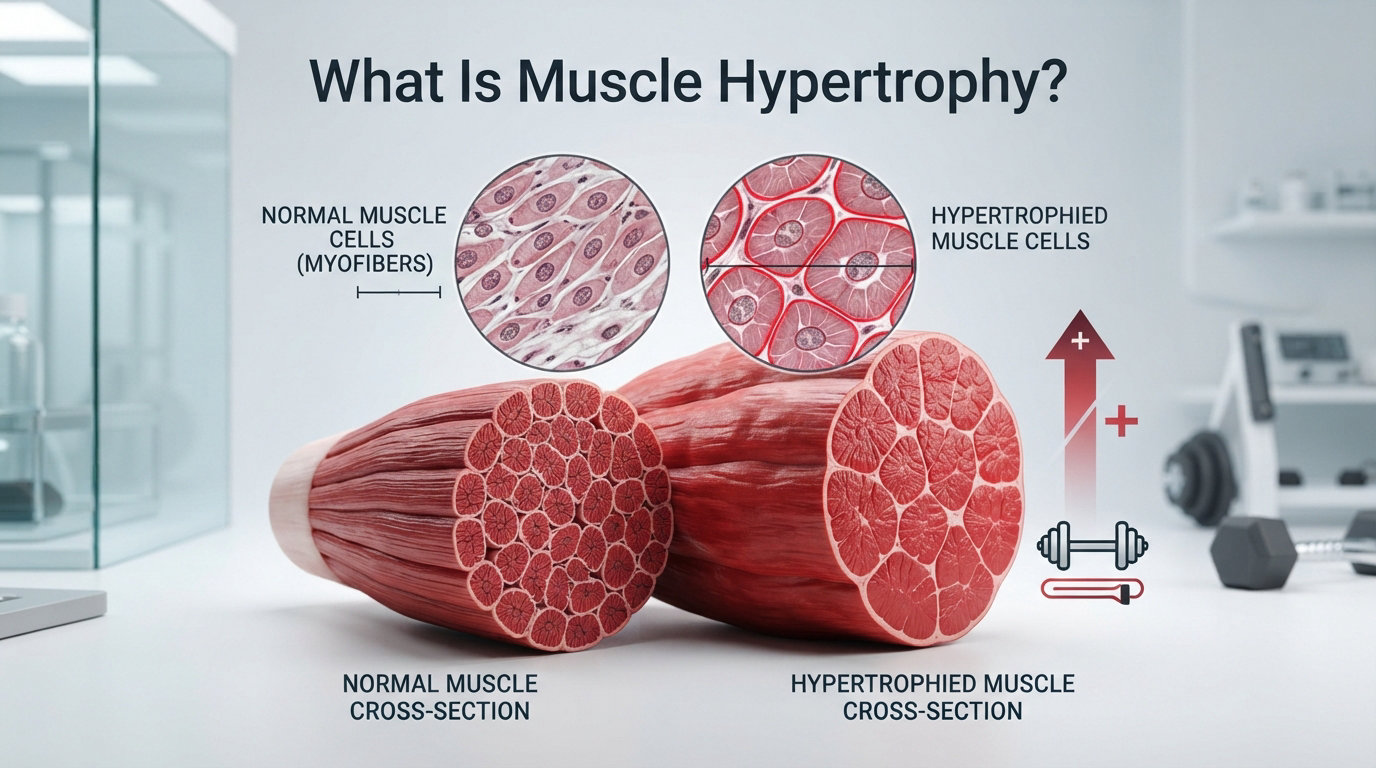
Muscle hypertrophy is the increase in the size of skeletal muscle cells, resulting in greater muscle mass and thicker muscle fibers.
It happens when the rate of muscle protein synthesis exceeds the rate of muscle protein breakdown over time. In simple terms, your body builds new muscle tissue faster than it breaks it down, and the net result is growth.
Three things drive this process:
Mechanical tension from lifting heavy loads
Muscle damage from training stress
Metabolic stress that accumulates during sets
When you consistently train with enough intensity and feed your body properly, your muscles adapt by getting bigger. That’s hypertrophy in its simplest form.
Types of Muscle Hypertrophy
Not all muscle growth looks the same under a microscope. Researchers break hypertrophy into three main types, and understanding each one helps you design a smarter training program.
Myofibrillar Hypertrophy
Myofibrillar hypertrophy is the growth of the actual contractile units inside your muscle fibers, called myofibrils. These are the actin and myosin filaments that generate force.
When you gain myofibrillar hypertrophy, your muscles get denser and stronger. This is the type most associated with strength training and lower rep ranges (1-5 reps).
Sarcoplasmic Hypertrophy
Sarcoplasmic hypertrophy is the increase in the volume of sarcoplasm, the fluid and energy stores (like glycogen and ATP) surrounding the myofibrils.
Bodybuilders who train in the 8-15 rep range often chase this type. The muscle looks fuller and bigger, even though the force-producing machinery hasn’t necessarily grown as much.
Connective Tissue Hypertrophy
Connective tissue hypertrophy is the thickening of tendons, ligaments, and fascia around the muscle.
It happens alongside the other two types and supports joint stability as your muscles get bigger. Ignoring this can leave you strong but injury-prone.
How Muscles Grow: The Science Behind Hypertrophy
I find it fascinating that what looks like a simple bicep curl is actually triggering a chain of biological events. Here’s what happens step by step when you train for hypertrophy.
Step 1: Mechanical Tension
When you load a muscle under stretch or force, mechanoreceptors in the muscle fibers fire. This is the primary driver of hypertrophy, and most strength coaches now agree it matters more than the old “pump” theory.
Step 2: Muscle Protein Synthesis Activation
The mechanical signal turns on a pathway called mTOR, which ramps up muscle protein synthesis. Your body starts assembling new proteins to repair and reinforce the stressed fibers.
Step 3: Micro-Damage and Repair
Resistance training causes microscopic tears in muscle fibers. During recovery, satellite cells fuse to the damaged fibers and donate nuclei, allowing the fiber to grow back thicker and stronger.
Step 4: Adaptation Over Time
Repeat this cycle with progressive overload, and over weeks and months, your muscles visibly grow. If you want to understand more about how muscles actually grow, that link dives deeper into the soreness myth.
The short version: hypertrophy is biology responding to a consistent stress signal with growth.
Training Parameters for Muscle Hypertrophy
You can’t just lift randomly and expect growth. Specific training variables control whether your body builds muscle or just burns calories. Here’s what the research says works.
Rep Range
For hypertrophy, 6-12 reps per set is the classic range. That said, recent studies show that anywhere from 5 to 30 reps works if you train close to failure. The key is effort, not just numbers.
Sets Per Muscle Per Week
Research suggests 10-20 sets per muscle group per week is the sweet spot for most lifters. Beginners can grow on as few as 6-10 sets. Advanced lifters sometimes need 20+ to keep progressing.
Load Intensity
Use 60-80% of your one-rep max for most hypertrophy work. Heavier loads (85%+) build strength, lighter loads (50-60%) build endurance. Both contribute to size if you push close to failure.
Rest Periods
Rest 60-120 seconds between sets for compound lifts, and 30-90 seconds for isolation work. Shorter rest boosts metabolic stress, longer rest supports heavier loads.
Time Under Tension
Control the eccentric (lowering) phase for 2-3 seconds and aim for 30-60 seconds per set total. This tempo boosts mechanical tension and muscle damage.
Training Frequency
Hit each muscle group at least twice per week when possible. A muscle protein synthesis spike only lasts 24-48 hours, so spacing sessions out keeps the growth signal on.
Nutrition for Muscle Hypertrophy
You can train perfectly and still gain nothing if your nutrition is off. I’ve seen this firsthand with clients who “eat clean” but never eat enough.
Protein Intake
Aim for 1.6-2.2 grams of protein per kilogram of bodyweight per day. For a 75 kg person, that’s 120-165 grams of protein daily. Whey, chicken, eggs, Greek yogurt, and legumes all work.
Caloric Surplus
To build muscle, you need a slight caloric surplus of about 200-500 calories per day. This gives your body the energy to fuel protein synthesis without piling on unnecessary fat.
Carbohydrates
Don’t fear carbs. They’re your muscles’ primary fuel and refill glycogen stores between sessions. Shoot for 3-6 grams per kilogram per day depending on how intense your training is.
Timing (Optional)
Total daily intake matters more than exact timing. Still, eating 30-40 grams of protein within 2 hours after training supports recovery. I usually have a shake with whey and a banana right after my last set.
Hydration and Micronutrients
Water carries nutrients into your muscles and supports recovery. Aim for at least 3 liters per day. Don’t forget vegetables for vitamins and minerals that drive hundreds of reactions in your body.
Hypertrophy vs Strength Training: Key Differences
This confusion trips up a lot of beginners. Strength training and hypertrophy training look similar, but they target different adaptations.
Primary Goal
Strength training: maximize force production
Hypertrophy training: maximize muscle size
Typical Rep Range
Strength training: 1-5 reps
Hypertrophy training: 6-12 reps (or higher near failure)
Load Used
Strength training: 85-100% of one-rep max
Hypertrophy training: 60-80% of one-rep max
Rest Periods
Strength training: 3-5 minutes
Hypertrophy training: 60-120 seconds
Adaptation Type
Strength training: more neural, less muscle growth
Hypertrophy training: more cellular, visible size changes
Here’s the truth though: training for one still builds the other. Strength athletes gain size, and bodybuilders gain strength. The difference is in priority, not exclusivity.
Benefits of Muscle Hypertrophy Training
Building muscle isn’t just about looking good in a t-shirt. The benefits extend across almost every aspect of health.
Stronger Bones and Joints
Muscle pulls on bone when you train, and bone responds by getting denser. Hypertrophy work helps prevent osteoporosis and joint degeneration as you age.
Faster Metabolism
Muscle tissue burns more calories at rest than fat. Each kilogram of muscle burns roughly 6-10 extra calories per day, so adding muscle makes fat loss easier over time.
Better Insulin Sensitivity
More muscle means your body handles blood sugar more efficiently. This reduces your risk of type 2 diabetes and metabolic syndrome.
Injury Prevention
Stronger muscles protect your joints, stabilize your movements, and reduce the risk of strains and sprains in everyday life.
Improved Mental Health
Resistance training boosts endorphins, reduces anxiety, and improves sleep quality. The visible progress also builds confidence.
Want to see real-world muscle building results? That link shows what consistent training actually did to someone’s physique and strength over 24 months.
Common Mistakes to Avoid When Training for Hypertrophy
I made every one of these mistakes in my first two years. Save yourself the frustration by learning from my errors.
Training Without Progressive Overload
If you lift the same weights for the same reps week after week, your body has no reason to grow. Add weight, reps, or sets every 1-2 weeks to keep forcing adaptation.
Eating Too Little Protein
Most people underestimate their protein needs. Track your intake for one week and you’ll probably find you’re at 1.0-1.2 g/kg, which is below the hypertrophy threshold.
Skipping Sleep
Growth hormone peaks during deep sleep. Cutting your sleep to 5-6 hours tanks your recovery and your results. Aim for 7-9 hours consistently.
Changing Programs Every 2 Weeks
Programs don’t fail, execution does. Stick with a structured plan for at least 8-12 weeks before judging it. Constant switching keeps you from adapting.
Going Too Heavy Too Soon
Ego lifting with bad form recruits other muscles, cheats the target, and injures you. Use weights you can control through the full range of motion.
Neglecting Mind-Muscle Connection
Actually feeling the muscle work during a set improves activation. Slow down, focus on the squeeze, and you’ll recruit more fibers than just yanking weight around.
Recovery and Rest for Optimal Hypertrophy
Your muscles don’t grow during the workout. They grow during recovery. This is why rest is just as important as the training itself.
Sleep Quality
Aim for 7-9 hours per night. Sleep is when growth hormone peaks and muscle protein synthesis is highest. Poor sleep directly reduces hypertrophy gains.
Deloads Every 4-6 Weeks
Take a lighter week every 4-6 weeks where you reduce volume by 40-50%. This resets fatigue, restores performance, and prevents overuse injuries.
Active Recovery
Light walks, mobility work, and stretching on off-days improve blood flow and reduce soreness without adding fatigue.
Managing Soreness
Some soreness is normal. Constant extreme soreness means you’re not recovering. Hydration, sleep, and protein handle most of it. If you want to compare recovery methods, this piece on recovery for muscle growth breaks down what actually works.
Track your recovery the same way you track your lifts. If soreness or fatigue climbs for 3+ weeks, scale back.
Frequently Asked Questions
How do you get muscle hypertrophy?
To get muscle hypertrophy, train each muscle group 2-3 times per week using 10-20 sets total, lifting 60-80% of your one-rep max for 6-12 reps per set, taking each set close to failure. Eat 1.6-2.2 grams of protein per kilogram of bodyweight daily and maintain a slight caloric surplus. Sleep 7-9 hours per night and progressively add weight or reps every 1-2 weeks.
What is the main cause of muscle hypertrophy?
The main cause of muscle hypertrophy is mechanical tension from resistance training. When you load a muscle with enough force, it triggers muscle protein synthesis and satellite cell activation, leading the fibers to grow back thicker over time. Nutrition, sleep, and progressive overload all support this process.
Is muscular hypertrophy good for your health?
Yes, muscular hypertrophy is good for your health. Increased muscle mass improves insulin sensitivity, boosts resting metabolism, strengthens bones and joints, reduces injury risk, and supports healthy aging. It also improves mental health through exercise-related endorphins and visible progress.
How many reps should I do for muscle hypertrophy?
For muscle hypertrophy, 6-12 reps per set is the classic target, but research shows any range from 5 to 30 reps works if you train close to muscular failure. The rep range matters less than the effort you put in. Most lifters do best with a mix of rep ranges across the week.
The Bottom Line on Muscle Hypertrophy
Muscle hypertrophy is your body’s response to consistent resistance training, proper nutrition, and adequate recovery. It’s not magic, and it’s not just genetics. It’s a process anyone can trigger with the right inputs.
To recap: lift with enough intensity and volume, eat 1.6-2.2 g/kg of protein daily, sleep 7-9 hours, and progress your training every week. Avoid the common mistakes I covered, and you’ll build muscle consistently.
Whether your goal is strength, aesthetics, or long-term health, understanding what muscle hypertrophy is and how to drive it puts you ahead of most people in the gym. Start with the basics, stay consistent, and the results will follow in 2026 and beyond.