
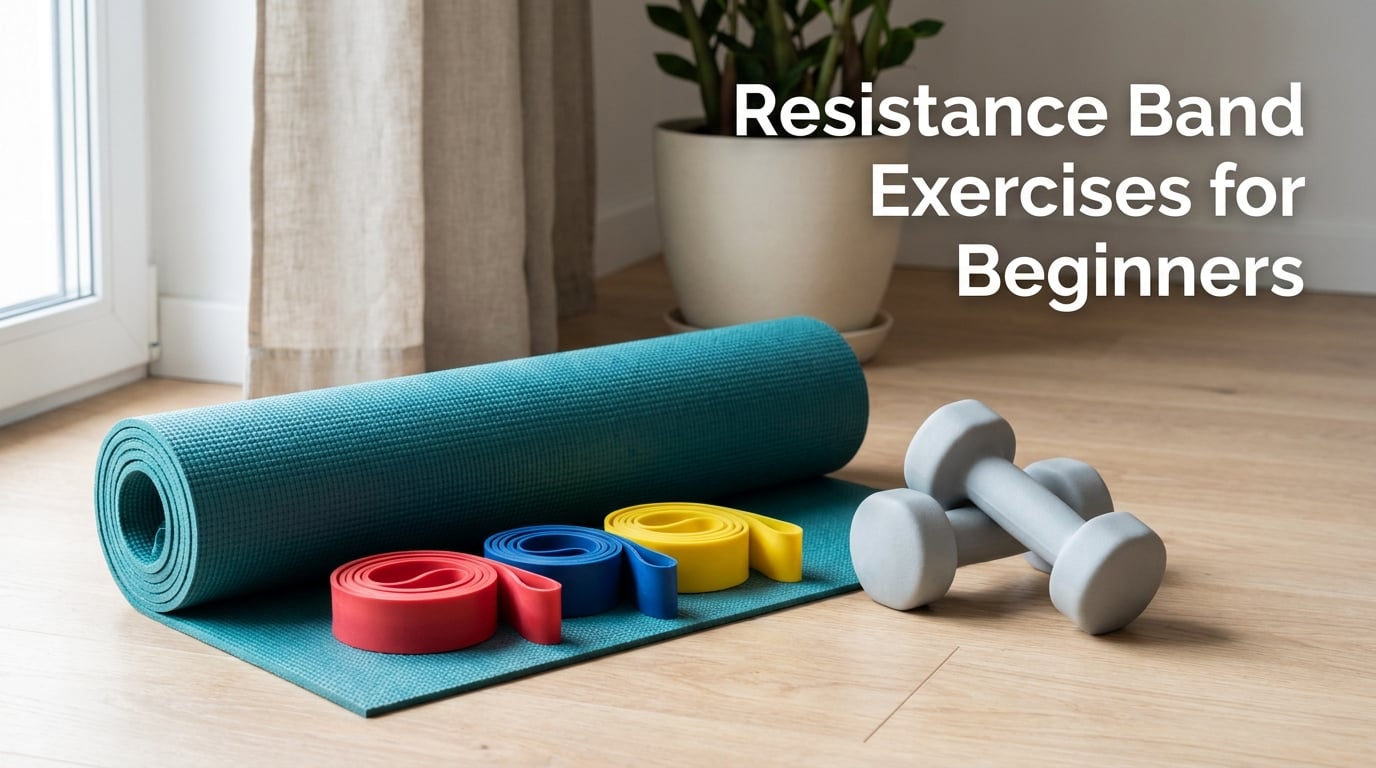
Resistance band exercises for beginners are the fastest way I know to build real strength without a gym membership, expensive equipment, or a complicated routine. I started training with bands years ago after a shoulder injury, and my team has since worked with hundreds of newcomers to put together the clearest starter guide we can.
In this article, I will walk you through everything a true beginner needs: why bands work so well, the three main types you will see on the market, the upper, lower, and core exercises that build a complete workout, plus a simple 4-week progression plan you can start this week. By the end, you will know exactly which band to buy, how to perform every move with good form, and how to keep making progress without getting bored.
Table of Contents
Benefits of Resistance Band Training for Beginners
Resistance band training works for beginners because the bands deliver constant tension your muscles have to fight through the entire range of motion. With a dumbbell, you only feel heavy resistance at the top of a curl. With a band, your bicep stays loaded from the moment you lift until you lower your arm back down. That difference matters when you are just starting out and want faster results from lighter effort.
Bands are also one of the most affordable pieces of fitness equipment you can own. Most beginner sets cost less than a single month of a gym membership, and a quality loop band can last you years of regular training.
Here are the key benefits our team has seen beginners experience in the first 4 to 6 weeks:
Portable: A set of bands weighs under two pounds and folds into a drawer, suitcase, or gym bag. You can train in a hotel room, at your kitchen table, or in a 6×6 foot apartment.
Versatile: One band can train your chest, back, shoulders, arms, glutes, quads, hamstrings, and core through dozens of exercise variations.
Low impact: Bands do not load your joints the way barbells or heavy dumbbells can. Physical therapists routinely prescribe them for post-surgery rehab and for adults over 50.
Beginner friendly: Light resistance bands let you learn movement patterns and build technique before you ever touch a heavier weight.
Strength and muscle gains: Research published in sports science journals shows that band-trained muscles grow and get stronger at rates comparable to free weights when effort and volume are matched.
I also like bands for beginners because failure happens gradually. With a dumbbell, the moment you reach muscle failure the weight is suddenly heavy and dangerous. With a band, the tension simply fades when your form breaks down, which makes the first few months of training much safer.
Types of Resistance Bands and How to Choose One
Choosing the right resistance band is the single biggest decision a beginner makes, and most starter guides skip the details. There are three main types you will find, and each one trains your body a little differently.
The three main types of resistance bands are loop bands, tube bands with handles, and fabric or hip circles. Each one has its own strengths, and most beginners end up owning two out of three within the first year.
Loop Bands
Loop bands are flat or tube-shaped closed circles. They are most popular for lower body and glute work because you can step into them and they stay put on your thighs or above your knees. Our team prefers 41-inch loop bands because that length gives you room to anchor them around furniture, door anchors, or your own body for upper body moves too.
Tube Bands With Handles
Tube bands come with plastic handles attached to the ends and often include a door anchor. These are the easiest for upper body work like chest presses, shoulder presses, and rows because the handles feel familiar and natural in your hands. Beginners like this type because the handles take a lot of confusion out of gripping.
Fabric or Hip Bands
Fabric bands are wider, non-slip loops that grip your legs and stay in place during squats, glute bridges, and lateral walks. They are a favorite among our female testers because they do not roll up like thin latex bands can. A beginner who plans to focus on lower body first should start here.
How to Pick the Right Resistance Level
Complete beginners should start with the lightest band available, usually labeled yellow or green. The right test is simple: when you perform 12 to 15 repetitions of your chosen exercise, the last two or three reps should feel challenging but never painful. If you cannot finish 8 clean reps, the band is too heavy. If 15 reps feels like a warm-up, step up one level.
Most quality sets come in a 5-band pack with resistance ranging from about 10 to 35 pounds of pull. For a beginner, the yellow, green, and red bands cover roughly 90 percent of your first six months of training.
Upper Body Resistance Band Exercises for Beginners
Upper body resistance band exercises for beginners target the chest, back, shoulders, biceps, and triceps without any of the intimidating machines you see in commercial gyms. The five moves below cover every major upper body muscle group and use either a tube band or a loop band anchored to a sturdy object. Aim for 2 to 3 sets of 10 to 12 repetitions per move on your first workout and rest 45 to 60 seconds between sets.
Standing Bicep Curl
The standing bicep curl is the beginner-friendly starting point for arm training because the movement pattern is identical to a dumbbell curl. Stand on the middle of a tube band with both feet hip-width apart, hold a handle in each hand with arms down at your sides, palms facing forward.
Keep your elbows pinned to your ribs, then curl your hands toward your shoulders by squeezing your biceps. Pause for one second at the top, then lower with control for a full three-second count. Do not swing your body or jerk the weight up, because that takes tension off the muscle you are trying to train.
Overhead Shoulder Press
The overhead shoulder press builds the deltoid muscles that give your shoulders their rounded shape. Step onto a tube band with feet hip-width apart, bring the handles up to shoulder height with palms forward, and press straight up until your arms are fully extended overhead.
Lower the handles back to shoulder height with a two-second count. Keep your core tight and avoid arching your lower back. Beginners often press the band slightly in front of their face instead of straight up, which loads the wrong muscles and irritates the shoulder joint.
Seated or Bent Over Row
Rows train the middle back muscles that support good posture, which most beginners desperately need after long days at a desk. Sit on the floor with legs extended in front of you, loop a tube band around your feet, and pull the handles toward your ribcage while squeezing your shoulder blades together.
If you prefer a standing version, hinge forward at the hips about 45 degrees, let your arms hang down holding the handles, and row toward your lower ribs the same way. Either variation keeps tension on the back through the full pulling motion.
Chest Press
The chest press is the upper body move beginners struggle with most using free weights because it is hard to stabilize heavy dumbbells. With a band, the instability disappears. Anchor a tube band behind your back by looping it around a door anchor, hold the handles at chest height, and press straight out in front of you until your arms are fully extended.
Bring the handles back to your chest with a three-second count. Keep your shoulder blades pulled down and back, which protects the shoulder joint from rolling forward during the press.
Tricep Extension
Tricep extensions target the back of the upper arm and pair well with bicep curls for balanced arm development. Hold one handle of a tube band behind your head with your elbow pointing up, then press straight overhead until your arm is fully locked out.
Lower your hand back behind your head with control. Beginners often let the elbow flare out to the side, which lets the band snap the arm awkwardly. Keep the elbow pointing forward and your upper arm close to your ear throughout the movement.
Lower Body Resistance Band Exercises for Beginners
Lower body resistance band exercises for beginners are where bands really shine, because they let you load your glutes and hips without loading your spine the way barbell squats can. The five moves below target the glutes, quadriceps, hamstrings, and hip abductors, and they double as excellent rehabilitation exercises for anyone returning from a knee or hip injury. Start with 2 sets of 12 to 15 repetitions per exercise, since the leg muscles are usually stronger than the upper body.
Banded Squat
The banded squat is the foundational lower body move for any beginner. Place a loop band just above your knees, stand with feet slightly wider than hip-width, and lower into a squat as if sitting back into a chair until your thighs are at least parallel to the floor.
Push through your heels to stand back up while actively pressing your knees out against the band. That outward pressure is what wakes up the glute muscles most beginners forget to use. Keep your chest up and your weight in your heels, not your toes.
Glute Bridge
The glute bridge is the single best beginner exercise for waking up sleepy glutes. Lie on your back with knees bent and feet flat on the floor, place a loop band just above your knees, and drive your hips up toward the ceiling by squeezing your glutes hard.
Hold the top position for two seconds, then lower your hips back to the floor with control. Beginners often use their lower back to lift instead of their glutes, which is a fast track to back pain. If you feel your hamstrings cramping or your lower back aching, drop the band and practice bodyweight bridges until your glutes learn to fire first.
Standing Leg Press
The standing leg press trains the quads and glutes while standing upright. Anchor a tube band to a low stable object behind you, step into the loop with one foot, and press that leg straight back by squeezing your glute.
Return to standing with control. Switch legs after your set. The key cue is to keep your standing knee soft, not locked, and to keep your torso tall throughout the press. Most beginners rock forward as they press, which steals work from the glute and loads the lower back.
Lateral Band Walk
Lateral band walks target the hip abductors and glute medius, the small muscles that keep your knees tracking properly during squats and running. Place a loop band just above your ankles, get into a quarter squat position, and step sideways leading with one foot while the trailing foot follows.
Take 10 steps in one direction, then 10 steps back. Keep tension in the band the entire time. If the band falls to your ankles, move it up to your shins or just above your knees for more grip.
Standing Glute Kickback
Standing glute kickbacks isolate the glute muscles for better muscle development. Anchor a tube band at ankle height behind you, loop it around one ankle, and stand tall holding a wall or chair for balance.
Slowly kick that leg straight back by squeezing the glute, hold for a second at the top, then return to start. Avoid arching your lower back or leaning forward, both of which are common beginner mistakes that take tension off the glute and onto the spine.
Core Resistance Band Exercises for Beginners
Core resistance band exercises for beginners add external load to moves that are normally just bodyweight, which makes the deep abdominal muscles work harder. The four exercises below cover the front, sides, and rotational strength of your core. Plan for 2 sets of 10 to 15 repetitions per move, and remember that slow tempo beats fast reps when training the abs.
Standing Woodchop
The standing woodchop trains the obliques and the rotational muscles that support your spine. Anchor a tube band at chest height to a sturdy object on your right, hold the handle with both hands, and step far enough away to create light tension.
Rotate your torso away from the anchor and pull the handle diagonally across your body toward your left hip, as if chopping wood. Return slowly. Switch sides after your set. Keep your arms mostly straight and let your torso do the work, not your arms.
Band-Assisted Crunch
The band-assisted crunch gives beginners something to pull against, which makes the move feel more controlled than a regular crunch. Lie on your back with knees bent, anchor a tube band behind your head, and hold both ends in your hands.
Curl your shoulders off the floor while pulling gently on the band for extra support. The band is not meant to yank you up, it is there to give you a focal point and a light assist. Exhale as you crunch up and inhale as you lower back down.
Russian Twist
The Russian twist trains the obliques through rotation. Sit on the floor with knees bent and heels touching the ground, hold a light loop band stretched between both hands in front of your chest, and lean back slightly so your torso is at a 45-degree angle.
Rotate your shoulders and hands to one side, then the other, counting one full rep as one rotation to each side. Keep your chest tall and your abs engaged. Beginners often round their lower back, which takes work off the abs. Keep a small arch in your lower back throughout the set.
Pallof Press
The Pallof press is a physical therapist favorite because it trains the deep core muscles that stabilize your spine. Anchor a tube band at chest height, hold the handle with both hands at your chest, and step sideways far enough to feel tension.
Press the handle straight out in front of your chest, hold for two seconds, then bring it back. The band will try to twist your torso, and resisting that twist is the entire point of the exercise. This is one of the safest and most effective beginner core moves you can do, especially if you have any history of lower back discomfort.
How to Get Started With Resistance Band Exercises?
Getting started with resistance band exercises means building a sustainable routine you actually look forward to doing. The most common beginner mistake our team sees is jumping straight into a complicated program designed for someone who has been training for years. Simplicity wins every time during the first month.
Here is the exact plan we walk new clients through during their first 28 days of resistance band training.
Beginner Workout Schedule
Train three days per week with at least one full day of rest between sessions. Monday, Wednesday, and Friday works well for most beginners because it gives your muscles 48 hours to recover and adapt, which is when strength actually grows.
Each workout should take 25 to 35 minutes total. Choose one exercise from each section of this guide: one upper body push (chest press or shoulder press), one upper body pull (row), one lower body (squat or glute bridge), one arm move (bicep curl or tricep extension), and one core move (woodchop or Pallof press).
Reps, Sets, and Rest
For weeks one and two, perform 2 sets of 10 to 12 reps using a light band that feels challenging only on the last few reps. Rest 60 seconds between sets to keep your form sharp.
For weeks three and four, bump up to 3 sets of 12 to 15 reps and shorten rest to 45 seconds. If the moves start to feel easy, move up to the next band resistance level. Many beginners see measurable strength changes within the first 28 days using this exact progression.
Form Cues From a Trainer Perspective
Move slowly on every rep, especially the lowering phase, because the eccentric part of the movement is where most muscle growth happens for beginners. Breathe out as you contract the muscle and breathe in as you return to the starting position. Never hold your breath, because that spikes blood pressure and makes you dizzy.
Check your form in a mirror or record yourself on your phone once per week. What feels right is often not what looks right, and a 30-second video can reveal form breakdowns you would never feel from the inside.
Common Beginner Mistakes to Avoid
Most resistance band mistakes fall into five categories, and our team has watched every single one in our gym over the past three years.
Using too much resistance too soon: Beginners want to lift the heaviest band they can buy, but form always breaks down under heavy tension. Start light and add resistance every two to four weeks.
Not controlling the lowering phase: Letting the band snap back instead of slowly lowering it cuts your workout’s effectiveness in half. Spend three seconds on every negative.
Anchoring the band to something unstable: Door anchors pull out, and furniture tips over. Use a proper anchor point rated for the resistance you are using.
Ignoring skin irritation: Latex bands can cause redness or chafing, especially on the back of the knees or thighs. Wear leggings or long socks, or switch to fabric bands if irritation appears.
Skipping warmups: Cold muscles tear more easily. Spend 5 minutes doing arm circles, hip openers, and bodyweight squats before your first set.
Beginner Progression Plan
Our team uses a simple 4-week progression plan that has worked for hundreds of clients in their first month of band training.
Week 1: Learn four basic moves at bodyweight pace with no band. Build movement memory.
Week 2: Add the lightest band. Perform 2 sets of 10 reps per exercise.
Week 3: Increase to 3 sets of 12 reps. Add one new exercise from a different muscle group.
Week 4: Bump up resistance by one level. Aim for 3 sets of 15 reps per exercise.
By the end of week four, you will have built real strength, learned proper form on the major movement patterns, and earned the right to choose more advanced exercises. Most beginners feel noticeably stronger in everyday movements like carrying groceries, climbing stairs, and picking up kids within the first 30 days.
Frequently Asked Questions
Are resistance bands effective for beginners?
Yes, resistance bands are highly effective for beginners. Multiple studies show that band-trained muscles gain strength and size at rates comparable to free weights when effort and volume are matched, and bands are much safer for beginners learning proper form.
What resistance band should a beginner use?
A beginner should start with a light band, usually the yellow or green level in a standard 5-pack set. The right test is whether 12 to 15 reps of your chosen exercise feel challenging only on the last two or three repetitions.
Can you lose belly fat with resistance bands?
Resistance bands help build muscle and burn calories, which supports fat loss, but spot-reducing belly fat is not possible. Combining band training with a moderate calorie deficit and adequate sleep produces the best body composition changes.
What are some beginner resistance band exercises?
The best beginner resistance band exercises are bicep curls, overhead shoulder press, chest press, seated rows, banded squats, glute bridges, standing woodchops, and Pallof presses. Each targets a major muscle group and uses simple movement patterns.
Final Thoughts on Resistance Band Exercises for Beginners
Resistance band exercises for beginners offer the simplest path to a stronger, more capable body without a gym, without expensive equipment, and without complicated programs. Start with one light band, master five basic moves, train three days a week, and progress to a heavier band every few weeks.
If you have been waiting for the right moment to start training, this is it. Pick a band, set a calendar reminder, and commit to your first 28-day progression. By the time the month ends, you will have built habits that pay off for years.
1 thought on “Resistance Band Exercises for Beginners (October 2026)”