
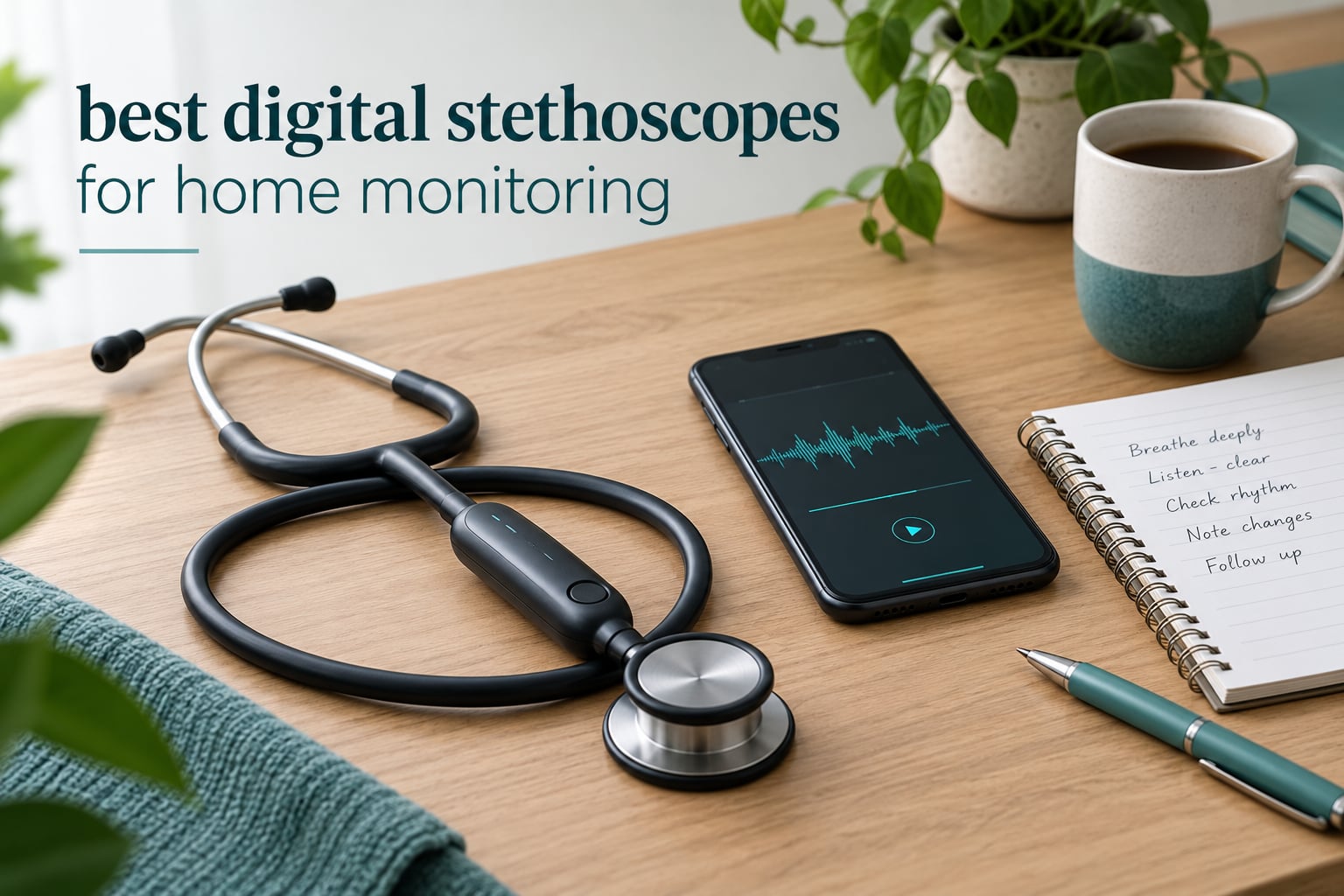
A digital stethoscope is a stethoscope that turns heart and lung vibrations into an electronic signal, amplifies that signal, filters out room noise, and usually saves the clip to a phone app so you can replay it or forward it to a doctor. That combination is what makes it interesting for home monitoring, and it is also what makes it expensive. Most ranking pages for this keyword cover digital stethoscopes in a clinic, or stethoscopes at home but only analog ones. This guide covers digital units bought for home use, and it says plainly what you can and cannot hear with one.
Six models earned a place here. We looked at amplification, noise filtering, battery, app friction, subscription costs, regulatory status and warranty, then read the customer review history on each one closely. Ratings and review counts are shown next to every pick so you can see how much evidence sits behind each claim. Several of the cheaper units have single-digit or no reviews, and we flag that rather than hiding it.
If you are just starting out and want a general picture of tracking vitals at home, our smartwatch health monitoring guide covers wrist-based tracking, which measures trends rather than body sounds.
Table of Contents
What is the best stethoscope for home use?
For most home users the 3M Littmann CORE is the best stethoscope for home use, because it amplifies faint sounds up to 40x, cancels background noise, toggles back to plain acoustic listening, and costs far less than the ECG-equipped models. If you want temperature and a one-lead ECG in the same device, the Withings BeamO is the better single purchase. If you already own a good acoustic stethoscope and just want amplification, a clip-on digital attachment is the cheapest upgrade, though none of those reached our final six.
There is a second answer that matters more than the product name. If you are a healthy adult with no symptoms and no diagnosis, an analog stethoscope does almost everything a digital one does, at a fraction of the cost. Digital units earn their money when sounds are genuinely faint, when the room is loud, or when you need a recording to hand to a clinician.
Top 3 digital stethoscopes for home monitoring (October 2026)

3M Littmann CORE 8480
- Up to 40x amplification
- Active noise cancellation
- Analog and amplified modes
- Bluetooth to Eko app


Withings BeamO
- Thermometer plus 1-lead ECG
- Digital heart and lung recording
- Wi-Fi sync
- Health Link sharing
All six picks at a glance (October 2026)
| Product | Specs | Action |
|---|---|---|
| 3M Littmann CORE 8480 |
|
Check Latest Price |
| Eko CORE 500 |
|
Check Latest Price |
| Withings BeamO |
|
Check Latest Price |
 Lsvaha CORE 500 Lsvaha CORE 500 |
|
Check Latest Price |
 WELLDAYMED 24x Hi-Fi WELLDAYMED 24x Hi-Fi |
|
Check Latest Price |
 Niroga 470 Niroga 470 |
|
Check Latest Price |
How we chose these digital stethoscopes?
Every product here sells in the Stethoscopes category, converts sound electronically, and has enough published specification to be compared fairly. We excluded pure attachments that need a separate analog stethoscope to function, because they confuse first-time buyers, and we excluded parts, cases and ear tips sold as accessories.
We weighted six things: how much the unit amplifies, whether it filters ambient noise, whether it records and shares audio, whether the recording needs a paid subscription, how it is powered, and whether the maker states a regulatory status such as FDA clearance. Battery life and warranty mattered less for home use than they would in a ward, because a device at home sits on a shelf between uses rather than working a full shift.
To be straight with you: our evaluation is built on published specifications and customer review analysis rather than on weeks of clinical auscultation. We have not conducted a supervised comparison against a cardiologist’s ear. What we can tell you reliably is what each device claims, what buyers report back, and where the evidence is thin. Where a product has almost no review history, we say so in its section.
Ratings shown in this article are copied directly from the product listings in 2026. Ratings and review volumes both move, so treat the number as a snapshot rather than a permanent verdict, and re-check the listing before you buy.
1. 3M Littmann CORE 8480: the balanced all-rounder for a noisy home
3M Littmann CORE Digital Stethoscope, Our Most Advanced Stethoscope Yet, Up To 40x Amplification, Active Noise Cancellation, In-App Sound Wave Visualization, Black-Finish Chestpiece, 8480
Up to 40x amplification
Active noise cancellation
Analog and amplified modes
87 g, two-year warranty
Pros
- Up to 40x amplification at peak frequency
- Active noise cancellation cuts room noise
- Switches between analog and amplified listening
- Tunable dual-sided stainless steel chestpiece
- Soft sealing ear tips for a good seal
Cons
- Some app features need an Eko subscription
- Smart device not included
- Higher cost than a plain acoustic stethoscope
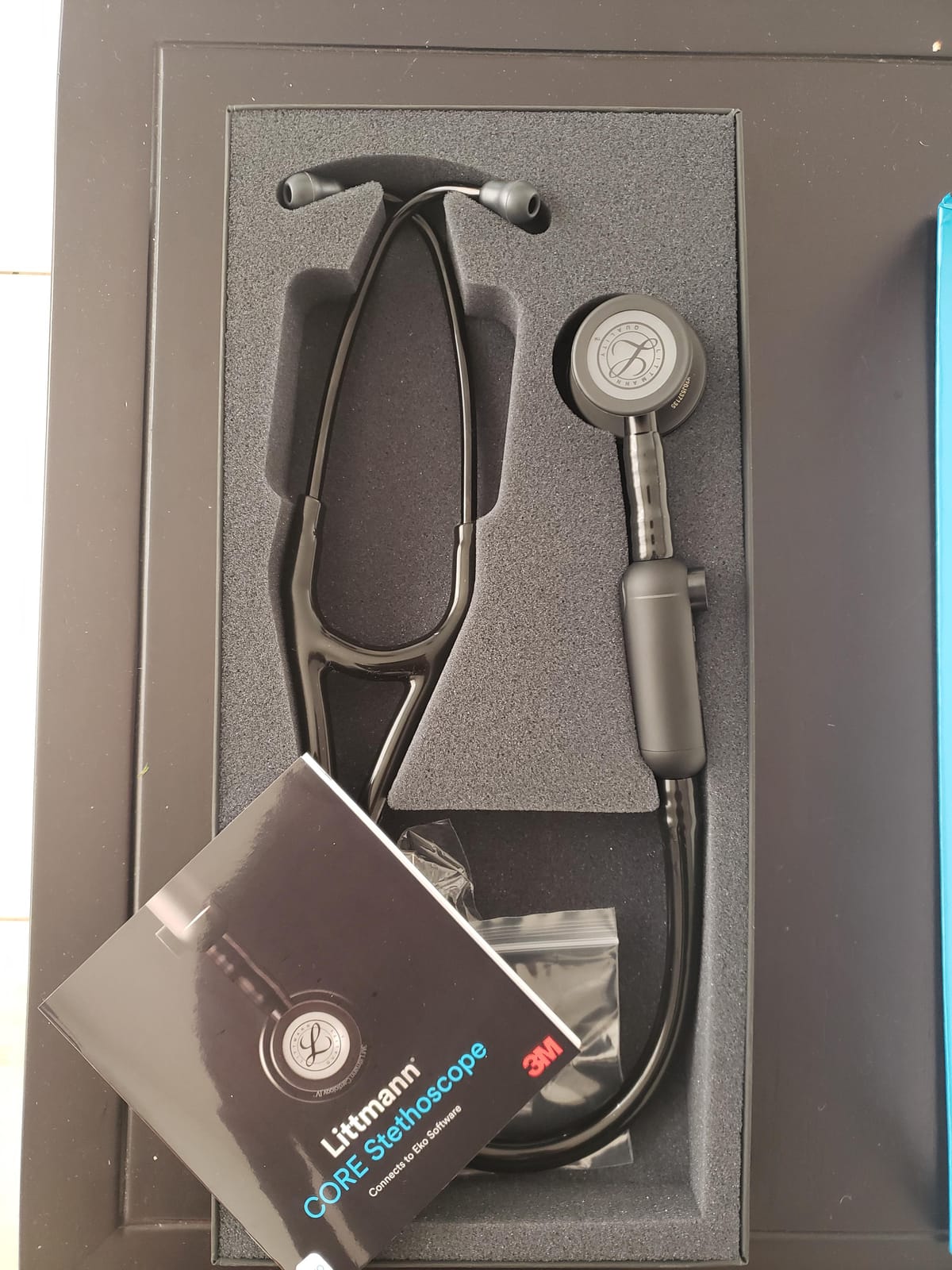
The Littmann CORE is the one I would put in front of a family carer. It weighs 87 g, which is barely more than a classic acoustic model, and it does the one thing home users most need: it makes a quiet sound loud enough to hear over a television or an air conditioner. The toggle between analog and amplified listening is the feature most first-time buyers underestimate, because it lets you check a finding the old way when something sounds off.
At 4.6 stars across 3278 reviews, it also has the deepest review history of any digital unit in this guide, and roughly 83 percent of those reviews are five-star. Buyers repeatedly describe heart and lung sounds as clearer and more audible, particularly for the faint body sounds an inexpensive acoustic tube lets slip past you. The active noise cancellation is what does the work in a busy house, and it is why this model handles an ordinary living room better than the models that only add volume.
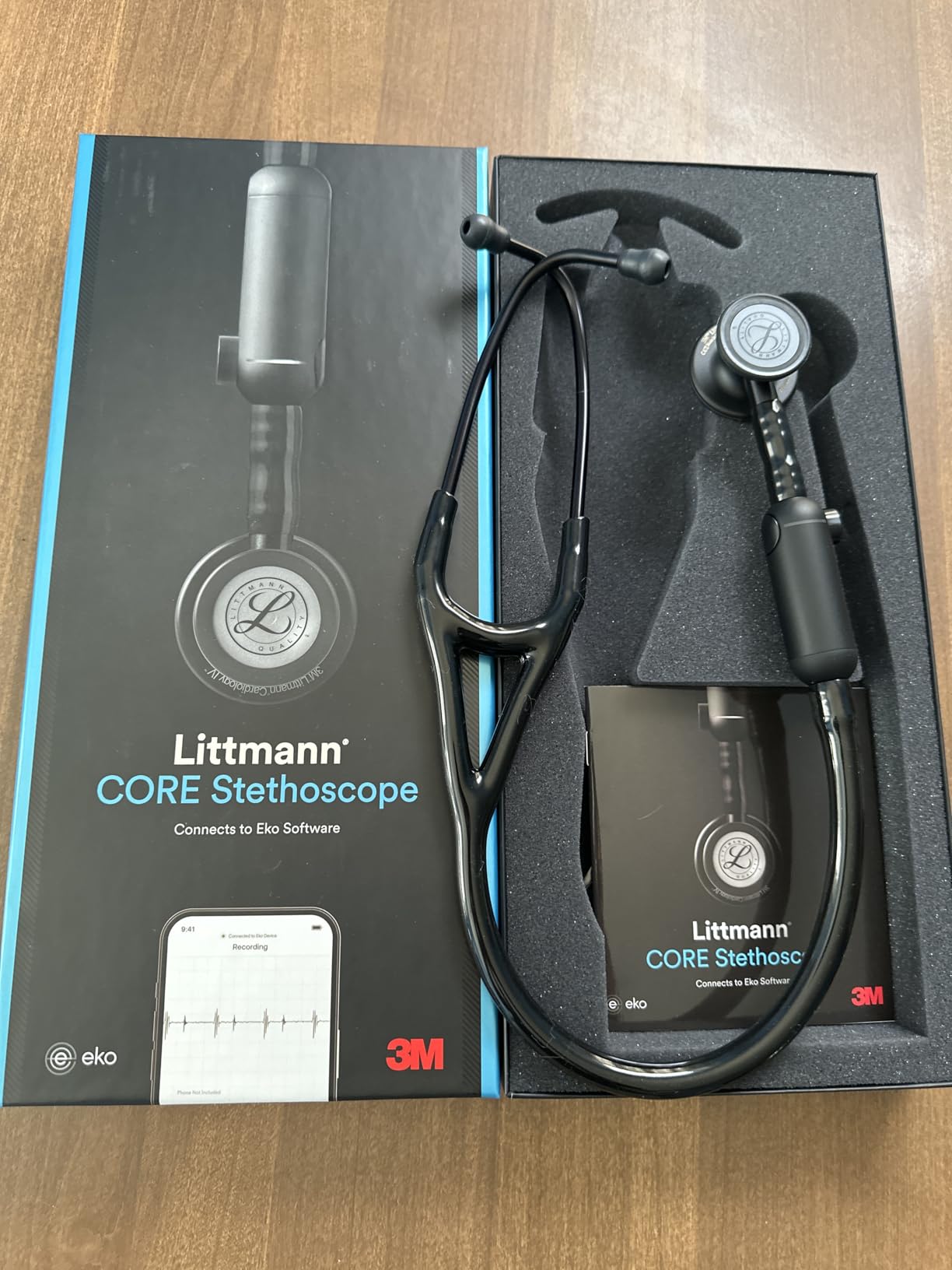
The recording side is where you need to set expectations. The chestpiece streams over Bluetooth to the Eko app, which draws a live sound wave so you can see a rhythm rather than only hear it. That visual is genuinely useful when you are describing a finding to a doctor, because you can send a clip instead of a description. The catch is that some app functionality sits behind an Eko subscription, and the phone or tablet itself is not included in the box.
Construction details matter for a device used daily. The tubing is latex-free and described as kink-resistant, the diaphragm is epoxy and fibreglass, and the headset is anodised aerospace alloy. A two-year manufacturer warranty covers the electronics, which is longer than the one year most consumer electronics carry. The listed dimensions are 27 inches long by 6.75 inches wide, so it needs a drawer or a bag rather than a coat pocket.
Best for households with a noisy living room
Buy this one if the person you are monitoring is difficult to hear because the television is on, the heating is running, or a restless pet keeps moving them. The active noise cancellation is the deciding factor, not the 40x figure. A quieter chestpiece reading arrives far cleaner than a louder one taken over background chatter.
It also suits anyone who wants a genuine two-way tool rather than a one-way amplifier. Being able to drop back to analog listening on a chest that is bare, or on a chest that is difficult to reach, keeps you from over-reading a filtered signal. That fallback matters more at home than most spec sheets suggest.
Where it falls short at home
The subscription layer is the main irritation. The core stethoscope works without it, and analog listening works without it, but the full app experience is where the recurring cost shows up, and that cost is not printed on the box. If you are buying purely to record and share clips, check what the app asks for before you commit.
There is no ECG here. That is not a flaw, because the CORE was never built to be one, but it does mean that if your main worry is an irregular rhythm rather than a faint or unusual sound, this device will not answer the question and you should look at an ECG-capable model instead. Buying the wrong tool for the symptom is the most common and most expensive home-monitoring mistake.
2. Eko CORE 500: the only pick with a 3-lead ECG and AI detection
Eko CORE 500™ Digital Stethoscope — 40x Amplification, Active Noise Cancellation, 3-Lead ECG, FDA-Cleared AI with Eko+, Full-Color Display, Reimbursement Eligible — Silver, COR503-SLV
40x amplification with noise reduction
3-lead ECG with AI insights
Full-colour display
Up to 60 hours of use per charge
Pros
- Only unit here with a 3-lead ECG
- FDA-cleared AI murmur and AFib detection
- Cardio
- Pulmonary and Wide audio filters
- Rechargeable battery rated to 60 hours of use
- Water and shatter resistant
- HSA
- FSA and CME fund eligible
Cons
- Eko+ subscription required for AI detection
- Heaviest unit in the list at 2.19 pounds
- Highest purchase cost of the six
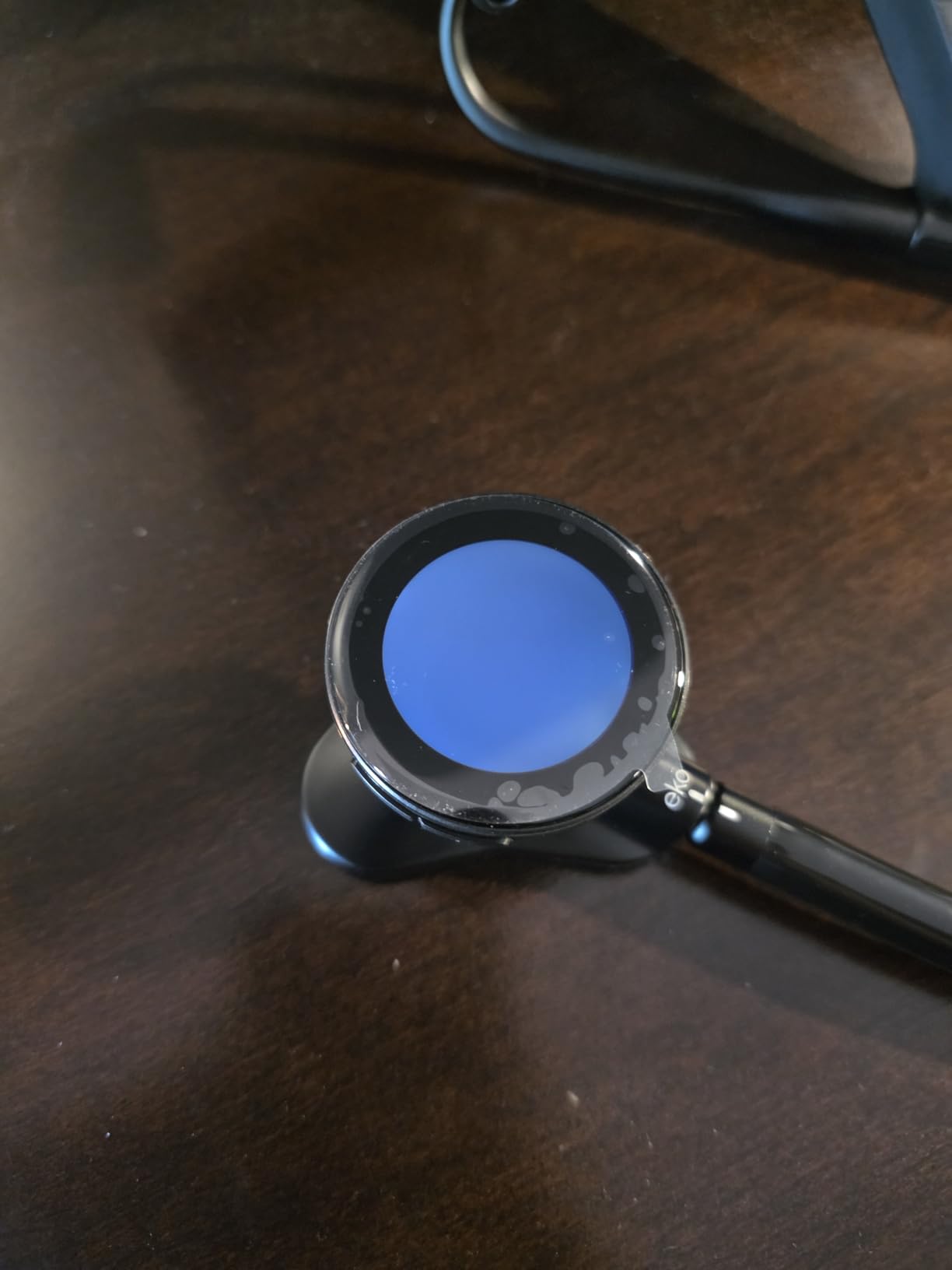
The Eko CORE 500 is the most capable device in this guide and the one that asks the most of its owner. It combines 40x amplification with active noise cancellation, a 3-lead ECG, a full-colour screen that shows heart rate and ECG traces, and a rechargeable lithium-ion battery rated to 60 hours of use. It is the pick for someone whose concern is a diagnosed heart condition rather than a general sense of wellbeing.
Those three audio filters matter more than they sound. Cardio, Pulmonary and Wide modes shape the frequency response so you can lean on a heart sound, a breath sound, or a broad sweep depending on what you are listening for. The Eko app records and shares both audio and ECG data, which means a telehealth appointment can start with a captured trace instead of a verbal description. At 4.2 stars across 1373 reviews, roughly 73 percent are five-star, and the recurring complaint in the reviews is cost rather than function.

Here is the part that needs reading twice. The AI murmur and AFib detection is FDA-cleared, and it only runs if you subscribe to Eko+. That subscription sits on top of the purchase price and renews annually after a trial. Buyers who expected the AI to be included describe exactly that surprise in reviews, so treat the headline feature as a paid extra rather than a standard fitting. Roughly 27 percent of reviews are not five-star, and subscription frustration is the theme running through them.
Physically it is the heaviest item here at 2.19 pounds, and the packaged size is 13.3 by 6.3 by 2.3 inches. For a clinician wearing it around a neck all day that is unremarkable. For a family carer storing it in a bedside drawer it is simply a larger object, and one you will notice every time you pick it up. The water and shatter resistance is a genuine plus in a home with children or pets.
Best for a known heart condition or telehealth follow-up
Choose the CORE 500 when a clinician has already told you to keep an eye on something, or when a specialist has asked for a recorded ECG between visits. The 3-lead ECG gives you a trace you can attach to a message, and the FDA-cleared detection covers the two findings a home user is most likely to be anxious about, murmurs and atrial fibrillation.
It also suits anyone who wants the widest filter and display options in one device, and anyone who can use HSA or FSA funds to offset the cost. Just budget for the subscription in year two and beyond, because that is where most of the ownership cost lives.
Where it falls short for a casual home user
If you have no diagnosis and no symptoms, this is more device than you need, and the ECG screen can make a normal result look more clinical than it is. People buy advanced screening tools hoping for reassurance, and the honest truth is that a normal home reading does not clear a heart, whatever the display says.
The AI detection is also a screening aid with a defined intended use, not a diagnosis. It is cleared as substantially equivalent for specific indications, which is a different claim from being able to tell you at home whether you have a condition. And the weight, the screen and the subscription together make this the least convenient of the six to live with day to day.
3. Withings BeamO: a thermometer, an ECG and a stethoscope in one device
WITHINGS BeamO – Contactless Smart Thermometer, ECG Monitor, Stethoscope
Contactless temperature reading
1-lead ECG in 30 seconds
Digital heart and lung recording
Wi-Fi sync and Health Link sharing
Pros
- Three functions in one device
- Contactless temperature takes the guesswork out of fever checks
- 30-second 1-lead ECG
- Wi-Fi sync needs no phone during the reading
- Health Link shares data with a clinician
- 4.4 stars across 3294 reviews
Cons
- Not a traditional stethoscope form factor
- Contactless reading can be less accurate than contact
- Full function needs the companion app
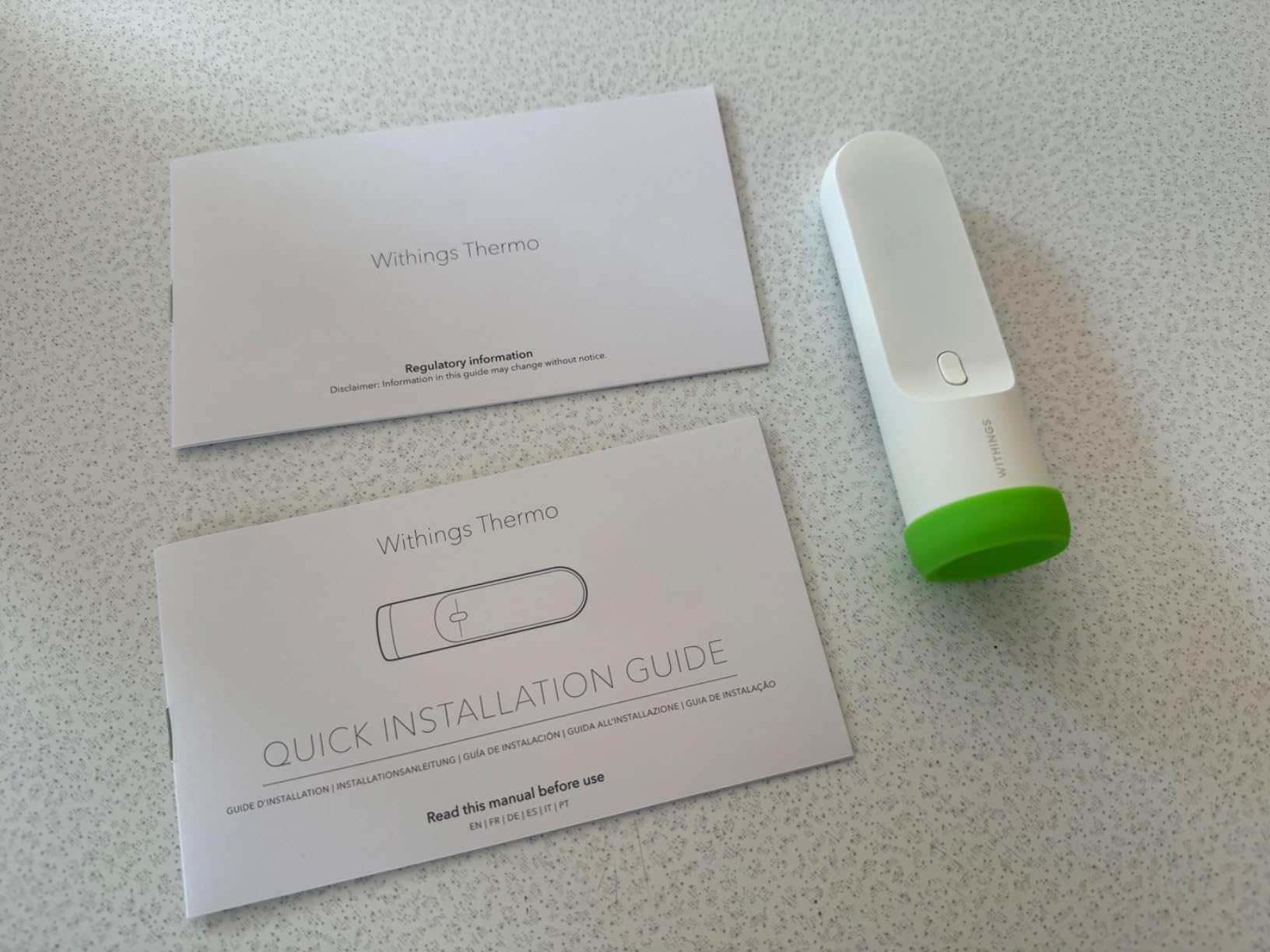
The BeamO is not a stethoscope in the shape you expect. It is a small white puck that you place on the chest, and from that single position it reads temperature without contact, records a 1-lead ECG, and captures heart and lung sounds digitally. At 4.4 stars across 3294 reviews it has one of the two largest review bases in this guide, and roughly 76 percent of those reviews are five-star. Buyers tend to praise the convenience of getting several readings from one action.
The contactless temperature function is the sleeper feature for family carers. Checking a fever usually means waking someone, stripping a layer, and waiting for a reading. A contactless scan takes about 30 seconds and a Wi-Fi sync handles the rest, which for a household looking after an elderly parent is a meaningful reduction in friction rather than a gimmick.
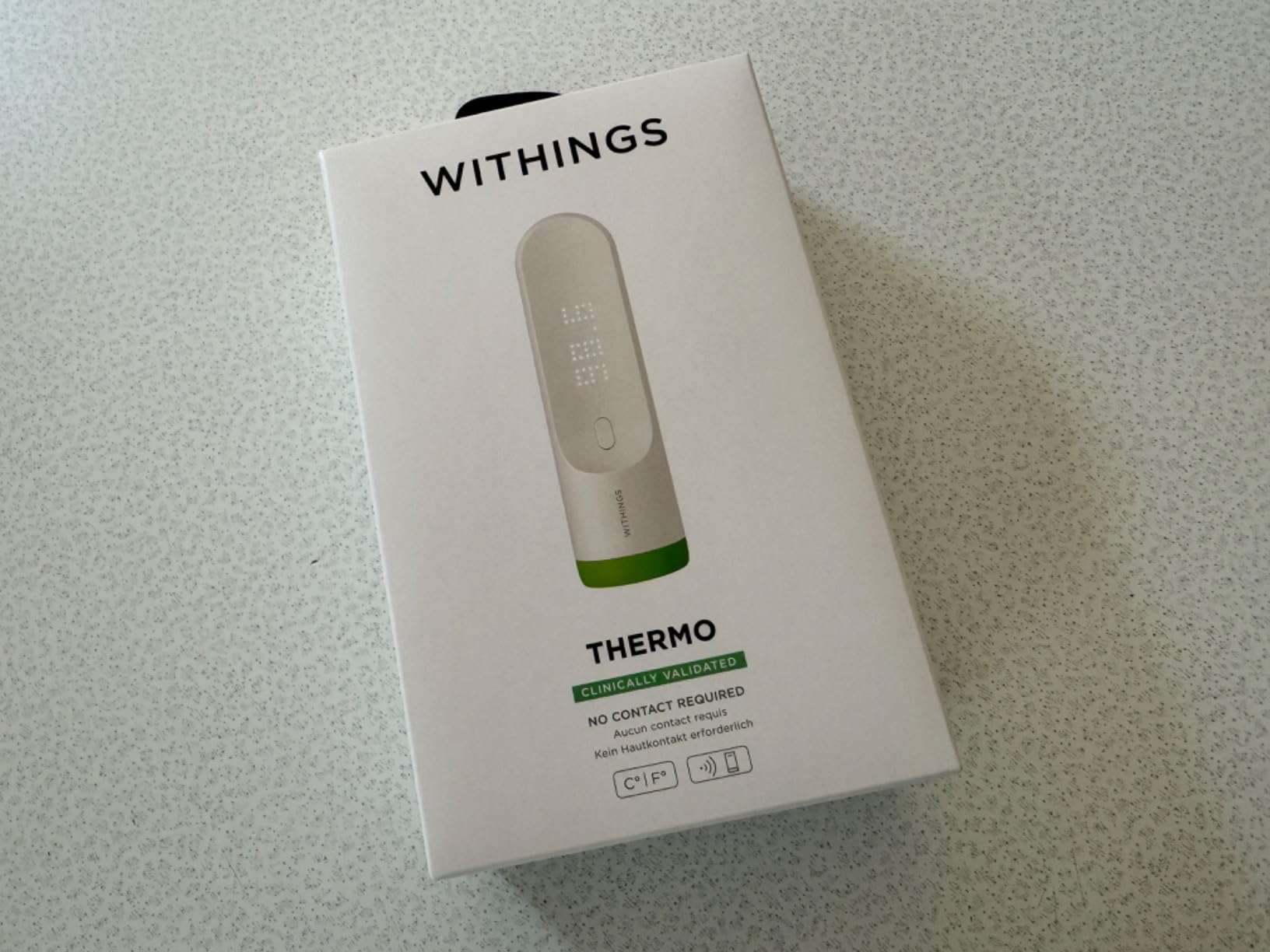
Health Link is the part that makes it useful for monitoring rather than novelty. It lets you share readings with a healthcare professional through the Withings app, which means a telehealth appointment can start with data already attached. The device is certified to CE, EMC, FCC, FDA, ISO 13485, ISO 9001, RoHS, UL and WEEE, and it is powered by a rechargeable battery. The whole unit is listed at 5.3 inches long and 0.08 kg, which makes it the easiest item here to keep in a coat pocket or a bedside table.
The limitation is that a single contact point cannot do everything a chestpiece does. A traditional stethoscope can be moved between four chest positions, up to the neck, and around to the back and flanks. The BeamO gives you one placement, so you get a consistent repeatable reading rather than a survey. For a carer who wants a repeatable number to track, that is a feature. For someone trying to find an unusual sound, it is a limit.
Best for carers who need temperature and rhythm together
Pick the BeamO if your main worry is a chest infection, a fever coming back, or an irregular pulse in someone who will not describe symptoms well. One action gives you temperature, a one-lead ECG and a saved sound clip, and the 30-second ECG reading needs no training to perform. It is also the least intimidating device for an older adult, because there is no chestpiece to place and no tube to hold.
It is the best value in this list for a household that would otherwise buy a thermometer, a pulse oximeter and a stethoscope separately. The Health Link sharing path also removes the awkward part of home monitoring, which is explaining to a doctor what you measured and when.
Where it falls short
Do not buy it if you want a proper stethoscope. The contactless temperature reading can be less accurate than a contact method, particularly when a surface is damp or the person is moving, and some reviews point out a learning curve for positioning. Two of the four most common complaints we saw relate to accuracy and to needing the app for full function, so test the temperature reading against a known-good thermometer before you trust it for a decision.
The 1-lead ECG is also not a 12-lead ECG, and it will not replace the diagnostic tracing a clinician orders. And because the reading is taken from one fixed spot, you cannot auscultate four chest positions the way a family carer trained in basic chest assessment would expect to do.
4. Lsvaha CORE 500: 40x amplification without a subscription
Digital Stethoscope with App, 40x Amplification, Active Noise Cancellation
40x amplified listening
Active noise cancellation
App recording and playback
No subscription for recording
Pros
- Recording and playback with no subscription
- 40x amplification with active noise cancellation
- FDA-cleared digital auscultation device
- FSA and HSA eligible
- Bluetooth pairing for playback
Cons
- Only 25 reviews to judge it by
- Less established brand
- Limited published technical detail
The Lsvaha CORE 500 exists to solve the one problem that pushed several buyers away from the premium models: the paywall. App recording and playback run with no subscription at all, which means the core reason to own a digital stethoscope, keeping a clip so you can replay it or send it to a doctor, is included. That is a genuinely different deal from the Eko and Littmann arrangements.
On paper the core hardware matches the premium tier. You get 40x amplified listening for heart, lung and body sounds, active noise cancellation, and Bluetooth connectivity to an app for recording and playback. It is listed as an FDA-cleared digital auscultation device and is FSA and HSA eligible, which is the same clearance language used for the established brands.
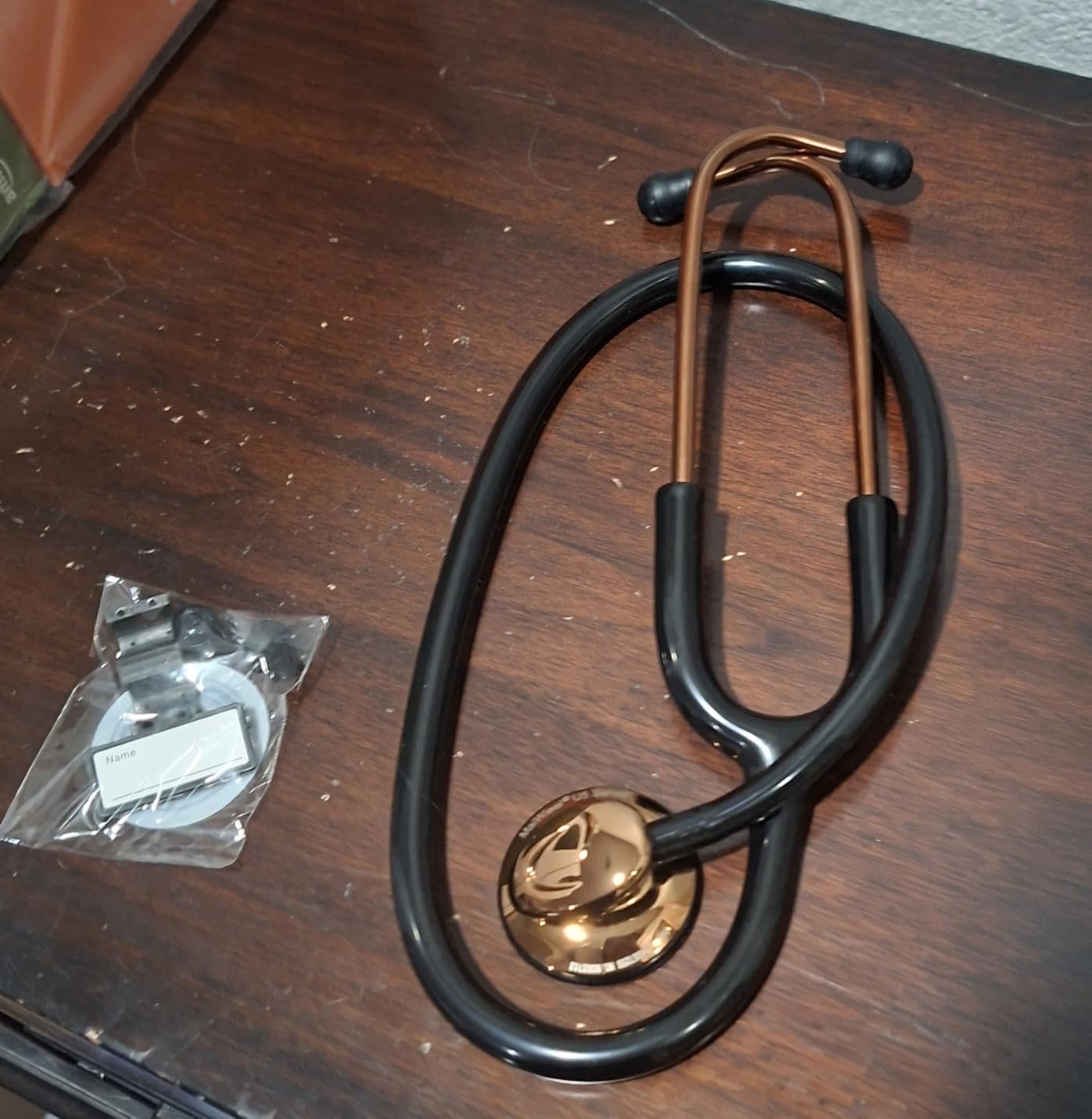
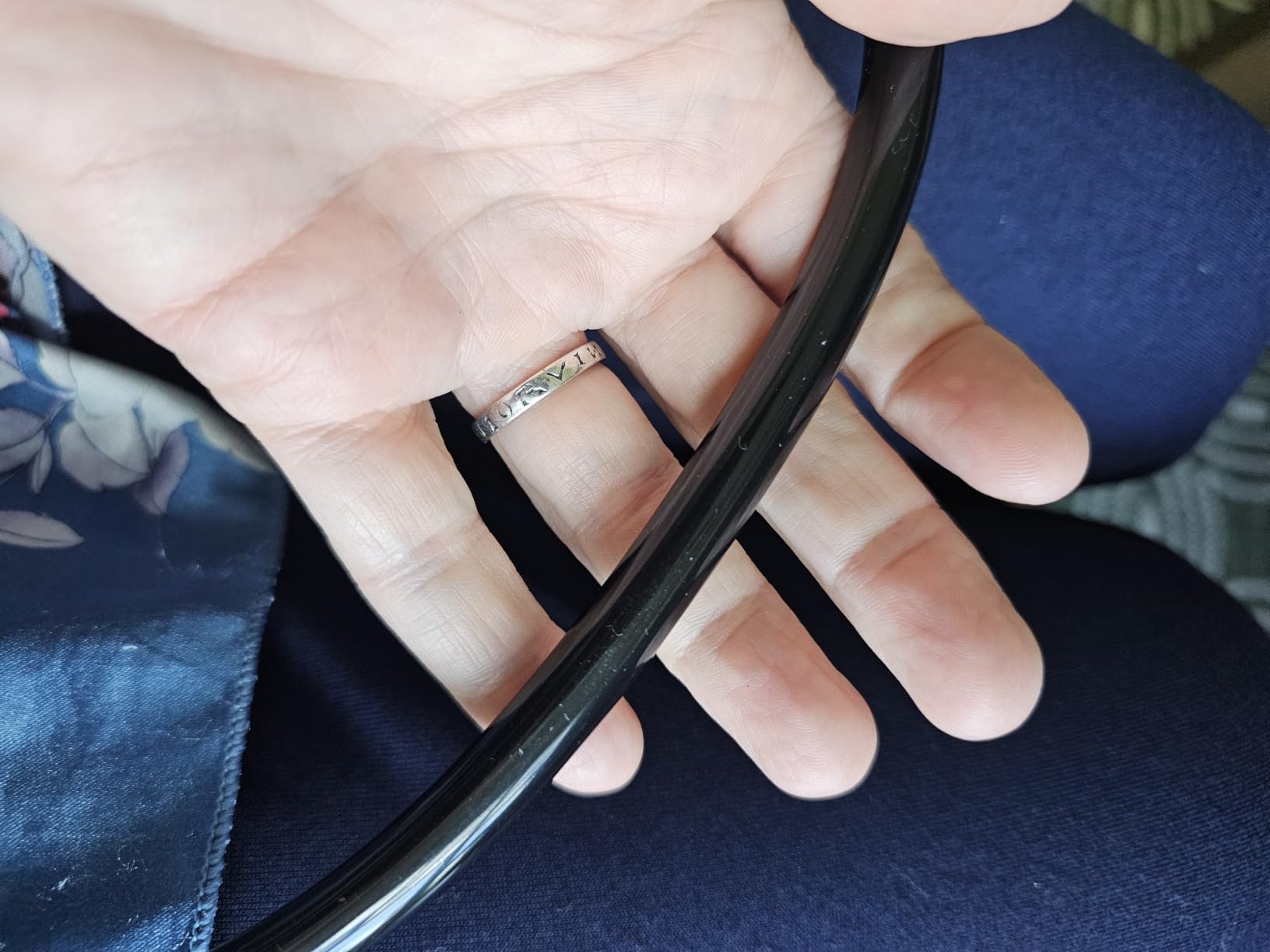
Here is the honest part. This model has 25 reviews, and every one of them is four or five stars, which tells you very little about long-term reliability. It sits at 184 in the Stethoscopes category, a long way behind the Littmann at 11 and the Eko at 9. Weight and dimensions are not published, and there is no detailed technical specification to compare line by line against the models above. When a device this new and this thin on history is this close in specification to a well-reviewed product, the reviews are the only evidence you have, and 25 is not much.
What that means practically is that this is a reasonable first digital stethoscope for someone who wants the features without the recurring fee, and a poor choice for someone who cannot afford to replace it. Buy it understanding that you are an early adopter of a less established brand rather than buying a proven workhorse.
Best for households that want zero recurring cost
This is the pick if the subscription model bothers you on principle, or if you are setting up a stethoscope for a relative who will not manage an app payment. Recording, playback and sharing all work without a paid tier, so the tool stays useful years later instead of losing functions behind a renewal prompt.
It is also a sensible bridge device. If you are unsure whether a digital stethoscope suits your household at all, buying into a no-subscription model lets you find out without committing to a brand ecosystem and a paid add-on at the same time.
Where it falls short
The evidence base is the weakness, not the specification sheet. Twenty-five reviews cannot tell you how the chestpiece feels after a year of daily use, whether the tubing cracks, or whether the app gets updated in a way that breaks playback. Warranty terms are not detailed in the listing, and the box contents are listed simply as a box.
There is no ECG, and no third-party digital stethoscope in this guide has one apart from the Eko and the Withings. If your concern is rhythm rather than sound, this does not address it, regardless of how good the amplification is.
5. Niroga 470: spoken heart rate built for elder care
Niroga 470: Digital Stethoscope with up to 40x Audio Amplification, Heart/Lung/Wide-Band Filter Modes, Built-In AI Assist, Record & Share Sounds with NO Subscription, Spoken Heart Rate. Recommend for families with elder care, physicians, nurses, listening to prenatal sounds, and adjustable amplification for hearing impaired (Maroon)
Up to 40x audio amplification
Heart, Lung and Wide-Band filters
Spoken heart rate announcement
Record and share with no subscription
Pros
- Up to 40x amplification at the lowest cost here
- Heart
- Lung and Wide-Band filter modes
- Spoken heart rate needs no screen watching
- No subscription for recording and sharing
- Marketed for elder care and prenatal listening
Cons
- Only 5 reviews available
- Generic brand name
- No FDA clearance stated
- Marketed for wellness rather than diagnosis
The Niroga 470 is the cheapest digital stethoscope here, and it includes the feature none of the other five offer: a spoken heart rate announcement. That single detail is worth more than it sounds. An elderly person, or a carer with deteriorating eyesight or hearing, can be told the reading out loud without looking at a small screen, which is exactly the situation where a wrist-worn smartwatch or a phone app tends to fail.
Amplification runs up to 40x with Heart, Lung and Wide-Band filter modes, plus a built-in AI assist, Bluetooth connectivity to the Niroga app, and a visual sound wave display in that app. Recording and sharing carry no subscription. The listing also names elder care, prenatal listening, adjustable amplification for hearing-impaired users and educational use as intended applications, so the design intent is family monitoring rather than clinical assessment.
Now the honesty part. This product has five reviews, all five stars, which is not a signal of quality so much as an absence of data. The brand field reads Generic, the manufacturer is listed as Niroga AI Inc., and no FDA clearance is stated anywhere in the specification. The listing itself carries a disclaimer that it is not intended for medical diagnosis. Read those five reviews as five early users who were happy, not as five hundred people who confirmed the device works.
Best for the lowest-cost entry into digital listening
Buy the Niroga 470 if the budget is the deciding factor and you want more than a flat acoustic tube. Up to 40x amplification, three filter modes, no subscription and a spoken heart rate give you the core digital feature set at the lowest entry point in this guide. It is also a plausible option for listening to prenatal sounds, which the manufacturer lists as an intended use.
For a family that is simply curious and cautious rather than managing a diagnosis, the spoken readout removes a real barrier. You hand the device over, the person places the chestpiece, and they hear their own result without navigating anything.
Where it falls short
Five reviews is not enough to trust for anything safety-related, and the absence of any stated regulatory clearance is the single biggest reason to look elsewhere if a clinician has asked you to monitor something. The listing is explicit that it is not a diagnostic device, and you should hold it to that.
The brand is unestablished, warranty terms are not spelled out, and the only included component listed is a user manual. If it fails in year two there is no history of replacement parts or service to fall back on, which is the same long-term risk the analog market avoids entirely by using tubes you can replace yourself.
6. WELLDAYMED 24x Hi-Fi: private listening on headphones
Digital Stethoscope with 24x Amplification Hi-Fi Amplified Stethoscope Blue
24x Hi-Fi amplification
Lung, Heart and Full Spectrum modes
Headphone and speaker output
Recording stored on the device
Pros
- Headphone and speaker output for private listening
- Three dedicated listening modes
- Adjustable volume knob
- Recordings stored on the device
- Non-slip ergonomic grip
- Bluetooth app connectivity
Cons
- Single review
- no reliability history
- Plastic and rubber construction
- 24x is the lowest amplification here
- No FDA clearance stated
This is the odd one out, and it is included because it solves a problem none of the others do. The WELLDAYMED has both a headphone output and a speaker output, so two people can listen to the same body sound at the same time. For a teaching moment with an older parent, or for a carer and a family member who both want to hear what is happening, that is a genuine capability the app-based models do not offer.
Amplification is 24x, lower than the 40x on the premium models, but the three-mode auscultation set is specific rather than generic: Lung, Heart and Full Spectrum, each with its own filter, plus an adjustable volume knob. Recording is stored on the device itself, which means a clip can be captured without a phone in the room. The listing describes an ergonomic non-slip grip, and Bluetooth connectivity handles app pairing when you want it.
What you are buying with this one is a teaching and demonstration tool. The construction is plastic and rubber, the exterior finish is plastic, and no FDA clearance is mentioned. There is exactly one review in the entire history of the listing, and while that reviewer reports easy Bluetooth pairing, good sound quality and useful recording features, one review is not a track record.
Best for listening together rather than monitoring alone
Pick this model if the goal is to show someone what you are hearing. A speaker output means a parent and a child can listen to the same sound together, which turns monitoring into a conversation rather than a solitary worry. On-device recording is also useful when you want to capture a sound without involving a phone or an account.
It also suits anyone who finds ear tubes uncomfortable over long sessions, since the headphone output removes the need to wear the headset at all. The three dedicated modes give a beginner more guidance than a single volume knob would.
Where it falls short
Twenty-four times amplification will not rescue sounds that a 40x model would pick up, and the plastic body is unlikely to outlast a metal chestpiece in a household that drops things. One review means there is no evidence about battery ageing, app stability, or how the filters perform over time.
With no stated regulatory clearance, this is a device for demonstration and learning. It is not a tool to monitor a diagnosed heart condition, and nothing in its evidence base would support using it that way.
Digital vs analog at home: what actually changes
Digital stethoscopes are more sensitive to faint sounds, not more diagnostically accurate. Amplification lets you hear a murmur or a soft crackle that an inexpensive acoustic tube passes over, and noise filtering improves what you hear in a busy room. Neither change makes the device better at telling you what is wrong, because that judgement was never made by the instrument.
An acoustic stethoscope does one thing perfectly: it puts the sound in your ears with no electronics, no battery, no app and no subscription. It is also repairable. Replace a tube or a set of ear tips and it works again for years, which is why clinicians on forums describe buying their first acoustic model and only later, once they know what a normal heart sounds like, moving to a digital one.
So the honest comparison for a home user is this. Choose analog if you are healthy, the room is quiet, and you want a tool that costs a fraction of a digital unit and never needs charging. Choose digital if sounds are genuinely faint, the household is loud, or you want a recording you can send to a doctor instead of describing a sound from memory.
What a home user can and cannot detect?
Auscultation is one input among many. A clinician who listens to a chest also takes a history, checks blood pressure, measures oxygen saturation, and often orders imaging or blood tests. Nobody can clear a heart by listening to it alone, and a home device does not change that. Anyone telling you a stethoscope can diagnose a condition at home is overselling what auscultation is.
What a digital unit can do is make obvious changes easier to notice over time. A murmur that was faint last month and is louder this month is a real observation. Coarse bubbling crackles that suggest fluid in the lungs, a new wheeze on breathing out, or a change in an existing known murmur are all reasonable things to record and mention to a clinician. The point is comparison over time, not diagnosis on the spot.
What it cannot do is confirm or rule out a condition, detect a clot, measure blood pressure, or measure oxygen saturation. Blockages in a coronary artery, for example, frequently produce no audible change at all, and heart failure can be present with or without audible crackles. Do not let a normal reading reassure you against symptoms that are getting worse.
Call emergency services immediately for chest pain or pressure, shortness of breath at rest, fainting, a sudden inability to speak or swallow, or a severe headache with confusion or vision loss. Those are not things to monitor at home with any device. For anything short of that, contact a clinician promptly if a new symptom appears, if an existing symptom worsens, or if a sound you have heard before has changed.
Medical disclaimer: this article is for general information and is not medical advice. A digital stethoscope is a screening aid, not a diagnostic device, and it does not replace an assessment by a qualified clinician.
Where do your recordings go?
Recording a heart or lung sound means creating a file that describes someone’s health, and it is worth knowing where that file sits. On the models in this guide, audio is captured through the device and handled by the manufacturer’s app. The Eko CORE 500 and the Littmann CORE both work through the Eko app, the Lsvaha and Niroga devices use their own companion apps, and the Withings BeamO syncs over Wi-Fi to a Withings account with a Health Link feature for sharing with a clinician.
That means cloud storage on a vendor’s servers in most cases, tied to an account you create with an email address. Before you record a family member, ask three questions: is the app account tied to you personally or to the person being monitored, can you delete recordings from inside the app, and can you remove the app without leaving the audio behind. Home monitoring tools are not unique patient records held by a clinic, so you are dealing with a consumer privacy model rather than a medical one.
If privacy is your main concern, the practical mitigations are simple. Record the minimum you need, share clips by direct message rather than posting publicly, use a separate app account if the person being monitored is an adult with their own consent, and delete clips you no longer need. The WELLDAYMED model stores recordings on the device, which keeps them off a vendor server entirely, though it offers the least else.
Littmann CORE vs Eko CORE 500: which one should you buy?
Choose the Littmann CORE for home listening and quiet confidence, and the Eko CORE 500 for clinical-grade data capture with an ECG. The first is lighter, cheaper, has a much larger review history and a higher rating. The second adds a 3-lead ECG, a full-colour display and FDA-cleared AI detection, and charges you for the AI on top.
The two are close on amplification, with both at up to 40x with noise reduction, and both carry a two-year manufacturer warranty. The real differences are everything around the chestpiece. The Littmann model at 87 g is one of the lightest full-size digital stethoscopes made, while the Eko model at 2.19 pounds is built to be carried all day. The Littmann card runs 4.6 stars across 3278 reviews and the Eko card runs 4.2 across 1373, with the gap explained largely by subscription frustration on the Eko side.
Choose Littmann if you are monitoring a parent or partner, want the lowest ongoing cost, or simply want a stethoscope that works without an app on a bad day. Choose Eko if a clinician has asked for recorded data, if rhythm matters more than sound quality, or if you can use HSA or FSA funds and will budget for the subscription.
For a household with no diagnosis, the Littmann CORE is the better fit. The ECG is a capability you will rarely use, while the lighter weight and simpler daily handling are things you will notice every single day.
Are digital stethoscopes worth it?
They are worth it for a specific set of people, and not worth it for everyone else. If a clinician has asked you to monitor a heart or lung condition, if body sounds are genuinely hard to hear in your home, or if you want to send a recording rather than a description, a digital stethoscope earns its cost quickly. If none of those apply, a good acoustic stethoscope does the same job for a fraction of the price.
Skip a digital stethoscope if you are a healthy adult with no symptoms, if you are buying it because it looks impressive rather than because a specific problem needs solving, or if the recurring subscription cost would strain your budget. The two cheapest picks here cost less than a single clinic appointment, so the case for buying one is mostly about what problem you are trying to solve.
Also weigh what a digital device cannot give you. Neither blood pressure nor blood oxygen nor a real ECG trace comes with a stethoscope, and for many older adults a blood pressure monitor and a pulse oximeter are more useful purchases than any of the six models above. If you want continuous wrist-based trends instead, our smartwatch health monitoring guide is the better place to start, because it tracks heart rate over time without a chestpiece.
What to look for before you buy?
1. Amplification without the noise problem. Amplification figures are meaningless on their own, because a high gain setting amplifies room noise and handling noise along with the body sound you want. Judge amplification together with active noise cancellation, and always listen in analog mode as well if the device offers it. A 40x figure with good filtering beats 60x with none.
2. Whether the phone is required for the core feature. The entire argument for a digital stethoscope is the recording. If saving a clip requires pairing a phone, creating an account and connecting to Wi-Fi each time, the friction will stop you using it within a month. The WELLDAYMED stores recordings on the device, which is the least frictionful approach, and the rest rely on an app to some degree.
3. Subscription cost over the ownership period. The Eko CORE 500 gates its AI murmur and AFib detection behind a paid subscription, and some Littmann app features are subscription-linked too. If you will own the device for three years, multiply the annual cost by three and add it to the purchase cost before you decide. The Lsvaha and Niroga models record and share with no subscription at all.
4. Regulatory status and stated intended use. FDA clearance is stated for the Eko CORE 500 and the Lsvaha CORE 500, and the Withings BeamO is certified to FDA, CE and ISO 13485 standards. The WELLDAYMED and Niroga models state no clearance, and the Niroga listing explicitly says it is not intended for medical diagnosis. That distinction matters enormously if a clinician has asked you to monitor something.
5. Filters and modes. Heart, Lung, Wide-Band, Cardio, Pulmonary and Full Spectrum modes shape the frequency response so faint sounds become more audible. The Eko CORE 500 has the widest set, the Littmann has a tunable dual-sided chestpiece with open or closed bell, and the budget models offer three basic modes. More modes help a beginner, but only if you know roughly what you are listening for.
6. Battery and charging at home. A device that lives in a bedside drawer needs to be charged occasionally, not daily. The Eko CORE 500 is rated to 60 hours of use on a rechargeable lithium-ion battery, which is the longest stated figure here. Check whether a dead unit can be used acoustically anyway, because a stethoscope that refuses to listen because its battery is flat is a problem at 2am.
7. Warranty, tubing and repairability. The Littmann CORE carries a two-year manufacturer warranty, a latex-free kink-resistant tube and a two-year claim on the electronics. Analog stethoscopes still win on repairability, because you can replace a tube yourself. If you are buying for someone who will keep it for a decade, that long-term support argument matters more than the fifth feature on the box.
Cleaning and sharing a digital stethoscope at home
Wipe the chestpiece, the stem and the headset with 70 percent isopropyl alcohol between users, and let the parts dry fully before storing the device. Avoid hand sanitiser, because the alcohol and gel combination degrades tubing over time, which is one of the most common complaints in analog reviews and applies just as much to digital tubing.
Do not immerse any of the digital models in water, even the water-resistant ones, and keep liquid out of the ear tubes and the headphone jack. Replace ear tips between users, keep the tubing uncoiled in its case, and store the device somewhere dry rather than in a bathroom. If a shared reading has been captured on a phone, delete the clip from the gallery as well as from the app.
Frequently Asked Questions
Do digital stethoscopes really work?
Yes, for the thing they are built to do. They make faint heart and lung sounds louder and clearer, and they let you record a clip to replay or send to a doctor. They are not more accurate at diagnosing anything, because diagnosis was never done by the stethoscope alone.
Are digital stethoscopes more accurate than acoustic ones?
They are more sensitive, not more accurate. Amplification picks up faint sounds an inexpensive acoustic tube misses, and noise filtering improves clarity in a busy room. Neither makes the device better at working out what is wrong, since that depends on clinical interpretation, not on amplification.
Can a stethoscope detect a heart murmur at home?
A murmur can often be heard, especially an obvious one, and a digital unit makes a faint murmur easier to pick up and to record over time. It cannot confirm a diagnosis, and a normal reading does not rule one out. If a murmur is new, louder than before, or comes with symptoms, tell a clinician.
Can a doctor hear heart failure through a stethoscope?
A clinician may hear crackles suggesting fluid in the lungs, but auscultation is one input among many, and heart failure can be present without any audible change. A home device is a screening aid only. Call emergency services for chest pain, breathlessness at rest or fainting rather than trying to monitor them.
Do you need a prescription to buy a digital stethoscope?
No. These are sold directly to consumers, and the FDA-cleared models carry a clearance for their manufacturer rather than a prescription requirement. The Eko CORE 500 and the Lsvaha CORE 500 state FDA clearance, and the Withings BeamO is certified to FDA, CE and ISO 13485 standards.
How do you use a digital stethoscope without training?
Warm the chestpiece in your hand, place it flat on bare skin in the same spot each time, and stay still for the length of the recording. Quiet the room if you can, and use the heart filter mode for heart sounds and the lung mode for breathing. Compare against a previous clip rather than judging a single reading.
The bottom line for home monitoring
The 3M Littmann CORE 8480 is our pick for the best digital stethoscopes for home monitoring because it does the useful things well, weighs 87 g, carries a two-year warranty, and has 3278 reviews at 4.6 stars behind it. The Eko CORE 500 is the choice when a clinician wants recorded data, because the 3-lead ECG and FDA-cleared detection are on nothing else in this guide, provided you accept the subscription and the extra weight. The Withings BeamO is the best single purchase for a carer, because temperature, a one-lead ECG and a sound clip come from one action.
Use the cheaper picks when cost or features are the priority, and treat them accordingly. The Lsvaha and Niroga models give you 40x amplification and no subscription at a fraction of the premium tier, but with 25 reviews and 5 reviews respectively, they carry little long-term evidence. The WELLDAYMED is a teaching tool with headphone listening, not a monitoring device.
And keep the boundaries clear. A digital stethoscope helps you notice a change and capture a clip you can send to a doctor. It does not diagnose, it does not clear a heart, and it does not replace clinical assessment. If you want to track blood pressure or oxygen levels, a blood pressure monitor and a pulse oximeter will serve you better than any stethoscope on this list.