
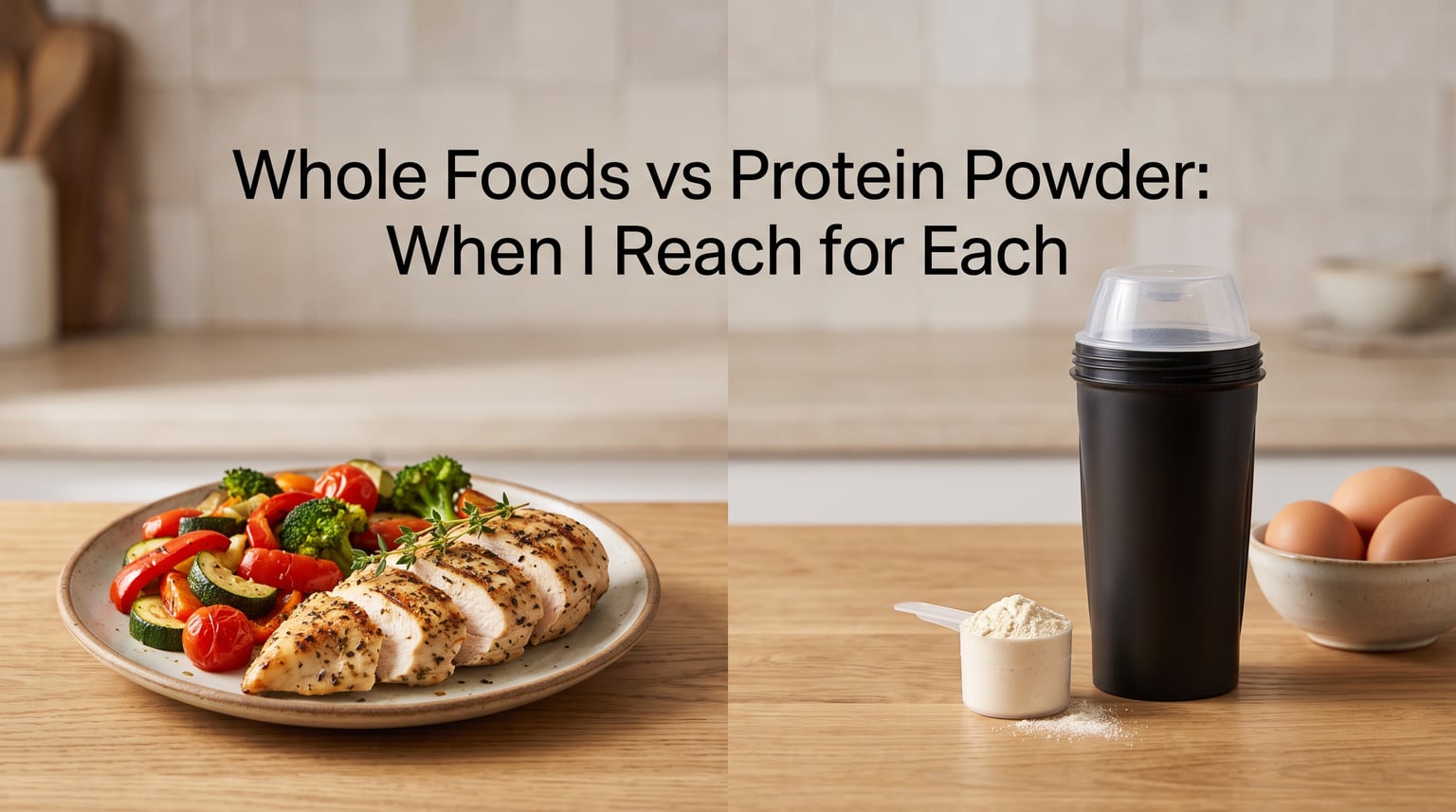
For most people trying to hit a protein target, whole foods vs protein powder is not an either-or question. It is a timing question. Whole food sources like chicken, eggs, Greek yogurt, and lentils should make up the bulk of your intake because they bring fiber, vitamins, minerals, and satiety that no scoop can match. Protein powder earns its place in the gaps, post-workout windows, travel days, and busy mornings when cooking is not realistic.
I have spent the last few years tracking my own protein intake across training blocks, travel weeks, and recovery phases. Some days I hit 180 grams almost entirely from food. Other days, especially when I am on the road or short on time, a whey shake does the heavy lifting. This guide is built around that real-world split rather than the “food always wins” or “powder is magic” extremes you see in most fitness feeds.
Dietitians almost universally recommend starting with food first, then layering in a powder supplement only when whole food protein falls short. No supplement can replicate the complexity of nutrients found in a varied, whole-food diet. That said, modern whey and plant isolates have legitimate advantages around absorption speed, leucine content per scoop, and convenience that food cannot match in every scenario.
By the end of this article you will have a clear rulebook for when I (and most sports nutritionists I have learned from) reach for each one. We will cover bioavailability, cost per gram, digestion rates, medical considerations like Hashimoto’s and tirzepatide, and a sample daily split you can adapt to your own training schedule.
Table of Contents
When Whole Foods Win: My Go-To Scenarios?
Whole foods win whenever time, appetite, and budget allow you to sit down and eat a real meal. They deliver more than just protein, and that extra payload is what makes them the foundation of any serious nutrition plan.
1. Sit-down meals where you have time to chew
I always prioritize whole food protein at breakfast, lunch, and dinner. A 6-ounce chicken breast gives me roughly 40 grams of protein alongside B vitamins, selenium, and zinc that a whey scoop simply does not carry. Chewing also triggers fullness signals that drinking a shake never will.
2. When you want to stay full for hours
Satiety is where whole food protein outclasses powder by a wide margin. A bowl of lentils with eggs keeps me full for four to five hours, while an isocaloric shake leaves me hungry again inside ninety minutes. If you are trying to manage weight or stick to a calorie target, that difference matters more than people admit on fitness forums.
3. Micronutrient density you cannot bottle
Salmon brings omega-3s, vitamin D, and astaxanthin along with its protein. Beef brings bioavailable iron and B12. Lentils bring folate, magnesium, and fiber. Powder delivers amino acids, full stop. When I want my body running on premium fuel, I eat the food.
4. Building sustainable long-term eating habits
People who learn to cook and eat whole food protein sources tend to keep weight off and stay consistent for years. People who lean on shakes as a crutch often bounce in and out of programs. I see this pattern repeatedly in nutrition communities, and the research backs it up.
5. Family meals and social eating
You cannot serve your kids a protein shake for dinner. Whole foods are how humans connect, share, and build healthy patterns together. When my family sits down, the table is full of food, not shaker cups.
6. Cost per gram of protein
Eggs, chicken thighs, Greek yogurt, canned tuna, and lentils routinely beat even budget whey on cost per gram of protein. I tracked my grocery spend for three months and whole foods came in around 1.5 to 2 cents per gram of protein. Mid-tier whey sat closer to 3.5 cents per gram.
7. Gut health and digestion
Fiber from legumes, whole grains, and vegetables feeds the gut microbiome in ways no shake can replicate. When I switched from a powder-heavy intake back to a food-first approach, my digestion improved noticeably within two weeks.
When Protein Powder Wins: Where I Reach for the Shaker?
Protein powder wins in specific, narrow scenarios where speed, portability, or appetite make whole food protein impractical. The convenience factor alone has earned powder a permanent spot in my kitchen.
1. The 30-minute post-workout recovery window
After a heavy training session I often have no appetite for solid food. A fast-digesting whey isolate shake with 25 to 40 grams of protein and 3 grams of leucine spikes muscle protein synthesis quickly and starts the recovery process while I shower and drive home. Whole foods would take an hour to digest the same amino acids.
2. Busy mornings when cooking is not happening
Some mornings I have ten minutes between the alarm and the door. A scoop of whey blended with oats, banana, and peanut butter gives me 35 grams of protein in under two minutes. Without that option, I would default to a pastry or skip breakfast entirely.
3. Travel days with no kitchen access
I keep a few single-serve pouches in my travel bag. Airport food protein options are usually sad chicken sandwiches at premium prices or fast-food patties with questionable macros. A shake plus a piece of fruit gets me through the layover without wrecking the day.
4. Hitting a high protein target without force-feeding
When I am pushing toward 200 grams of protein per day during a building phase, drinking 50 of those grams in two shakes is far easier than choking down another chicken breast. Powder lets me hit the number without feeling stuffed.
5. Precise dosing and tracking
Every scoop is the same. If I need 30 grams of protein post-workout for a research-backed muscle protein synthesis response, the label tells me exactly how much to use. Whole food portions vary by cut, cooking loss, and water content.
6. People with low appetite or digestive limits
Older adults, people recovering from illness, and anyone whose appetite is suppressed (including those on certain medications) often struggle to eat enough solid protein. A liquid shake is dramatically easier to get down.
7. Plant-based eaters who need a clean boost
Plant-based whole food protein is excellent but lower in leucine per serving. A pea-and-rice protein blend helps close the leucine gap needed for muscle protein synthesis without forcing someone to eat a pound of tofu.
Whole Foods vs Protein Powder: Head-to-Head Comparison
Looking at the two side by side helps clarify why I split the difference rather than picking a winner. They are tools built for different jobs.
Nutrient density and bioavailability
Whole foods win nutrient density in a landslide. A single salmon fillet delivers protein plus omega-3s, vitamin D, selenium, and B12. Bioavailability, the percentage of protein your body actually absorbs, is a closer contest. Whey isolate scores near 100 on the biological value scale, with eggs and milk close behind. Beef and chicken sit in the 75 to 80 range, and most plant sources land between 50 and 70 unless combined.
Digestion and absorption rates
This is where protein powder pulls ahead for specific use cases. Whey digests in roughly one to two hours, peaking amino acids in the blood fast enough to drive a strong muscle protein synthesis response. Casein digests over five to seven hours, which makes it useful as a slow overnight source. Whole food protein digests more slowly overall, which is great for sustained amino acid release but slower for post-workout recovery.
Cost per gram of protein
Reddit users routinely cite supplement costs of $500 or more per year, and that matches my experience. Whole foods win on cost for most people. Eggs cost roughly one cent per gram of protein. Chicken thighs sit around 1.5 cents. Budget whey runs 2.5 to 3 cents per gram, and premium isolates climb to 4 or 5 cents. If budget is your priority, food wins almost every time.
Muscle protein synthesis and lean mass gains
Studies on resistance-trained adults show that total daily protein intake matters more than whether it comes from food or powder, assuming the leucine threshold of around 2.5 to 3 grams per meal is hit. Whey makes hitting that threshold easier. Whole food meals hit it too, especially meat and dairy. For pure muscle hypertrophy outcomes, the source matters less than the total.
Sustainability considerations
This is rarely covered and it should be. Plant-based whole proteins like lentils, chickpeas, and peas have the lowest carbon footprint per gram of protein. Whey, a byproduct of cheese production, is actually a smart upcycling story and rates well compared to beef. Beef and lamb sit at the high end of environmental impact. If sustainability matters to you, plant-based whole foods and whey both beat ruminant meat.
My Daily Protein Framework: How I Split the Two
Here is the rough split I follow across a training week, and the framework I recommend to anyone trying to translate this debate into action.
The 80/20 baseline
I aim for roughly 80 percent of my daily protein from whole foods and 20 percent from powder. On a 180-gram day, that means about 144 grams from food and 36 grams from one shake, usually post-workout. On rest days I often skip the shake entirely.
Sample timing across a training day
Breakfast is three eggs with spinach and a slice of toast, giving me about 20 grams of whole food protein. Lunch is a chicken and rice bowl for 45 grams. A post-workout whey shake adds 30 grams in under two minutes. Dinner is salmon with vegetables for another 40 grams. Greek yogurt with berries before bed delivers 20 grams of slow-digesting casein. Total sits around 155 grams, with only the post-workout portion coming from powder.
Adjust for age and activity
Older adults need more protein per meal to trigger the same muscle protein synthesis response, roughly 35 to 40 grams instead of 20 to 25. Highly active athletes can push toward one gram per pound of body weight. Sedentary folks do fine at the FDA minimum of 0.36 grams per pound, though most people feel better around 0.6 to 0.8.
How much protein powder per day is safe
For healthy adults, one to two scoops per day (25 to 80 grams of protein from powder) is well within safe intake ranges. Going beyond that starts to displace nutrient-dense whole foods and can cause digestive issues if your gut is not used to it. If you find yourself hitting three or four shakes a day, step back and ask what real food you are avoiding.
A quick either-or decision framework
If you have time, appetite, and access to a kitchen, eat whole food protein. If any of those three are missing, a shake is the right call. That is the entire decision tree in one sentence, and it has served me well across years of training and travel.
Medical Considerations: Hashimoto’s, Tirzepatide, and Doctor Warnings
Several People Also Ask questions reference specific medical conditions, and these deserve direct answers with proper disclaimers. None of this replaces advice from your own physician.
Is whey protein ok for Hashimoto’s?
For most people with Hashimoto’s thyroiditis, whey protein is fine. Dairy sensitivity is common in autoimmune conditions, though, so some people do better with a high-quality grass-fed whey or a switch to a plant-based protein. Watch for bloating, skin flare-ups, or fatigue after a dairy-based shake. If you notice any of those, try an isolate (which has most of the lactose removed) or move to pea protein.
Which protein shake is best for tirzepatide?
People on tirzepatide and similar GLP-1 medications often struggle with appetite and need concentrated, low-volume protein. A clean whey isolate or a pea-and-rice blend is usually the easiest way to hit protein targets without forcing large meals. Avoid mass-gainer shakes loaded with sugar and fillers. Look for short ingredient lists and third-party tested products. Work with your prescribing physician on the right daily intake.
Why do doctors say no to protein powder?
Doctors push back on protein powder for three legitimate reasons. First, many cheap powders are contaminated with heavy metals, BPA, or undeclared stimulants, which is why third-party testing matters. Second, people with kidney disease should not load extra protein without supervision. Third, powders often displace real food and the nutrients that come with it. A clean, tested powder used as a supplement rather than a replacement addresses all three concerns.
FAQs
Is it better to eat whole foods or protein powder?
Whole foods are better as the foundation of your protein intake because they deliver fiber, vitamins, minerals, and satiety that powder cannot match. Dietitians almost universally recommend starting with food first, then adding one or two protein shakes per day only when whole food protein falls short of your target.
Is whey protein ok for Hashimoto’s?
For most people with Hashimoto’s thyroiditis, whey protein is fine. Dairy sensitivity is more common in autoimmune conditions, so if you notice bloating, skin flare-ups, or fatigue after a dairy-based shake, try a whey isolate (lower in lactose) or switch to a pea-and-rice plant protein. Check with your endocrinologist for personalized guidance.
Why do doctors say no to protein powder?
Doctors warn against protein powder mainly because cheap brands can be contaminated with heavy metals or undeclared stimulants, because excess protein can stress kidneys in people with kidney disease, and because powders often replace nutrient-dense whole foods. A third-party tested powder used as a supplement rather than a meal replacement addresses all three concerns.
Which protein shake is best for tirzepatide?
People on tirzepatide and similar GLP-1 medications often need concentrated, low-volume protein because appetite is suppressed. A clean whey isolate or a pea-and-rice blend with a short ingredient list is usually the easiest way to hit protein targets without forcing large meals. Avoid mass-gainer shakes with added sugar. Work with your prescribing physician on intake.
Can I replace whole foods with protein powder entirely?
No, you should not replace whole foods with protein powder entirely. Powder is a supplement, not a substitute. Whole food protein sources like eggs, chicken, fish, dairy, and legumes carry fiber, vitamins, minerals, and antioxidants that no shake can replicate. Use powder to fill gaps, not to replace meals.
How much protein powder per day is safe?
For most healthy adults, one to two scoops per day (about 25 to 80 grams of protein from powder) is well within safe intake ranges. Going beyond that starts to displace nutrient-dense whole foods and can cause digestive issues. If you regularly need three or more shakes per day, look at why you are skipping real food.
The Bottom Line
The whole foods vs protein powder debate is not really a debate. Whole foods should anchor your protein intake because they bring nutrients, fiber, satiety, and sustainability that no scoop can match. Protein powder is a precision tool for the post-workout window, the busy morning, the travel day, and the moment when you simply cannot face another chicken breast.
My personal rule, and the one I will leave you with, is the 80/20 split. Build your day around real food first, then add one or two clean, third-party tested shakes to close whatever gap remains. Adjust the ratio based on your training load, schedule, appetite, and any medical considerations like Hashimoto’s or tirzepatide.
Your next step is simple. Audit your current protein intake for one week, note where whole food protein is already doing the work, and identify the specific moments a shake would make your day easier. Use that data to build your own version of the framework above, and stop treating this as an either-or choice.