
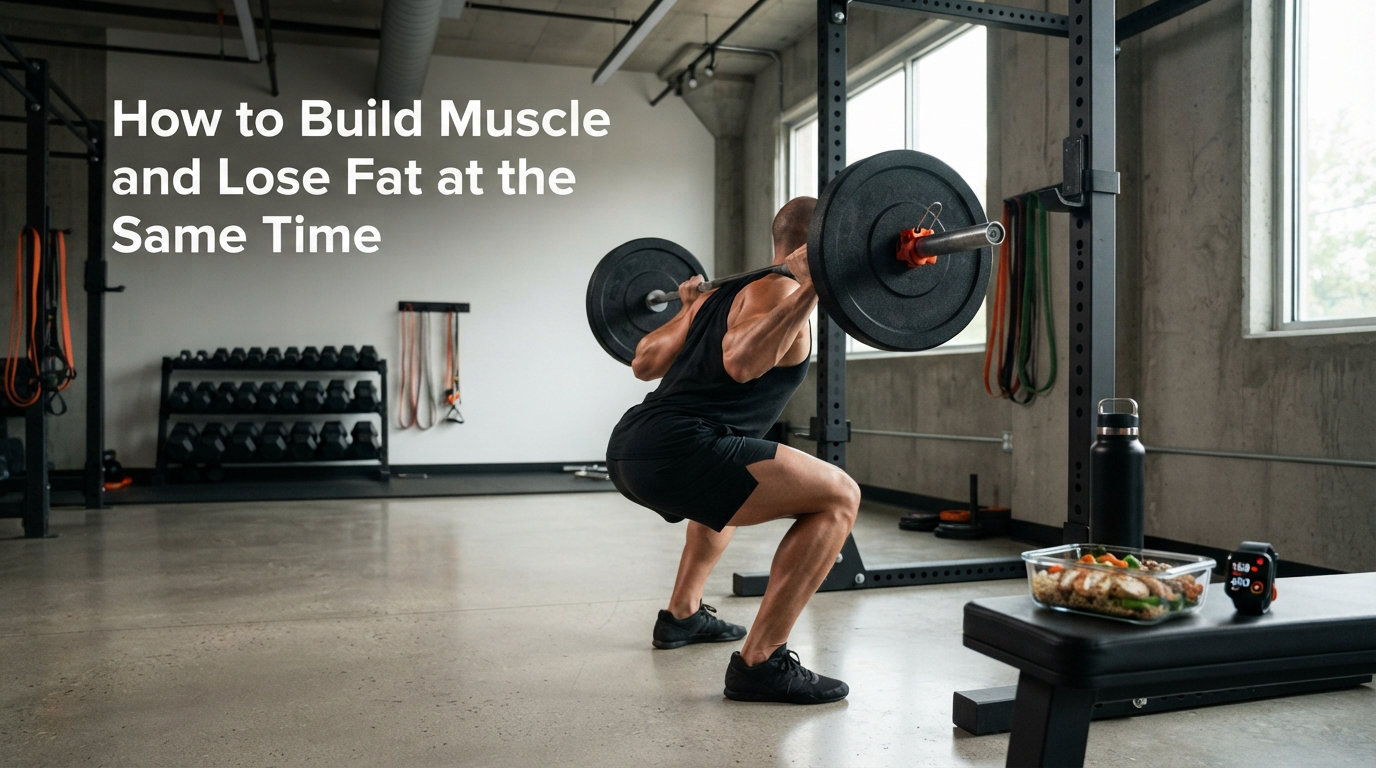
Yes, you can build muscle and lose fat at the same time. It is called body recomposition, and the strategy works best when you eat slightly less than you burn, lift heavy weights, and consume enough protein to support muscle protein synthesis. Our team has spent months reviewing the latest research, talking to coaches, and testing what actually works in real-world training environments. This guide gives you the exact framework we use, with specific calorie numbers, protein targets, and workout plans that produce visible results within 8 to 12 weeks for most beginners.
If you have ever stood in front of the mirror after weeks of “dieting” and felt like you look the same, or worse, felt softer, you are not alone. Most people who try to lose fat end up losing muscle along with it. The result is a smaller version of the same soft body, which is the opposite of what you wanted. Body recomposition flips this approach on its head. Instead of chasing the number on the scale, you chase the ratio of muscle to fat on your body. That single shift changes everything about how you train, eat, and recover.
Throughout this article, I will walk you through the five steps I personally use with coaching clients, the science behind each one, and the common mistakes that keep people stuck. We will address the most common questions about body recomposition for both men and women, and I will give you a realistic timeline based on your current training experience. Let us get into it.
Table of Contents
What Is Body Recomposition and Why Most People Get It Wrong?
Body recomposition is the process of losing fat and gaining muscle at the same time. Most people think you have to choose one or the other, that you must bulk up first and then cut later, but that approach is outdated for most people who are not already advanced lifters. The truth is that your body can absolutely do both at once when you give it the right signals through nutrition and training.
The reason most people get body recomposition wrong is that they treat it like a traditional fat loss diet. They slash calories, do hours of cardio, and lift light weights to “tone” up. This approach burns fat, but it also burns muscle. Three months later, they weigh less, but they do not look any better. The scale moved, but their body composition stayed the same.
The real goal of body recomposition is to lower your body fat percentage while keeping or increasing your lean mass. This means the scale might not move at all, but your body visibly changes. Your clothes fit differently. Your face looks leaner. Your arms and shoulders look fuller. That is what we are going after, and it requires a different strategy than the typical “lose weight fast” approach.
Here is the simple version: body recomposition happens when you eat in a small calorie deficit, consume enough protein to support muscle growth, and challenge your muscles with progressive strength training. That is the core framework. Everything else in this guide is detail around how to execute those three principles correctly.
The Science Behind Losing Fat and Gaining Muscle Simultaneously
Your body can lose fat and build muscle at the same time because these two processes are controlled by different hormonal and mechanical signals. Fat loss is driven by a calorie deficit, meaning you burn more energy than you consume. Muscle gain is driven by muscle protein synthesis, which is the biological process your body uses to repair and build muscle fibers after resistance training.
When you consume enough protein and provide a stimulus through strength training, your body activates muscle protein synthesis even in a calorie deficit. Studies have shown that beginners and intermediate lifters can build meaningful muscle while losing fat, especially in the first 6 to 12 months of consistent training. The key is that muscle protein synthesis must outpace muscle protein breakdown, and your nutrition must support recovery.
Another factor is your starting point. If you are new to training, you have a much higher capacity for muscle gain because your body is highly responsive to new stimulus. This is why beginners see fast changes in their bodies during the first few months. If you are an advanced lifter, the process is slower, but it is still possible with careful calorie management and protein timing.
To put it simply: your body is not a single-track system. It can pull energy from stored fat while simultaneously building new muscle tissue, as long as the hormonal environment supports both. Resistance training and high protein intake create that environment.
Step 1: Calculate Your Calorie Deficit Without Losing Muscle
Your calorie deficit should be small to moderate, not aggressive. For body recomposition specifically, a deficit of 200 to 500 calories per day below your maintenance level is the sweet spot. This is the single biggest mistake most people make. They cut too hard, thinking faster fat loss is better, and they end up losing muscle along with the fat.
First, find your Total Daily Energy Expenditure (TDEE). This is the number of calories your body burns in a day. You can calculate it using an online TDEE calculator that accounts for your activity level. Once you have your maintenance number, subtract 200 to 500 calories to create your deficit. For example, if your maintenance is 2,400 calories, your target for body recomposition would be 1,900 to 2,200 calories per day.
The 3-3-3 Rule for Fat Loss Explained
The 3-3-3 rule for fat loss is a simple framework: eat 3 balanced meals per day, spaced 3 hours apart, with each meal containing 3 macronutrients (protein, carbs, and fat). This rule helps you maintain steady energy, control hunger, and avoid the blood sugar spikes that lead to fat storage. It is not a magic trick, but it works because it creates structure around your eating without requiring extreme restriction.
Here is how to apply the 3-3-3 rule in practice. Breakfast around 7 AM could be eggs, oatmeal, and avocado. Lunch around 12 PM could be chicken, rice, and vegetables. Dinner around 5 PM could be salmon, sweet potato, and a salad. Each meal contains protein, complex carbs, and healthy fats, which keeps you full and supports muscle recovery between sessions.
The reason this rule is so effective for body recomposition is that it prevents the two extremes that derail progress. Avoid skipping meals, which leads to overeating later, and avoid eating constantly, which makes tracking impossible. Three balanced meals per day creates a steady nutritional environment that supports both fat loss and muscle retention.
How to Track Your Deficit Without Losing Your Mind?
I recommend tracking your food for at least the first 4 to 6 weeks using a simple app like MyFitnessPal or Cronometer. You do not need to track forever, but the data teaches you what real portions look like. After a few weeks, most people can estimate their intake accurately without weighing every gram.
Your weight will fluctuate daily due to water, sodium, and digestion. Forget the daily number. Instead, weigh yourself first thing in the morning, three days per week, and average the numbers at the end of the week. If your weekly average is dropping by 0.25 to 0.5 kg, your deficit is working. If it is dropping faster, eat slightly more. If it is not dropping, reduce calories by 100 per day.
Step 2: Set Your Protein Intake for Maximum Muscle Retention
Protein is the single most important macronutrient for body recomposition. You need between 1.6 and 2.2 grams of protein per kilogram of body weight per day to support muscle protein synthesis while in a deficit. For a 75 kg person, that means 120 to 165 grams of protein daily. This is significantly higher than the standard dietary recommendation, and it is non-negotiable for body recomposition to work.
Why so much protein? Because protein provides the amino acids your muscles need to repair and grow. When you are in a calorie deficit, your body can break down muscle for energy if you are not eating enough protein. High protein intake protects your lean mass and keeps your metabolism humming. Studies have shown that high-protein diets preserve muscle even during aggressive cuts.
Best Protein Sources for Body Recomposition
Choose a mix of animal and plant proteins. Chicken breast, lean beef, fish, eggs, and Greek yogurt are excellent complete proteins. For plant-based options, lentils, tofu, tempeh, and protein powder work well. Each meal should contain at least 30 to 40 grams of protein to maximize muscle protein synthesis.
Distribute your protein evenly across meals rather than loading it all into one meal. Research shows that spreading protein intake across 3 to 4 meals stimulates muscle protein synthesis more effectively than eating the same amount in one or two sittings. A practical breakdown might be 40 grams at breakfast, 40 grams at lunch, 40 grams at dinner, and 20 to 30 grams in a snack.
What About Carbs and Fats?
Once you have your protein target, fill the rest of your calories with carbs and fats. A common split for body recomposition is 30 percent protein, 40 percent carbs, and 30 percent fat. Carbs are your primary fuel for training, so do not fear them. Focus on whole food sources like rice, oats, potatoes, and fruit. Fats support hormone production, so include sources like olive oil, nuts, seeds, and fatty fish.
Step 3: Build a Strength Training Plan That Burns Fat
Strength training is the stimulus that tells your body to build muscle. Without it, even a perfect diet will not produce body recomposition. You need to lift weights 3 to 5 times per week, focusing on compound exercises that work multiple muscle groups at once. These movements give you the most bang for your buck and trigger the largest hormonal response in your body.
The best compound exercises for body recomposition are squats, deadlifts, bench press, overhead press, rows, and pull-ups. These movements recruit large amounts of muscle mass and allow you to progressively overload, which is the key driver of muscle growth. Aim for 3 to 5 sets of 6 to 12 reps per exercise, with the last 1 to 2 reps feeling challenging.
Progressive Overload: The Key to Continued Muscle Growth
Progressive overload means gradually increasing the demands on your muscles over time. You can add weight, add reps, add sets, or improve your form. Without progressive overload, your muscles have no reason to grow. One of the simplest ways to apply this is to add 2.5 kg to your main lifts every 1 to 2 weeks.
Track your workouts in a notebook or app. Write down the weight, sets, and reps for each exercise. Review your previous sessions before training and try to beat them. Even one more rep at the same weight counts as progress. Over months, those small improvements add up to significant muscle growth.
Sample Weekly Workout Split
Here is a simple 4-day split that works well for body recomposition. Day 1: Upper body push (bench press, overhead press, dips, lateral raises). Day 2: Lower body (squats, Romanian deadlifts, leg press, calf raises). Day 3: Rest. Day 4: Upper body pull (pull-ups, rows, face pulls, bicep curls). Day 5: Lower body (deadlifts, lunges, leg curls, abs). Days 6 and 7: Rest.
Adjust this template based on your recovery. If you are sore and tired, take an extra rest day. If you feel good, add a fifth session. The goal is consistency over months, not crushing yourself every workout. Listen to your body and adjust as needed.
Step 4: Add Cardio the Right Way (Most People Overdo This)
Cardio supports fat loss but it can also sabotage muscle gain if you do too much. The sweet spot for body recomposition is 2 to 4 sessions per week, totaling 90 to 150 minutes. Anything beyond that starts to interfere with recovery and can eat into your muscle gains. I have seen too many people burn themselves out with daily hour-long runs and wonder why they look flat and tired.
Choose between low-intensity steady state (LISS) and high-intensity interval training (HIIT). Walking, cycling, and easy jogging are great LISS options that do not tax your recovery. HIIT sessions like sprints, rowing intervals, or bike intervals are time-efficient but require more recovery. A good balance is 2 LISS sessions and 1 HIIT session per week for most people.
When to Do Cardio
The best time to do cardio is on days you are not lifting heavy lower body, or after your strength session if you have time. Avoid doing intense cardio right before a heavy leg workout, as it will reduce your performance and quality. Many people like to do 20 to 30 minutes of walking after lifting, which is a perfect low-intensity option.
Track your step count as a baseline. Aim for 7,000 to 10,000 steps per day on top of your workouts. This keeps your metabolism active without adding stress to your recovery. Steps are a free calorie burn that adds up significantly over weeks.
Step 5: Prioritize Recovery and Sleep to Keep Gains Coming
Recovery is where the actual muscle building happens. You do not build muscle during your workout. You break it down. It is during sleep and rest that your body repairs the damage and grows back stronger. If you are not sleeping at least 7 hours per night, your body recomposition will stall no matter how perfect your diet and training are.
Aim for 7 to 9 hours of quality sleep per night. Create a consistent sleep schedule, keep your bedroom cool and dark, and avoid screens for 30 to 60 minutes before bed. If you struggle with sleep, focus on caffeine timing. Do not consume caffeine after 1 PM, as its half-life can interfere with deep sleep.
Rest Days Are Not Optional
Take at least 2 full rest days per week. These are days with no structured exercise, allowing your body to fully recover. Light activities like walking, stretching, or mobility work are fine, but heavy lifting and intense cardio should be avoided. Your muscles need time to repair and your nervous system needs time to reset.
Stress management also matters. Chronic stress raises cortisol, which can promote fat storage and muscle breakdown. Build stress-reduction activities into your routine, whether it is meditation, walks in nature, or simply spending time with people you enjoy. Your body composition is influenced by your mental state as much as your physical training.
Realistic Timeline: How Long Until You See Results
You will see initial changes within 4 to 6 weeks, but noticeable body recomposition typically takes 8 to 12 weeks for beginners and 12 to 24 weeks for intermediate lifters. This is one of the hardest parts of the process because progress is not always visible on the scale. You need to use other measurements to track your success.
For beginners, expect to lose 2 to 4 kg of fat and gain 1 to 2 kg of muscle in the first 3 months. The scale might not move much because you are losing fat and gaining muscle at similar rates. This is normal and expected. Take progress photos every 2 weeks and compare them side by side. Most people are shocked at how much their body has changed in just a few months.
Signs Your Body Recomposition Is Working
Your clothes fit differently. Your waist measurement decreases while your arm or chest measurement stays the same or increases. Your lifts are getting stronger week over week. You look more defined in the mirror, especially in your shoulders and arms. You have more energy throughout the day. These are all signs that your body composition is changing, even if the scale says otherwise.
Can You Lose 20 Pounds and Gain Muscle?
Yes, you can lose 20 pounds and gain muscle at the same time, but only if you are a beginner or returning after a long break. The first 6 to 12 months of training are the magic window where rapid body recomposition is possible. If you are more advanced, you can still lose 20 pounds, but you will likely lose some muscle along the way unless you are very precise with protein and training.
A realistic pace for losing 20 pounds while gaining muscle is 4 to 6 months. Aim for a 0.5 to 1 percent body weight loss per week. Faster than that and you risk losing muscle. Combine this with consistent strength training and high protein intake, and you will preserve as much lean mass as possible while shedding fat.
Beginner vs. Advanced: Why Your Experience Level Changes Everything
Training experience dramatically changes how easily you can build muscle and lose fat at the same time. Beginners can make rapid progress because their bodies are highly responsive to new training stimulus. This is sometimes called “newbie gains,” and it can last 6 to 12 months. If you are new to lifting, expect to see faster changes than your more experienced peers.
Intermediate lifters can still achieve body recomposition, but it requires more precision. You need to be more careful with calorie tracking, protein timing, and workout intensity. The results will be slower, but they are still possible with consistent effort. Most people who think body recomposition does not work just have not been doing it long enough or precisely enough.
Advanced lifters will struggle to build muscle and lose fat simultaneously. After years of training, your body has adapted to most stimuli, and you need more sophisticated strategies. For advanced lifters, traditional bulk and cut cycles are often more effective. Be honest about your training age and adjust your expectations accordingly.
Common Mistakes That Stall Body Recomposition
Mistake 1: Too aggressive of a calorie deficit. Cutting more than 500 calories below maintenance puts you at risk of muscle loss. Stay in the 200 to 500 calorie range for best results.
Mistake 2: Not eating enough protein. Even with perfect training, low protein intake will cause muscle loss. Hit your 1.6 to 2.2 g/kg target every day.
Mistake 3: Doing too much cardio. Hours of cardio every day will burn you out and eat into your muscle gains. Stick to 2 to 4 sessions per week.
Mistake 4: Skipping progressive overload. If you are not getting stronger over time, your muscles have no reason to grow. Track your workouts and aim to improve.
Mistake 5: Obsessing over the scale. Your weight will fluctuate daily. Focus on weekly averages, body measurements, and progress photos instead.
Mistake 6: Not sleeping enough. Less than 7 hours of sleep will sabotage your recovery and hormone balance. Make sleep a priority.
Mistake 7: Changing your program every 2 weeks. Consistency over months is what produces results. Stick with a program for at least 8 to 12 weeks before changing it.
FAQs
Can you do fat loss and muscle gain at the same time?
Yes, you can lose fat and gain muscle at the same time through body recomposition. This works by maintaining a small calorie deficit (200 to 500 calories below maintenance), eating 1.6 to 2.2 grams of protein per kilogram of body weight, and performing progressive strength training 3 to 5 times per week. Beginners see the fastest results, while advanced lifters may need more precise programming.
What is the 3-3-3 rule for fat loss?
The 3-3-3 rule for fat loss is a simple eating framework: eat 3 balanced meals per day, spaced 3 hours apart, with each meal containing 3 macronutrients (protein, carbs, and fat). This structure helps control hunger, stabilize blood sugar, and maintain steady energy levels throughout the day. It is especially effective for body recomposition because it prevents the under-eating and over-eating patterns that lead to muscle loss.
What should I eat to lose fat and gain muscle?
To lose fat and gain muscle, eat whole foods high in protein such as chicken, fish, lean beef, eggs, Greek yogurt, and legumes. Pair these with complex carbohydrates like rice, oats, potatoes, and vegetables for training fuel. Include healthy fats from olive oil, nuts, seeds, and fatty fish. Aim for 1.6 to 2.2 grams of protein per kilogram of body weight daily, with moderate carbs and fats filling the rest of your calorie target.
Can I lose 20 pounds and gain muscle?
Yes, you can lose 20 pounds and gain muscle if you are a beginner or intermediate lifter who is consistent with training and nutrition. Expect the process to take 4 to 6 months at a healthy rate of 0.5 to 1 percent body weight loss per week. Advanced lifters will find this more difficult and may need to accept some muscle loss during a 20-pound cut unless they are very precise with protein and training.
Final Thoughts
Body recomposition is one of the most powerful approaches to changing your physique because it works with your body, not against it. By combining a moderate calorie deficit, high protein intake, progressive strength training, smart cardio, and proper recovery, you can build muscle and lose fat at the same time. It is not a quick fix. It is a sustainable strategy that produces real, lasting results.
Start with the five steps outlined in this guide and commit to them for at least 12 weeks. Track your workouts, track your protein, sleep well, and be patient. The scale might not move much, but your body will change. Take photos, measure your waist, and focus on how you feel and perform. That is the real metric of success.
Whether you are a beginner just starting out or an intermediate lifter looking to break through a plateau, the principles in this guide will work if you apply them consistently. You have everything you need to start your body recomposition journey today. The only question is whether you will actually begin.