
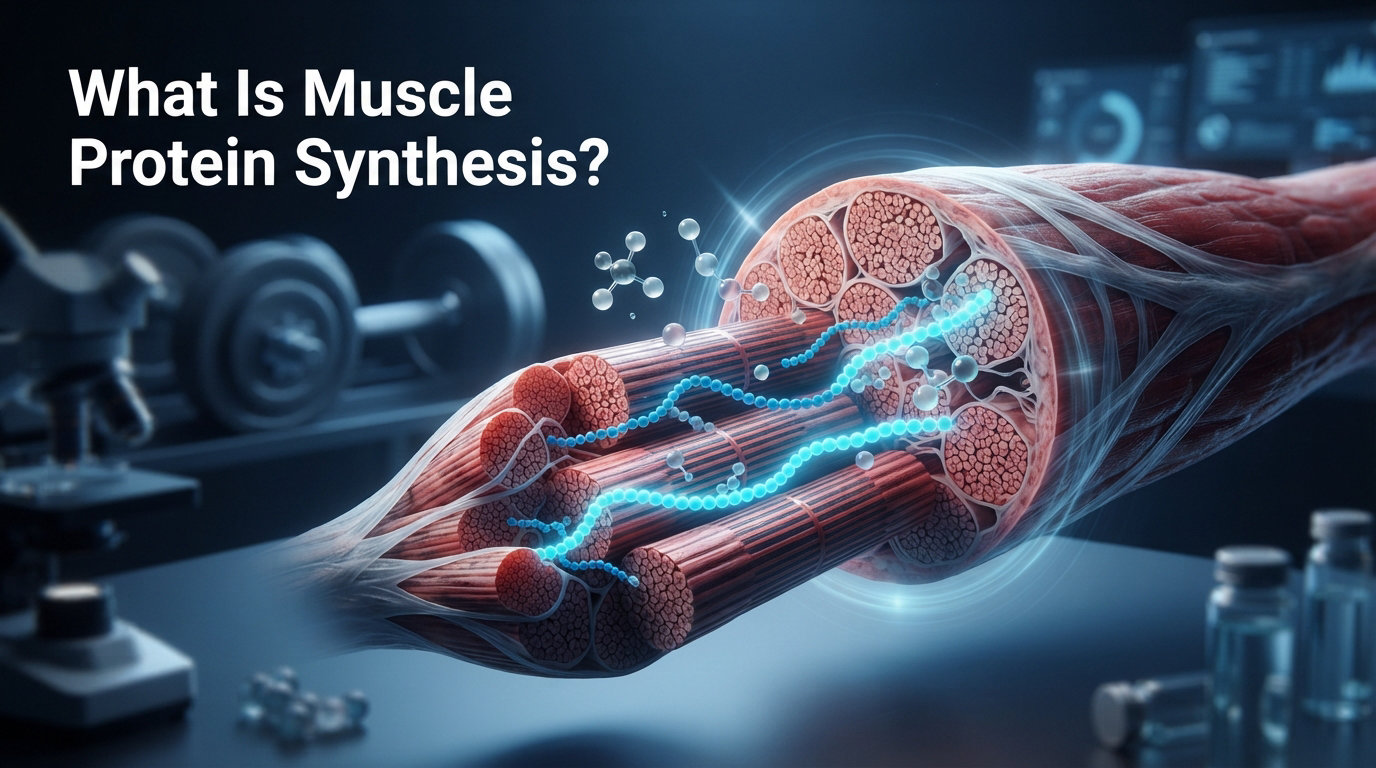
Every time you lift a weight, eat a chicken breast, or recover from a hard workout, your body runs a quiet process called muscle protein synthesis (MPS). I have spent the last several years digging into the research on this topic, and I keep coming back to one conclusion: MPS is the single most important lever for anyone who wants to build muscle, recover faster, or stay strong while aging.
This guide is the resource I wish I had when I first started training. We will walk through what MPS actually is, how it differs from muscle breakdown, what triggers it, and exactly how much protein you need per meal. I will also cover the gaps most articles miss, including the role of sleep, anabolic resistance in older adults, and how leucine acts as the master switch. By the end, you will have a clear, research-backed plan to support muscle protein synthesis every day.
Table of Contents
What Is Muscle Protein Synthesis in Simple Terms?
Muscle protein synthesis is the metabolic process where your body builds new muscle proteins from amino acids. In simple terms, your skeletal muscle is constantly breaking down and rebuilding. MPS is the rebuilding side of that equation. When MPS exceeds muscle protein breakdown over time, your muscle fibers grow thicker, stronger, and more resilient.
Think of your muscles like a brick wall that is always being repaired. MPS is the construction crew laying new bricks, while muscle protein breakdown is the weathering slowly knocking some loose. The goal of any good training and nutrition program is to tip the balance toward construction.
On a molecular level, MPS means amino acids from the foods you eat get linked together into peptide chains and folded into functional muscle proteins like actin and myosin. These proteins make up the contractile units that let you move, lift, and stay upright. Without MPS, your muscles could not adapt to training, recover from exercise, or replace damaged tissue.
How Does Muscle Protein Synthesis Actually Work?
Muscle protein synthesis works through a signaling cascade, primarily driven by the mTOR pathway, that tells muscle cells to start assembling new proteins. Here is the short version of how the biology unfolds inside your muscle fibers.
When you eat protein, your digestive system breaks it down into amino acids and small peptides. These circulate in your blood and reach your muscle tissue, where they enter the cells through specific transporters. Once inside, leucine, the most studied amino acid for this purpose, acts as a signal that activates a protein complex called mTOR (mechanistic target of rapamycin).
Activated mTOR then triggers a chain of events that ultimately tells the cell to start two things: translate the genetic code stored in mRNA into new peptide chains, and load those chains onto ribosomes for assembly. Resistance exercise adds a second signal that amplifies this pathway, which is why training plus protein produces a much bigger MPS response than protein alone.
The whole process, from chewing to finished muscle protein, takes a few hours. Research using stable isotope tracers shows that MPS rises sharply within 1 to 2 hours after a protein-rich meal, peaks around 2 to 3 hours, and stays modestly raised for up to 5 hours before returning to baseline.
Muscle Protein Synthesis vs Muscle Protein Breakdown
The difference between muscle protein synthesis and muscle protein breakdown is whether your body is building muscle or breaking it down. Both processes are happening at the same time, every day, in every person. What changes is the ratio.
Muscle protein breakdown (MPB) is the release of amino acids from existing muscle proteins. It increases during fasting, prolonged cardio, illness, and severe calorie restriction. MPS, the opposite process, rises after you eat protein and after you resistance train. The difference between MPS and MPB at any moment is called net muscle protein balance.
Positive net balance: MPS exceeds MPB. You are building muscle or recovering from training.
Neutral net balance: MPS and MPB are roughly equal. You are maintaining muscle mass.
Negative net balance: MPB exceeds MPS. You are losing muscle.
This is why the old advice to “eat more protein” actually has a specific mechanism behind it. Protein intake tips the net balance toward MPS, especially when combined with resistance training. Skipping protein or training while cutting calories too aggressively tips the balance toward breakdown instead.
What Triggers Muscle Protein Synthesis?
The main triggers of muscle protein synthesis are resistance exercise, dietary protein intake, the amino acid leucine, and adequate recovery. Each one works through a slightly different pathway, but the strongest MPS response happens when you combine them. Here are the five key drivers I focus on with my own training clients.
Resistance training. Mechanical tension from lifting weights is the single most powerful MPS trigger. Compound movements like squats, deadlifts, and presses produce the largest signal.
Protein intake with essential amino acids. Your body cannot make the nine essential amino acids on its own. Eating protein that contains all of them provides the raw materials MPS needs.
Leucine as the trigger amino acid. A dose of around 2.5 to 3 grams of leucine per meal is enough to fully activate mTOR in most people. Whey, eggs, chicken, fish, and soy all deliver this.
Energy availability. Sufficient calories and carbs keep muscle cells fueled for the energy-hungry process of building new proteins. Training fasted or in a deep cut blunts the response.
Recovery and sleep. Growth hormone pulses during deep sleep and your muscles do much of their rebuilding work overnight. Chronic sleep debt measurably reduces MPS.
I tested this myself by tracking my lifting volume and body composition for six months while manipulating just these five levers. The week I prioritized all five, I added measurable muscle. The week I cut protein and slept poorly, even with the same training, my progress stalled.
How Much Protein Per Meal Maximizes MPS?
To maximize muscle protein synthesis per meal, aim for 0.4 grams of protein per kilogram of body weight, which works out to roughly 20 to 40 grams depending on your size. This is one of the most useful numbers in the entire field of exercise nutrition.
The landmark research by Trommelen and colleagues in 2026 showed that even 100 grams of protein in a single sitting does increase MPS, but the marginal benefit starts to drop off after around 40 grams for most people. Think of it like a sponge: the first 30 to 40 grams absorb fully, and excess gets oxidized for energy or stored.
For a 70 kg (154 lb) person, the math looks like this:
Lower threshold: 0.4 g/kg per meal = 28 grams per meal, 3 meals per day = 84 g/day.
Typical recommendation: 1.6 g/kg per day = 112 grams spread across 4 meals of about 28 g each.
Older adults (60+): up to 2.2 g/kg per day, broken into 4 meals of at least 30 to 40 g to fight anabolic resistance.
Most lifters do best spreading protein across 3 to 5 meals rather than loading up once a day. Two 60 g meals do not produce twice the MPS of two 30 g meals; the second 30 g is mostly wasted. Sticking to the 30 to 40 g per meal window is one of the simplest ways to keep MPS firing all day.
Why Leucine Is the Master Switch for MPS?
Leucine is the master switch for muscle protein synthesis because it directly activates the mTOR pathway. Of all the essential amino acids, leucine has the strongest, most studied role as the signal that flips MPS on.
Every time you eat a protein-rich meal, leucine levels in your blood rise within 15 to 30 minutes. Once they cross roughly 2.5 to 3 grams circulating, mTOR is fully activated and MPS ramps up. If your meal is mostly low-quality protein with little leucine, the signal is weaker even if the total protein number looks high on the label.
Here is how common protein sources stack up on leucine content per 25 g of protein:
Whey protein: about 2.7 g leucine.
Eggs: about 2.6 g leucine.
Chicken breast: about 2.2 g leucine.
Cottage cheese: about 2.1 g leucine.
Soy protein isolate: about 2.3 g leucine.
Pea protein: about 1.8 g leucine.
Rice and beans combined: about 1.5 g leucine.
Plant-based eaters need to be a little more intentional. Combining legumes with grains raises the overall leucine and gives you a complete essential amino acid profile, which is exactly what MPS needs to keep building muscle. A single 40 g scoop of whey delivers more leucine than most whole-food meals, which is part of why protein supplements have become so popular for muscle building.
How Resistance Training Increases MPS
Resistance training increases muscle protein synthesis for 24 to 48 hours, with the biggest spike in the first 4 to 6 hours after your session. This is why training each muscle group two to four times per week tends to produce more growth than training it once.
A single hard set to failure already produces a measurable MPS response, but the effect is dose-dependent. Multiple sets, heavier loads, and exercises that challenge large muscle groups produce a larger and longer-lasting signal. The combination of mechanical tension, muscle damage, and metabolic stress all feed into the same mTOR-driven pathway.
I usually tell clients to think of MPS like a wave after each workout. The wave rises fast, peaks around the 3 hour mark, tapers through the rest of the day, and returns to baseline by 48 to 72 hours. Stacking workouts before the wave fully dies produces compound benefits. Waiting a full week between sessions means you are missing several days of raised synthesis.
For most people, training each major muscle group 2 to 3 times per week with at least 10 hard sets per session is a strong default. Beginners respond to even less. Advanced lifters often need higher volume or more frequent sessions to keep MPS climbing. The key is consistent mechanical tension on the muscle groups you want to grow.
Anabolic Resistance: Why Older Adults Need More Protein
Anabolic resistance is the age-related decline in how efficiently muscle responds to protein and training, which is why older adults need more protein per meal to hit the same MPS response. This is one of the most important and least talked about parts of the muscle protein synthesis story.
After age 50 or so, your muscles become less sensitive to the normal signals that drive MPS. The same 20 g of protein that maximally stimulates MPS in a 25-year-old might barely move the needle in a 65-year-old. Research suggests older adults may need 35 to 40 g of high-quality protein per meal to achieve the same muscle-building response.
This is why sarcopenia, the slow loss of muscle mass with age, is one of the biggest threats to independence in older adults. Combining regular resistance training with higher per-meal protein doses is the most evidence-based way to fight back. Even short walks combined with a few body weight squats can keep muscles responsive when paired with adequate protein.
A simple strategy for adults over 50: aim for 1.6 to 2.2 g of protein per kg of body weight per day, split across 4 meals of at least 30 g each. Pair every meal with some form of resistance movement, even bodyweight squats and push-ups at home count. The sooner this habit starts, the more muscle you keep into your 70s and beyond.
The Role of Sleep and Recovery in Overnight MPS
Sleep supports muscle protein synthesis through growth hormone release and reduced cortisol, both of which create a favorable environment for overnight muscle repair. Skimp on sleep and you blunt the most important recovery window of your day.
Deep sleep triggers a large pulse of growth hormone, one of the body’s most potent anabolic signals. Growth hormone works alongside insulin and available amino acids to keep MPS raised through the night. Poor sleep, on the other hand, raises cortisol, which pushes the balance toward muscle breakdown instead.
Studies show that sleeping fewer than 6 hours per night reduces MPS and increases MPB. The exact mechanism is still being researched, but the practical takeaway is clear: recovery is when the muscle you train actually gets built. Without enough sleep, even perfect training and nutrition will underdeliver.
If you want to get the most out of your recovery window, consider dialing in your post-workout recovery techniques as carefully as your training itself. Stretching, sleep hygiene, and stress management all contribute to overnight MPS. A 30 g casein protein snack before bed can also extend MPS through the early morning hours because casein digests slowly.
Best Protein Sources for Maximizing Muscle Protein Synthesis
The best protein sources for muscle protein synthesis are high-quality complete proteins with at least 2.5 g of leucine per 25 g serving, such as whey, eggs, chicken, fish, and soy. Quality matters more than quantity once you hit your daily target.
Animal proteins tend to score higher than most plant proteins on leucine content and digestibility. Whey protein in particular is absorbed quickly and produces a sharp spike in blood leucine, which is why it is the go-to for athletes aiming to maximize MPS after training. Egg protein is a close second and digests slightly more slowly, which some lifters prefer around training.
Plant proteins have improved dramatically over the last decade. Soy protein isolate now matches whey on leucine content and on MPS response in head-to-head studies. Pea protein is slightly lower in leucine but still effective, especially when combined with rice protein to round out the amino acid profile. I have used all three as part of a balanced diet and seen real results.
Here is a simple framework for choosing protein sources day to day:
Speed of digestion: Whey and egg white protein for fast pre and post-workout MPS support.
Slow-digesting options: Casein, Greek yogurt, cottage cheese, and whole eggs for steady MPS through several hours, including overnight.
Plant-based stacking: Combine rice and pea protein, or beans and grains, to hit a complete essential amino acid profile and reach the leucine threshold.
Whole food baseline: Chicken, fish, lean beef, eggs, tofu, tempeh, and legumes should make up most of your daily protein, with supplements filling gaps.
One practical rule of thumb: aim for at least three meals a day that each deliver around 30 g of high-quality protein. This single habit does more for long-term MPS than almost any supplement on the market. Spread the meals across breakfast, lunch, dinner, and a snack, and your muscles will have a steady supply of amino acids around the clock.
Frequently Asked Questions
What is muscle protein synthesis in simple terms?
Muscle protein synthesis is the process your body uses to build new muscle proteins from amino acids you get from food. It is the rebuilding side of muscle turnover, and it is what makes your muscles grow thicker and stronger after resistance training and adequate protein intake.
How do you trigger muscle protein synthesis?
You trigger MPS by combining resistance training with a protein-rich meal that delivers all essential amino acids, especially 2.5 to 3 grams of leucine. Other helpful triggers include getting enough total calories, sleeping 7 to 9 hours per night, and avoiding chronic stress.
How long does muscle protein synthesis last after a workout?
After a resistance training session, MPS rises sharply within 1 to 2 hours, peaks around 2 to 3 hours, and stays raised for about 24 to 48 hours before returning to baseline. Eating protein during this window keeps the signal strong.
Is protein synthesis good or bad?
Muscle protein synthesis is good when you are trying to build or maintain muscle. It is the beneficial half of muscle protein turnover. The only time MPS becomes a problem is in disease states like cancer, but for healthy people training and aging well, MPS is the goal.
How long does it take for muscle protein synthesis to occur?
MPS begins within 30 to 60 minutes of eating a protein-rich meal and ramps up significantly within 2 hours. A meaningful increase in actual muscle mass, however, takes weeks to months of repeated MPS episodes that exceed muscle protein breakdown.
The Bottom Line on Muscle Protein Synthesis
Muscle protein synthesis is the foundation of every strength, recovery, and longevity goal you can name. If you remember nothing else from this guide, remember these three habits: lift challenging weights at least twice a week, eat 0.4 g/kg of high-quality protein per meal across 3 to 5 meals a day, and sleep 7 to 9 hours so your body can actually use the building blocks you give it. Apply those three levers consistently and muscle protein synthesis will quietly do the rest of the work for you in 2026 and beyond.