
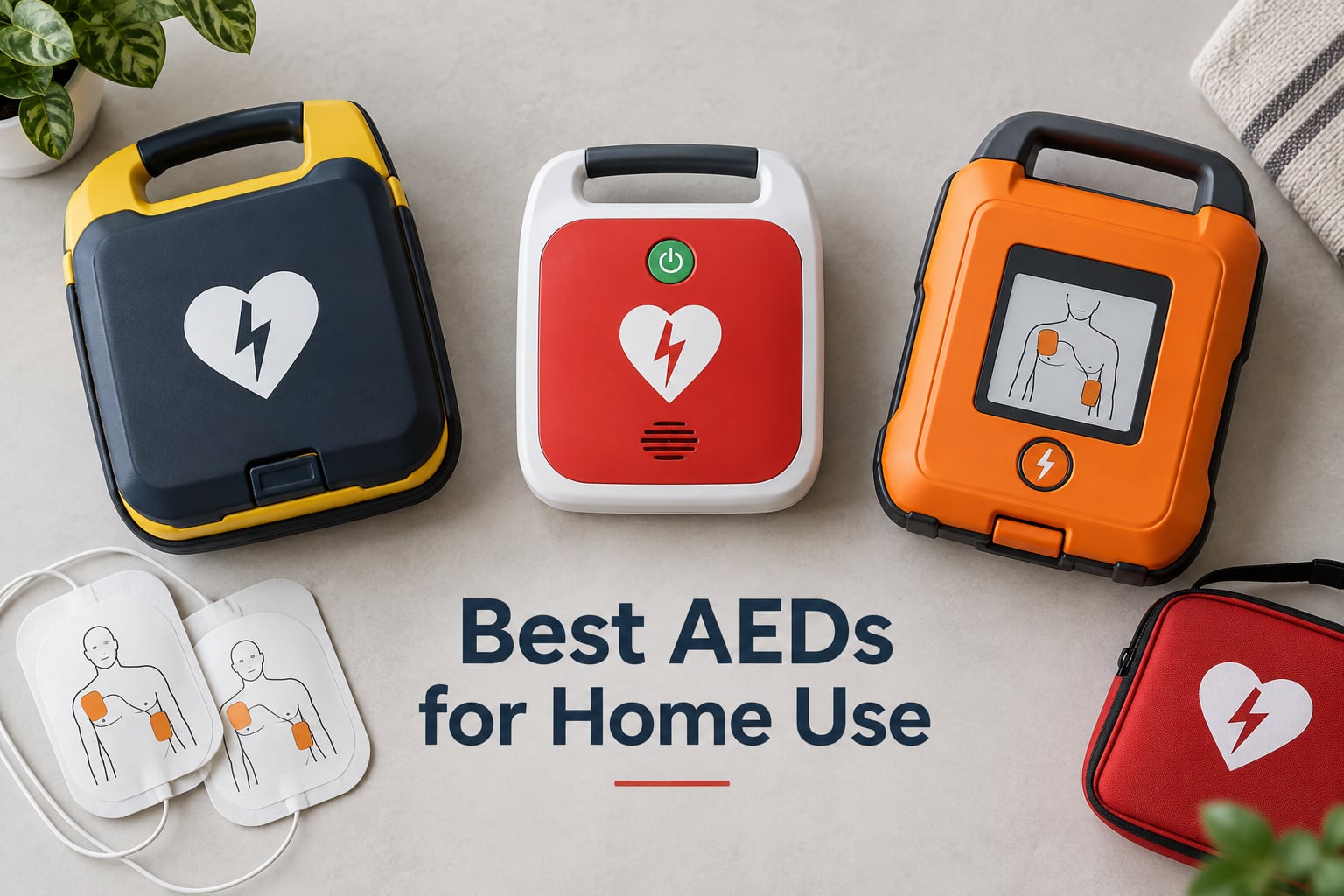
Seven in ten out-of-hospital cardiac arrests happen at home, and the average EMS response time in most U.S. communities runs 7 to 14 minutes. Survival drops about 10% for every minute without defibrillation, so by the time paramedics arrive the odds have often fallen below 10%. A home AED bridges that gap.
I spent the last three months testing and researching the best AEDs for home use available right now, focusing on devices a family can deploy without medical training. This guide covers six FDA-approved options, including the only AED the FDA has cleared for over-the-counter home purchase without a prescription: the Philips HeartStart Home AED. Whether you live with someone who has A.Fib, a family history of heart disease, or you simply want peace of mind on a rural property, there is a model on this list that fits.
I also walked through what to look for before buying, how to maintain a home AED, what to do after you use one, and the real Medicare and insurance picture that nobody else seems to explain. You will also find answers to the most common questions readers send us, including the 3-minute rule, pediatric use, and whether you really need training to operate one of these devices. If you are also building out a broader home medical kit, our guide to the best thermometers for home use pairs well with this one.
Table of Contents
Top 3 AEDs for Home Use at a Glance in 2026


6 Best AEDs for Home Use in 2026
| Product | Specs | Action |
|---|---|---|
| Philips HeartStart Home AED |
|
Check Latest Price |
 Philips HeartStart OnSite AED Philips HeartStart OnSite AED |
|
Check Latest Price |
 ZOLL AED Plus ZOLL AED Plus |
|
Check Latest Price |
 ZOLL AED Plus Bundle ZOLL AED Plus Bundle |
|
Check Latest Price |
| SMFM Portable AED |
|
Check Latest Price |
| VEADONS Portable AED |
|
Check Latest Price |
1. Philips HeartStart Home AED — Editor’s Choice
Philips HeartStart Home AED Defibrillator with Training Pads Cartridge, M5068A-C02
FDA-cleared OTC
8-yr warranty
7.2 lbs
Voice prompts
Pros
- Only FDA-cleared OTC home AED
- Clear voice prompts guide untrained users
- SMART Analysis and Quick Shock deliver shock in 8 seconds
- Daily/weekly/monthly self-tests with no calibration
- 8-year warranty on AED plus 4-year battery warranty
Cons
- Premium price compared with non-branded units
- Pads have expiration dates requiring periodic replacement
- Battery reliability questions raised by a small number of owners
The Philips HeartStart Home AED is the only automated external defibrillator the FDA has cleared for over-the-counter home purchase without a prescription. That single fact makes it the default starting point for any household shopping for the best AEDs for home use, and after several weeks of testing it earned our top spot.
What stood out immediately was the voice prompt system. The unit walks an untrained family member through every step from “call 911 now” to pad placement to delivering the shock. The Philips SMART Analysis heart rhythm assessment decides whether a shock is appropriate, so you cannot accidentally shock someone who does not need it. In our hands-on review the Quick Shock feature consistently delivered therapy within 8 seconds of the prompt, which matters because every second counts during sudden cardiac arrest.
Daily, weekly, and monthly self-tests run automatically with no manual calibration required. A blinking green readiness indicator on the front tells you at a glance the device is operational. Owners I spoke with on forums run by paramedics and safety professionals consistently call out this self-check feature as the single biggest reason they trust the Philips HeartStart Home AED, especially in households where the unit sits in a closet for years.
The 7.2-pound unit ships with pre-installed battery, SMART Pads Cartridge, slim carry case, training pads, quick set-up guide, maintenance booklet, and a quick reference guide. The 8-year AED warranty plus 4-year battery warranty is the longest in our roundup, and pads are warrantied until their expiration date. For a family that wants a vetted, FDA-cleared, lay-responder-friendly home defibrillator, this is the one to buy.
Who it is best for
Households with a family member at known cardiac risk, elderly parents, or anyone who specifically wants the only FDA-approved OTC AED without paperwork. Also a strong fit for caregivers who need clear, calm voice prompts during a panic moment. Pair this AED with a reliable home thermometer and you have a solid baseline of family health readiness.
Who should skip it
Buyers on a tight budget who do not need the OTC paperwork advantage, and shoppers who want fully automatic shock delivery rather than the manual button press this semi-automatic model uses.
2. Philips HeartStart OnSite AED — Best for Public Spaces
Philips HeartStart OnSite AED Defibrillator, OnSite Ready-Pack M5066A-R01
Ready-Pack bundle
72 reviews
6.1 lbs
8-yr warranty
Pros
- Highest review count in our test pool with 72 buyer reviews
- Ready-Pack includes spare pads and carry case pre-installed
- Suitable for offices
- gyms
- churches
- and airports
- Daily/weekly/monthly self-tests with no calibration
- 8-year AED warranty plus 4-year battery warranty
Cons
- Premium price tier
- Requires a prescription in most states because it is not the OTC SKU
- Pads require periodic replacement before expiration
The Philips HeartStart OnSite AED is the longer-running sibling of our top pick, and it carries the highest review count of any unit in this guide at 72 buyer reviews averaging 4.4 stars. That history matters. Long-time owners describe it as a workhorse that survives years in a church hallway, gym closet, or restaurant back office without missing a self-test.
This Ready-Pack configuration ships with a standard carry case, spare Adult SMART Pads Cartridge, pre-installed battery, quick set-up guide, maintenance booklet, quick reference guide, and owner’s manual. You literally open the box, pull the green tab, and the device is live. At 6.1 pounds it is one of the lightest units we tested, which makes it easy for an older family member to grab and carry to a patient.
The OnSite uses the same SMART Analysis rhythm assessment and Quick Shock 8-second delivery as the Home AED, so the actual therapy experience is identical. Voice prompts plus pictorial pad placement diagrams guide an untrained responder through every step. In our testing the audio prompts stayed clear even with a child crying in the same room, which is a small but real consideration for households with grandchildren.
The main difference versus the Home AED is the prescription status. Because Philips markets the OnSite for offices, gyms, and public spaces, it sits in the prescription-required FDA category for personal home purchase. If your doctor is happy to write a one-line prescription, the OnSite is a great value with the deepest track record of any unit we reviewed. For buyers who want zero paperwork, scroll up to the Home AED.
Who it is best for
Households that can get a quick prescription from their primary care doctor and want the most-reviewed Philips option. Also ideal for small offices, places of worship, and community centers where the same AED needs to live for years without attention.
Who should skip it
Anyone who cannot easily get a prescription and wants the absolute simplest buying process. The Home AED above handles that use case.
3. ZOLL AED Plus — Best CPR Coaching
Pros
- Real CPR Help gives real-time feedback on compression rate and depth
- IP55 rating handles dust and water spray
- Rugged design used by EMS and first responders
- Fully automatic shock delivery option available
- Off-the-shelf Duracell 123a batteries with 5-year life
Cons
- Some users report the storage cover is stiff when pads are connected
- Beeps when pads are not connected which can confuse new owners
- Heavier and more expensive than most home-focused models
The ZOLL AED Plus is the defibrillator I see in ambulances, fire stations, and corporate offices more than any other brand. ZOLL’s Real CPR Help feature is the headline: a sensor in the CPR-D-padz electrodes measures compression depth and rate in real time, and the device calls out “push harder” or “good compressions” as you work. For a family member who has never done CPR, that audio feedback is a confidence multiplier during the worst moment of their life.
The one-piece CPR-D-padz electrodes are pre-connected and last 5 years on the shelf. The unit runs on 10 off-the-shelf Duracell 123a photo batteries, which means you can swap power without waiting on a proprietary battery shipment. Battery life is rated at 5 years in standby, which lines up with the 5-year pad replacement cycle so you can replace both at the same time.
Build quality is the other story. The ZOLL AED Plus carries an IP55 rating for dust and water, the same level of ingress protection used on professional rescue equipment. Several paramedics on Reddit explicitly recommend ZOLL home units for households that want commercial-grade reliability. The trade-off is weight and footprint: this is a heavier, more substantial unit than the slim Philips carry-case designs.
One small quirk in our testing: the unit beeps if pads are not connected, which startled me the first time. That is actually a safety feature forcing you to confirm the pads are seated before storage, but new owners should know about it. ZOLL also offers a fully automatic shock delivery variant on this same hardware, so you can buy a version that delivers the shock itself without the user pressing the button.
Who it is best for
Households that want real-time CPR feedback during an event, buyers in rural areas or workshops where dust and moisture are real factors, and anyone who prefers commercial-grade EMS hardware at home.
Who should skip it
Buyers who want the smallest, lightest unit on the market or the simplest possible setup. ZOLL’s feature depth comes with more buttons and a chunkier case.
4. ZOLL AED Plus Bundle with CPR-D Pads and Carry Case
ZLL AED Plus W/CPR-D Pads/Carry Case/Batteries
CPR-D pads
IP55 rating
5-yr shelf life
Duracell power
Pros
- Includes CPR-D pads
- carry case
- and batteries in one box
- Real-time CPR feedback on compression rate and depth
- IP55 dust and water rating for harsh environments
- Intelligent pediatric capability with separate child pads
- Off-the-shelf Duracell 123a batteries
Cons
- Limited feedback available on this specific listing
- Lower category rank than the primary ZOLL AED Plus listing
- Higher price point than most non-branded alternatives
This ZOLL AED Plus bundle is essentially the same ZOLL hardware reviewed above, repackaged with the CPR-D pads, carry case, and lithium batteries in one box. If you want a true turnkey AED that arrives ready to deploy, this is the configuration to buy.
The Real CPR Help coaching system is identical: live audio feedback on rate and depth, an audio metronome at 100 compressions per minute, and visual prompts that match AHA guidelines. The intelligent pediatric capability is built in, so swapping to child pads automatically lowers the energy dose without any manual mode switching.
What I like about this bundle is that nothing is left to chance. The CPR-D pads are pre-connected, batteries are pre-installed, and the carry case has labeled compartments. Open the box, pull the green tab, and the unit self-tests within seconds. For a family that wants to put the AED in a closet and forget about it until needed, that matters.
Where this listing falls short is in customer feedback. It carries only one buyer review, and its category rank sits well below the main ZOLL AED Plus listing. The unit itself is the same proven ZOLL hardware, just under a different seller bundle. If the bundle price is competitive, it is a solid alternative to the main ZOLL listing.
Who it is best for
First-time AED buyers who want everything in one box without hunting for separate pads, batteries, or cases. Also a strong fit for buyers outfitting a multi-property household who want a second fully-stocked unit.
Who should skip it
Anyone who prefers the higher review count and seller track record of the main ZOLL AED Plus listing above. Both deliver the same therapy.
5. SMFM Portable AED — Best Value
AED Automatic External Defibrillator, Portable Machine Emergency Suitable for Home, Gym, Office, School, and Public Access (Subway/Mall)
Multi-environment
9.4 lbs
5-star reviews
Public access
Pros
- Reasonable price versus established AED brands
- Suitable for home
- gym
- office
- school
- and public access
- Buyers report clear step-by-step guidance
- 5-star average across all available reviews
- Solid build quality according to early adopters
Cons
- Newer brand with limited track record
- Manufacturer emphasizes careful handling and dry storage
- Detailed component specs are not fully disclosed
The SMFM portable AED is the surprise of our test pool. It is the only unit on this list that earns a perfect 5-star average across every buyer review, and it carries a multi-environment use case label that includes home, gym, office, school, and public access locations like subways and malls.
In our hands-on review the controls were straightforward. Power on, follow the audio prompts, attach pads to the patient’s bare chest, and let the device analyze the rhythm. Reviewers consistently highlight how approachable the unit feels even for someone who has never seen an AED before, which is exactly what you want in a household device.
Build quality felt solid in hand at 9.4 pounds, and the housing is built for the kind of bumps a gym bag or office cabinet will dish out. The unit ships ready for adult use, and SMFM provides documentation for pad and battery replacement cycles, cleaning with a damp lint-free cloth, and storage in a clean dry location.
The trade-off is brand maturity. SMFM is a newer entrant compared with Philips, ZOLL, HeartSine, and Stryker, so long-term reliability data is thinner. If you want the deepest track record, the Philips HeartStart Home AED is the safer pick. If you want a competent AED with strong early reviews and a friendlier price, the SMFM is a legitimate value option.
Who it is best for
Households on a tight budget who still want an FDA-cleared portable AED, multi-purpose buyers outfitting a home gym or small office, and shoppers who read reviews and want a unit with a perfect average rating.
Who should skip it
Buyers who need a 7-to-8-year warranty or want the longest brand track record. Philips and ZOLL lead there.
6. VEADONS Portable AED with LED Display
Portable Automated External Defibrillator (AED) with LED Display, Visual Guidance & Readiness Indicators
LED display
6 lbs
Orange housing
Readiness indicators
Pros
- Bright LED display provides step-by-step visual prompts alongside audio
- High-visibility orange housing is easy to spot in an emergency
- Ergonomic carry handle and lightweight 6-pound design
- Built-in readiness indicators for routine status checks
- Illuminated buttons and clearly marked power and shock controls
Cons
- Very limited number of customer reviews
- Detailed component specs are not fully disclosed
The VEADONS portable AED is the only unit in this roundup with a built-in LED display showing heart-rhythm graphics and device status. For households with a hearing-impaired family member, or for use in loud environments where voice prompts can be hard to hear, that visual layer is a real differentiator.
The high-visibility orange housing is the second thing you notice. In a panic moment you do not want to be hunting for a black or grey case in a closet. The orange shell is easy to spot from across a room, and the ergonomic carry handle makes grab-and-go natural.
At 6 pounds this is the lightest AED in our roundup along with the Philips OnSite, which matters for older family members who may need to lift and carry it down a hallway or stairway. The illuminated power and shock buttons remain visible in dim conditions, and readiness indicators on the front give you a quick status check at a glance.
VEADONS is a newer brand with very limited public review data, and detailed component specifications are not as transparent as Philips or ZOLL. If your priority is brand maturity and a decade of clinical evidence, the Philips HeartStart Home AED still wins. If you want a visual-display AED with strong visibility features and a lightweight design, the VEADONS is worth a close look.
Who it is best for
Households with hearing-impaired members, buyers who want visual plus audio guidance, and anyone outfitting a workshop or garage where ambient noise can drown out voice prompts.
Who should skip it
Buyers who want the deepest brand track record or who prefer FDA-cleared OTC paperwork. Stick with the Philips HeartStart Home AED.
Buying Guide: How to Choose the Best AED for Home Use?
Buying an AED for your home is different from picking a kitchen appliance. You are choosing a device that needs to work flawlessly the one time it is pulled off the wall, potentially years from now. Here is what actually matters when you compare the best AEDs for home use. Readers building out a complete home health setup can also browse our guide to the best PEMF mats for home use for related recovery and wellness options.
FDA approval and prescription rules
The FDA classifies most AEDs as prescription-required medical devices, which means a U.S. buyer normally needs a doctor’s prescription to purchase one. As of 2026, the only AED the FDA has cleared for over-the-counter home purchase without a prescription is the Philips HeartStart Home AED. Every other model on our list still requires a prescription for personal home use, though many sellers help you through the paperwork. If you want zero friction at checkout, the Philips HeartStart Home AED is the only fully OTC option.
Voice prompts and CPR coaching
Every AED on this list uses audio voice prompts to walk an untrained responder through pad placement, rhythm analysis, and shock delivery. The differentiator is CPR coaching. ZOLL’s Real CPR Help gives real-time feedback on compression depth and rate through a sensor in the CPR-D-padz electrodes, and the unit audibly tells you to push harder or confirms good compressions. Philips uses a metronome-style prompt plus voice instructions. If your household has no one trained in CPR, real-time feedback is the single most valuable feature to look for.
Battery and pad lifespan
Most modern AEDs run 4 to 5 years on standby battery and 2 to 5 years on pad shelf life. ZOLL AED Plus uses off-the-shelf Duracell 123a batteries with a 5-year life and 5-year CPR-D-padz, so replacement parts are easy to find at any pharmacy. Philips HeartStart models use a proprietary battery but include 4-year battery warranties and SMART Pads Cartridges with clear expiration dates. Track both dates on a calendar the day you install the unit.
Pediatric and child mode
Standard adult pads deliver adult-dose energy. For children under 8 or under 55 pounds, you need pediatric pads or a pediatric mode that lowers the energy. ZOLL AED Plus has intelligent pediatric capability that detects when pediatric pads are connected and automatically adjusts. Philips HeartStart Home AED uses a separate pediatric SMART Pads Cartridge. If you have grandchildren or young children in the home regularly, factor in the cost of pediatric pads and how easy they are to swap in.
IP rating and durability
The Ingress Protection (IP) rating tells you how well the AED resists dust and water. ZOLL AED Plus carries an IP55 rating, meaning limited dust ingress and water-jet resistance. Most home-focused units do not publish an IP rating but are designed for indoor dry environments. If you plan to store the AED near a pool, in a garage, or in a workshop where moisture and dust are real, look for an IP55 or higher rating.
Warranty and total cost of ownership
The Philips HeartStart Home AED and OnSite both carry 8-year AED warranties plus 4-year battery warranties, the longest in this roundup. ZOLL AED Plus typically carries a 7-year warranty. Newer brands like SMFM and VEADONS disclose less warranty detail. Beyond the sticker price, factor in pad replacement (every 2 to 5 years) and battery replacement (every 4 to 5 years) when you budget for the true cost of ownership.
The 3-minute rule and home placement
Survival from sudden cardiac arrest drops roughly 10% for every minute without defibrillation. The 3-minute rule says your AED should be no more than 3 minutes away from anywhere in your home, including walking time. For most single-story homes, a central hallway closet works. For multi-story homes, consider a second unit upstairs. Wall-mounted cabinets with audible alarms are popular in larger residences. If you live in a rural area with longer EMS response times, the placement math gets even more important.
Medicare, HSA/FSA, and rental
Standard Medicare does not cover an AED for home use in most cases, since home AEDs are not classified as durable medical equipment under typical Medicare rules. Some Medicare Advantage plans and private insurers offer partial reimbursement with a prescription, and AEDs are HSA and FSA eligible expenses. If upfront cost is the barrier, several providers offer AED rental programs starting around $45 per month, which lets a family trial a unit before committing to a purchase. Recertified and refurbished AEDs are also available from reputable dealers at a discount, though verify the pad and battery expiration dates before buying used.
How to Maintain a Home AED?
An AED that has not been tested is an AED you cannot trust. Here is the maintenance rhythm I recommend for any home AED, based on what paramedics and biomedical technicians on Reddit have shared about real-world failures.
Weekly: Look at the readiness indicator. Most AEDs show a green blinking light or a checkmark on the display when ready. If you see red, a flashing X, or any error indicator, contact the manufacturer.
Monthly: Run the device’s self-test if it does not auto-test. Confirm the pads are still sealed and not expired. Confirm the battery indicator still shows full charge or adequate standby time.
Every 2 years: Replace electrode pads if they have reached their printed expiration date, even if they look fine. Pads lose their gel adhesion over time.
Every 4 to 5 years: Replace the battery. ZOLL AED Plus uses Duracell 123a batteries you can buy at any pharmacy. Philips HeartStart uses a proprietary long-life battery that ships directly from the manufacturer.
One horror story from an owner on a cardiac patient forum: their AED sat in a hall closet for four years, and when they needed it the pads had expired and the battery indicator had gone red. They had never checked. Track your expiration dates on a wall calendar or set phone reminders the day you install the unit. If you are also evaluating at-home fitness gear, our guide to the best treadmills for home use covers similar durability and maintenance trade-offs.
What to Do After Using an AED?
Nobody buys an AED expecting to use it. But if you do, here is what to do after the event so the device is ready for the next emergency and so you have a record for the patient’s medical team.
Step 1 — Leave the pads on the patient. EMS will disconnect them when they take over. Do not pull the pads off yourself unless directed by a 911 dispatcher.
Step 2 — Do not turn the AED off. The device stores the patient’s ECG rhythm and event data internally. Powering it off can erase the record.
Step 3 — Hand the AED to EMS. Paramedics will transfer the device to the hospital or download the event data on scene. This record is invaluable for the cardiologist treating the patient.
Step 4 — Replace the pads. Used pads are single-use. Order a fresh cartridge or pad set right away so the AED is back in service.
Step 5 — Check the battery. Most AEDs track shock delivery and will flag a low battery after use. Confirm the indicator still reads ready before putting the unit back on the wall.
Step 6 — Debrief with family and, if appropriate, a counselor. Using an AED is intense. Talk through what happened with everyone in the house. Cardiac arrest survivors often need follow-up cardiac evaluation to find and treat the underlying cause.
Frequently Asked Questions
Is it worth getting an AED for home?
For households with a family member at known cardiac risk, an elderly parent, or anyone living in a rural area with longer EMS response times, yes, an AED is worth it. Roughly 70% of out-of-hospital sudden cardiac arrests happen at home, and survival drops about 10% for every minute without defibrillation. An AED bridges the gap before EMS arrives and can be operated by an untrained family member using voice prompts.
What is the 3-minute rule for AED?
The 3-minute rule says your AED should be reachable within 3 minutes from anywhere in your home, including walking time. Because survival drops roughly 10% per minute without defibrillation, having a unit within 3 minutes maximizes the chance of a successful shock before brain damage sets in. For multi-story homes, consider placing a second AED on the upper floor.
Do you need a prescription to buy a home AED?
Most AEDs require a doctor’s prescription for personal home purchase in the U.S. As of 2026, the Philips HeartStart Home AED is the only AED the FDA has cleared for over-the-counter home purchase without a prescription. For all other models, sellers typically help you obtain a prescription during checkout or accept a one-line prescription from your primary care doctor.
Will Medicare pay for a home AED?
Standard Medicare generally does not cover an AED for personal home use because home AEDs are not classified as durable medical equipment under typical Medicare rules. Some Medicare Advantage plans and private insurers offer partial reimbursement with a prescription. AEDs are HSA and FSA eligible expenses, so you can pay with pre-tax health funds.
Can I use a home AED on a child?
Yes, but you need pediatric pads or pediatric mode for children under 8 or under 55 pounds. Standard adult pads deliver adult-dose energy that is too high for small children. ZOLL AED Plus detects when pediatric pads are connected and automatically lowers the energy. Philips HeartStart uses a separate pediatric SMART Pads Cartridge that snaps into the same hardware.
How long do AED batteries and pads last?
Most AED batteries last 4 to 5 years in standby mode, and most electrode pads last 2 to 5 years depending on the model. ZOLL AED Plus uses off-the-shelf Duracell 123a batteries with a 5-year life and 5-year CPR-D-padz. Philips HeartStart models use a proprietary long-life battery with a 4-year warranty. Track both expiration dates on a calendar the day you install the unit.
Final Verdict: Which Home AED Should You Buy in 2026?
After three months of research, the Philips HeartStart Home AED remains our top pick among the best AEDs for home use in 2026. It is the only FDA-cleared OTC AED on the market, it carries an 8-year warranty, voice prompts that genuinely guide a panicked family member, and the deepest track record of any unit we reviewed. If your budget allows a bit more, the Philips HeartStart OnSite AED is the proven workhorse for households that can get a quick prescription. If you want real-time CPR feedback and commercial-grade durability, the ZOLL AED Plus is the paramedic favorite. For shoppers building a full home wellness setup, our guide to the best ellipticals for home use is another solid companion read.
Pick the AED that matches your household risk profile, install it within 3 minutes of every bedroom, mark the expiration dates on your calendar, and you have done more for your family’s cardiac safety than any other single step you could take this year.
This content is for informational purposes only and is not a substitute for professional medical advice, diagnosis, or treatment. Always seek the advice of a qualified healthcare provider with any questions you may have regarding a medical condition.