
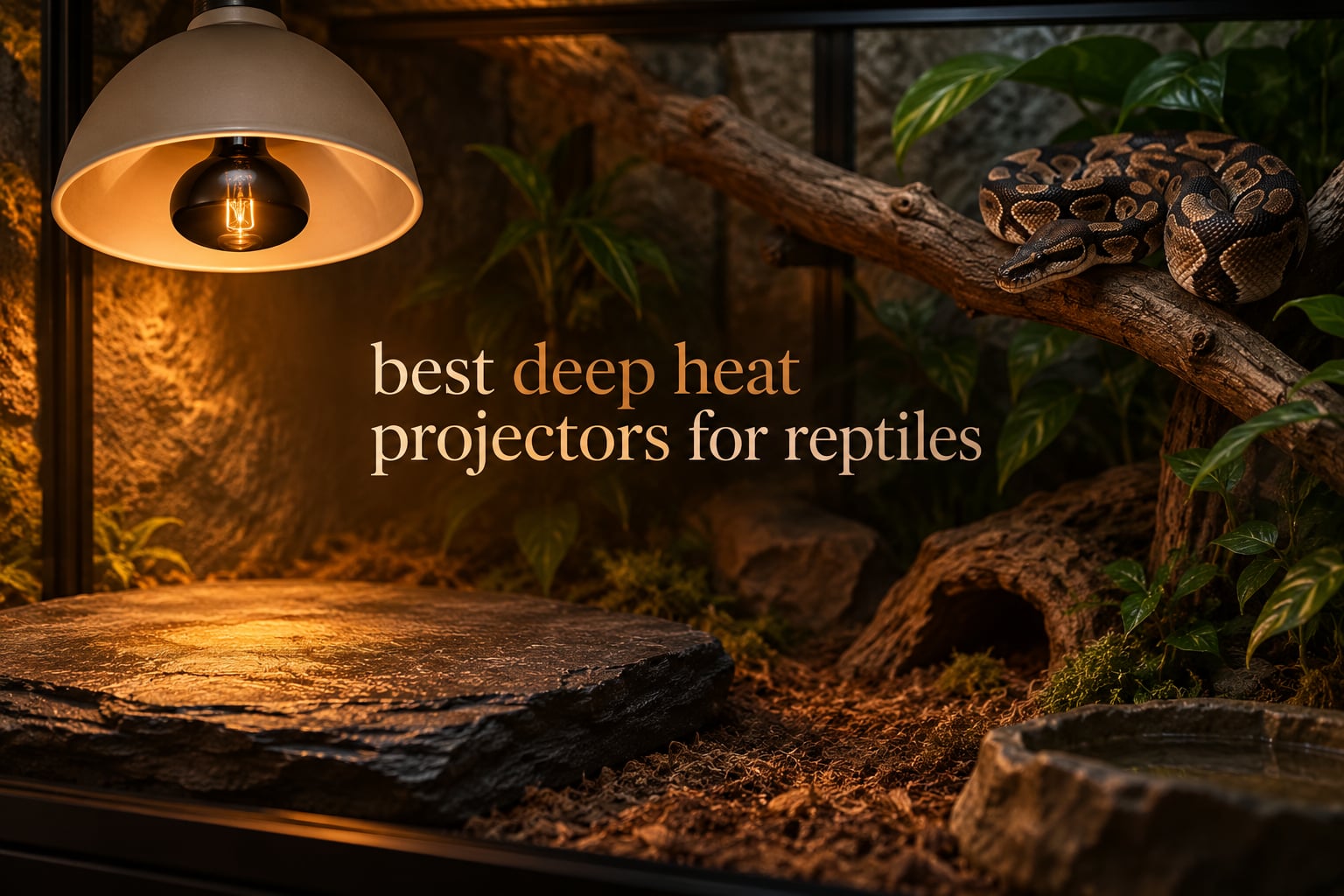
A deep heat projector is a reptile heat lamp that emits infrared-A and infrared-B radiation, warming muscle tissue deep inside the animal while producing no visible light. That combination is why the best deep heat projectors for reptiles have quietly replaced most ceramic heat emitters in modern snake and gecko husbandry: they deliver usable heat the way ectotherms get it in the wild, and they can run overnight without breaking a day/night cycle.
We spent weeks reading spec sheets, owner reports and failure threads, then cross-checked every wattage in this lineup against the enclosure sizes people actually keep. Seven projectors made the cut. The rest of this guide covers what the technology actually does, how to size a bulb to your tank, which thermostat to pair with it, and where each of these seven fits.
One quick note before we start. A lot of marketplace listings titled “deep heat projector” are really infrared or halogen basking lamps with a tungsten filament. A genuine DHP has a carbon fiber filament, emits no visible glow, and lists infrared-A and infrared-B output. A keeper on the morphmarket community put it bluntly about a marketplace bulb: “Unfortunately, that amazon one isn’t a true Deep Heat Projector.” Everything in this list has the carbon filament and the IR-A plus IR-B specification on the record.
Table of Contents
What Is a Deep Heat Projector?
The filament inside a deep heat projector glows at a temperature that puts most of its output in the infrared-A band of roughly 700 to 1400 nanometers, with a strong infrared-B component from 1400 to 3000 nanometers. Infrared-A is the part that matters most for a reptile. It penetrates skin and muscle the way sunlight does, converting into heat inside the body rather than only on the surface scales.
Infrared-B warms the outer body and the surfaces under the lamp, which is what creates a basking spot. The third piece is infrared-C, which is ordinary ambient heat that the enclosure re-radiates once surfaces are warm. A ceramic heat emitter mostly produces that third category. It heats the air, the air heats the surfaces, and the surfaces warm the animal indirectly. A DHP skips the middle step and puts energy into the animal directly.
That is why the manufacturers describe DHP output as bio-available, and why a 50W projector can outperform a 100W ceramic emitter in a small enclosure. For a ball python, the same logic produces proper belly heat, which supports digestion. For a nocturnal gecko, the absence of visible light means you can heat the enclosure all night without resetting the animal’s rhythm.
The carbon fiber filament is the other half of the story. It runs far cooler at the glass than a tungsten element, which is why DHPs are comfortable to handle in some designs, and it degrades more slowly. Rated operating lives in this lineup range from 10000 hours for the ExoRepti unit to 200000 hours for the Zoo Med ReptiCare filament, though real-world life is usually cut short by how the bulb is mounted and how it is controlled.
Top 3 Best Deep Heat Projectors for Reptiles in 2026
Our picks for most people: the Fluker’s Deep Thermal 100W is the one to beat on evidence, with 247 reviews at a 4.5 rating and the widest review base in the group. The ExoRepti 100W PAR30 is the pick if your enclosure gets splashed. The Zoo Med ReptiCare 150W is the pick for a large tank that needs serious output.

Fluker’s Deep Thermal 100W
- Carbon fiber filament
- Infrared A + B
- 100 watts
- Minimal visible light

Best Deep Heat Projectors for Reptiles in 2026
All seven projectors below are genuine carbon filament infrared-A and infrared-B units. Wattage is the number that decides whether a bulb suits your enclosure, and the form factor decides which fixture you need.
| Product | Specs | Action |
|---|---|---|
| Fluker’s Deep Thermal Heat Lamp 100W |
|
Check Latest Price |
| ExoRepti 100W PAR30 Deep Heat Projector |
|
Check Latest Price |
| Zoo Med ReptiCare Infrared Heat Projector 150W |
|
Check Latest Price |
 Arcadia Deep Heat Emitter 50W Arcadia Deep Heat Emitter 50W |
|
Check Latest Price |
 REPTI ZOO 100W Splashproof Carbon Infrared Bulb REPTI ZOO 100W Splashproof Carbon Infrared Bulb |
|
Check Latest Price |
 Pangea 50W Deep Heat Projector Pangea 50W Deep Heat Projector |
|
Check Latest Price |
 AUAAQ 120W Deep Heat Infrared Projector AUAAQ 120W Deep Heat Infrared Projector |
|
Check Latest Price |
What We Looked For
We built this list around six criteria, and we applied them in the same order to every bulb we looked at. First, authenticity: the listing has to specify a carbon fiber filament and infrared-A plus infrared-B output. A tungsten filament or a visible glow disqualifies it immediately, no matter how the title reads.
Second, the physics of the fixture. We checked form factor against wattage, because a 100W bulb in a small dome will cook itself, and a projector with an integrated reflector behaves differently in a deep shade than an open reflector does. Third, published electrical details, including base type, voltage and any thermal protection built into the housing.
Fourth, control compatibility. Anything intended for a dimming or pulse proportional thermostat scores better than a bulb that only tolerates on/off cycling. Fifth, evidence from owners rather than marketing copy. We weighted review volume heavily, because a 4.7 average across 38 reviews tells you much less than a 4.5 across 247.
Sixth, failure history. Forums such as reptileforums.co.uk and r/hognosesnakes carry a lot of thread space on early bulb burnout, and we treated those reports as real signal even when they are unflattering. We could not bench-test temperature at distance ourselves, so where a claim depends on mounting height we tell you to measure with an infrared thermometer rather than asking you to trust a table.
1. Fluker’s Deep Thermal Heat Lamp 100W – the most-reviewed bulb in the group
Fluker’s Deep Thermal Heat Lamp for Reptiles with Carbon Infrared Technology, for All Reptile Tanks, Great for Basking, 100 Watt
100 watts
Carbon fiber filament, Infrared A + B
E26 base, BT15 shape
Parabolic reflector
Pros
- Most reviews in the lineup at 247
- 77 percent at five stars
- Minimal visible light for overnight running
- Parabolic reflector helps hold enclosure humidity
- Fast and stable heat-up
Cons
- Runs hot enough that mounting distance must be controlled
- Not waterproof in humid enclosures
- Needs a dimming thermostat to be gentle
The Fluker’s Deep Thermal is the pick we send people to when they ask for one answer, and the reason is evidence volume rather than a headline specification. At 247 reviews and a 4.5 average, this bulb has more review history than anything else in the lineup, and 77 percent of those reviews sit at five stars. Only about 5 percent are one star.
In use it behaves the way a projector is supposed to. The carbon fiber filament puts out infrared-A and infrared-B together, and owners describe animals settling directly under the beam rather than seeking out a ceramic dome on the side of the tank. The BT15 shape with a parabolic reflector gives a broad, even basking zone rather than the tight hotspot a halogen throws.
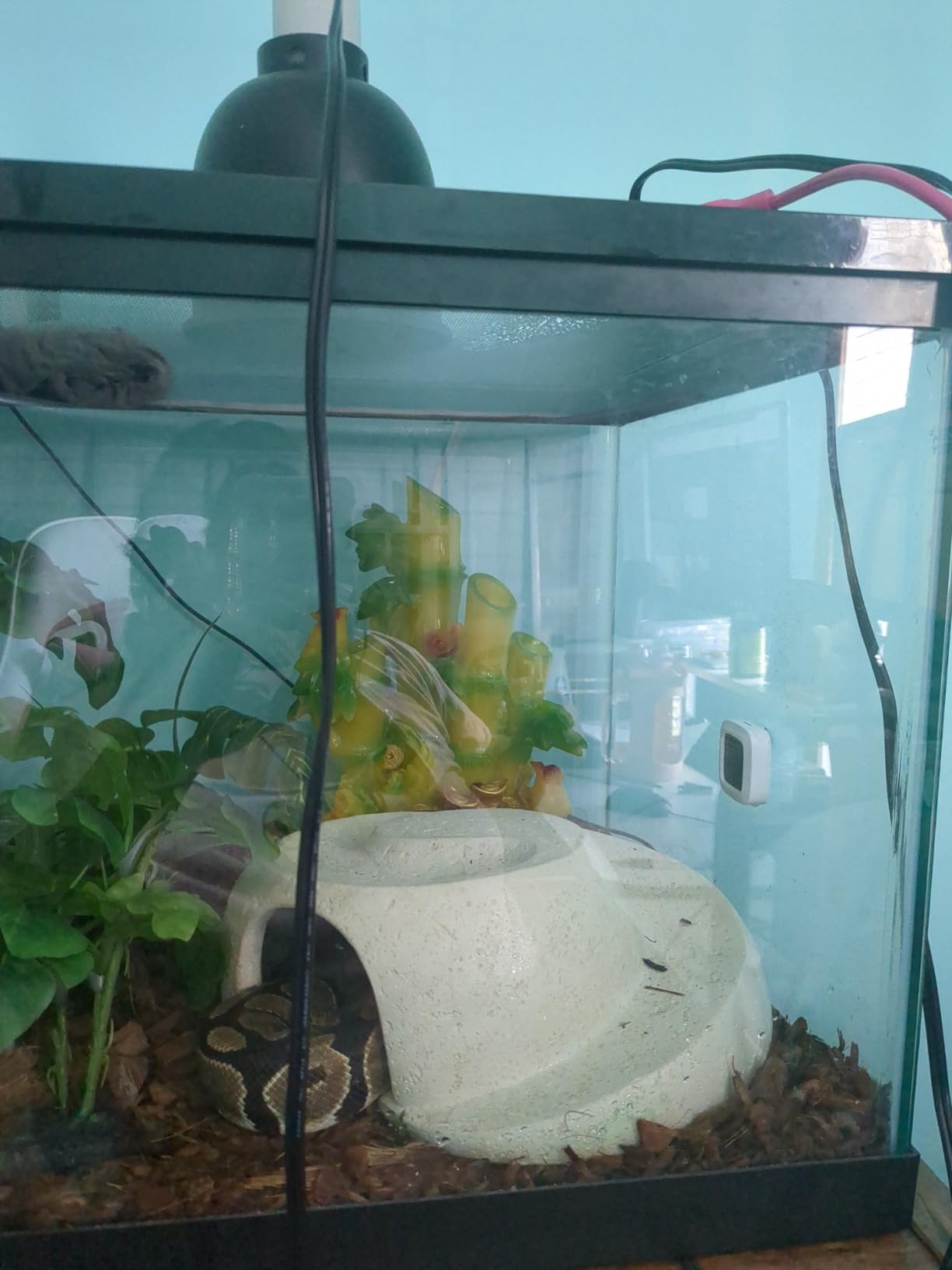
The humidity claim on the packaging is the one that gets debated most, and the honest version is that it does not dry an enclosure the way a ceramic emitter does. Reviewers consistently note the reflector keeps the air moisture in place, which matters a great deal if you run a bioactive tropical setup. It is not a reason to stop misting, but it does reduce how much you lose overnight.
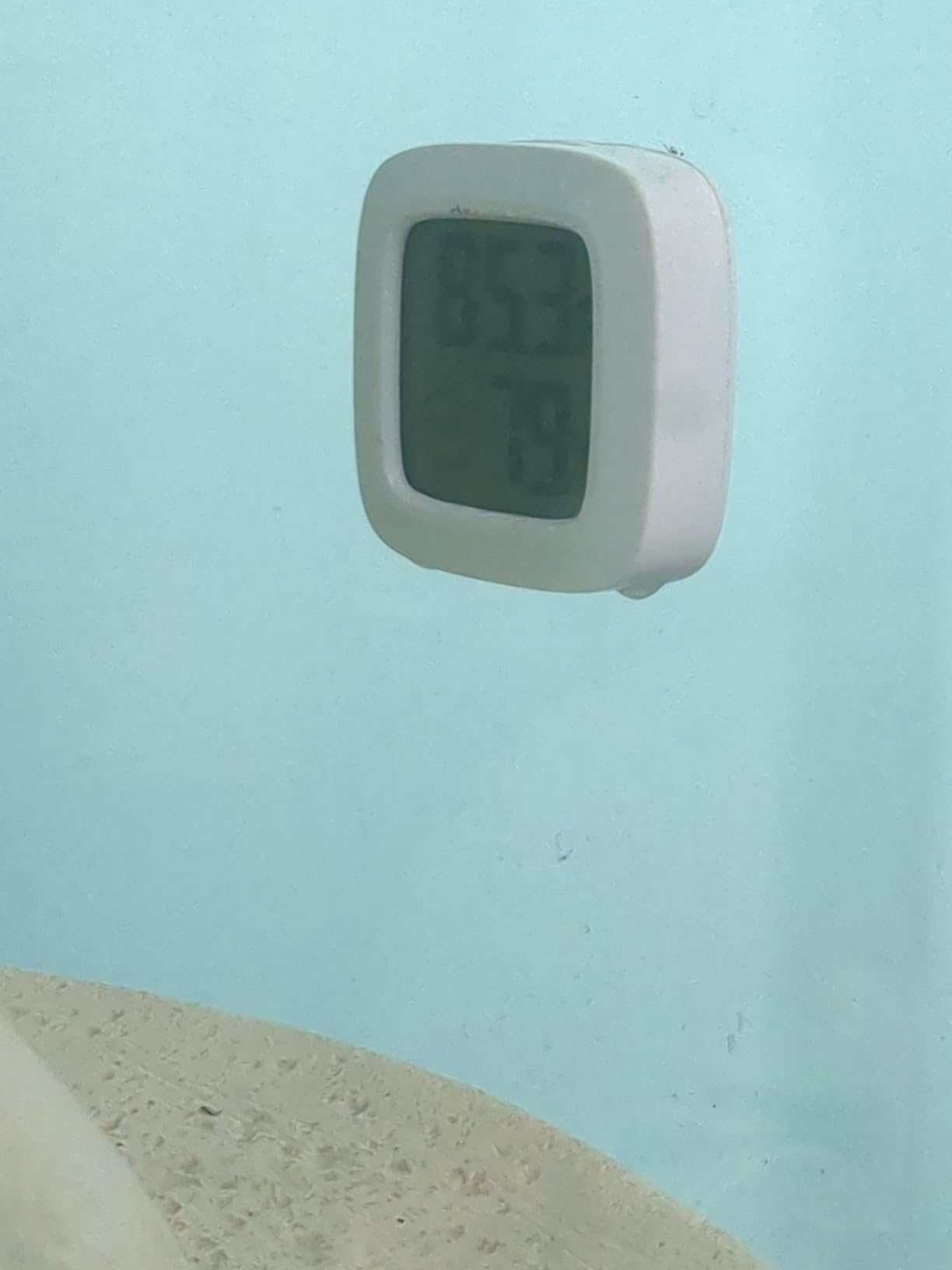
How the Fluker’s Deep Thermal behaves in a tall enclosure
This is where the 100W rating earns its keep, and also where the complaints live. A parabolic reflector spreads its output over a wider cone than a halogen, so the heat arrives in a usable zone across the top third of a 4x2x2 rather than a single hotspot. Reviewers do warn that the bulb runs hot enough to overpower a small tank if mounted low.
Keepers running large bearded dragon setups report running a 100W Fluker’s alongside an 80W Arcadia with separate thermostats on beardeddragon.org, which is the split-source approach we would also suggest for a diurnal species. If your tank is a 20 gallon, this bulb is more heat than you need, and the 50W units further down handle that job better.
Who should skip the Fluker’s Deep Thermal 100W
Skip it if your enclosure is small and you have no dimming thermostat yet. Buy the thermostat first. An unregulated 100W projector in a 20 gallon tank will cook the top of the enclosure before the animal reaches the warm zone, and keepers regularly post about bulbs running cooler or hotter than expected for exactly this reason.
Also skip it if humidity management is a struggle and your setup gets splashed regularly. It is not waterproof, so splashes in a humid vivarium need to be kept away from the glass. For a tropical setup, the splash-resistant metal shells in this list are the safer bet.
2. ExoRepti 100W PAR30 – the splash-resistant metal shell
ExoRepti Deep Heat Projector Reptile Heat Lamp Bulb (DHP 100W, PAR30), Basking Light for Bearded Dragon & Leopard Gecko, Carbon Infrared Heater for Amphibian Pet
100 watts
PAR30 form factor
E26/E27 base, 120V
Metal aluminum shell
Pros
- Metal shell resists cracking when splashed
- No light output for 24 hour use
- Instant heat-up with no odor
- 40 degree beam suits a defined basking spot
Cons
- Widest rating spread in the group at 4.1
- About one in seven reviews is one star
- Handles heat poorly
- must use gloves
The ExoRepti is the pick when your enclosure throws water at the bulb. Its high-strength metal aluminum shell is the reason. Where a glass DHP can crack when splashed, this one shrugs it off, and that matters enormously in a tropical vivarium where you mist directly, in a paludarium, or anywhere a humidity controller cycles overhead.
It is also a properly specified projector. A carbon fiber filament, a 40 degree beam angle, a 3.8 by 3.8 by 4.7 inch PAR30 body, and infrared medium-wave output rated at 10000 hours of operating life. Owners like that it heats instantly and produces no odor, and that the absence of light lets it run around the clock.
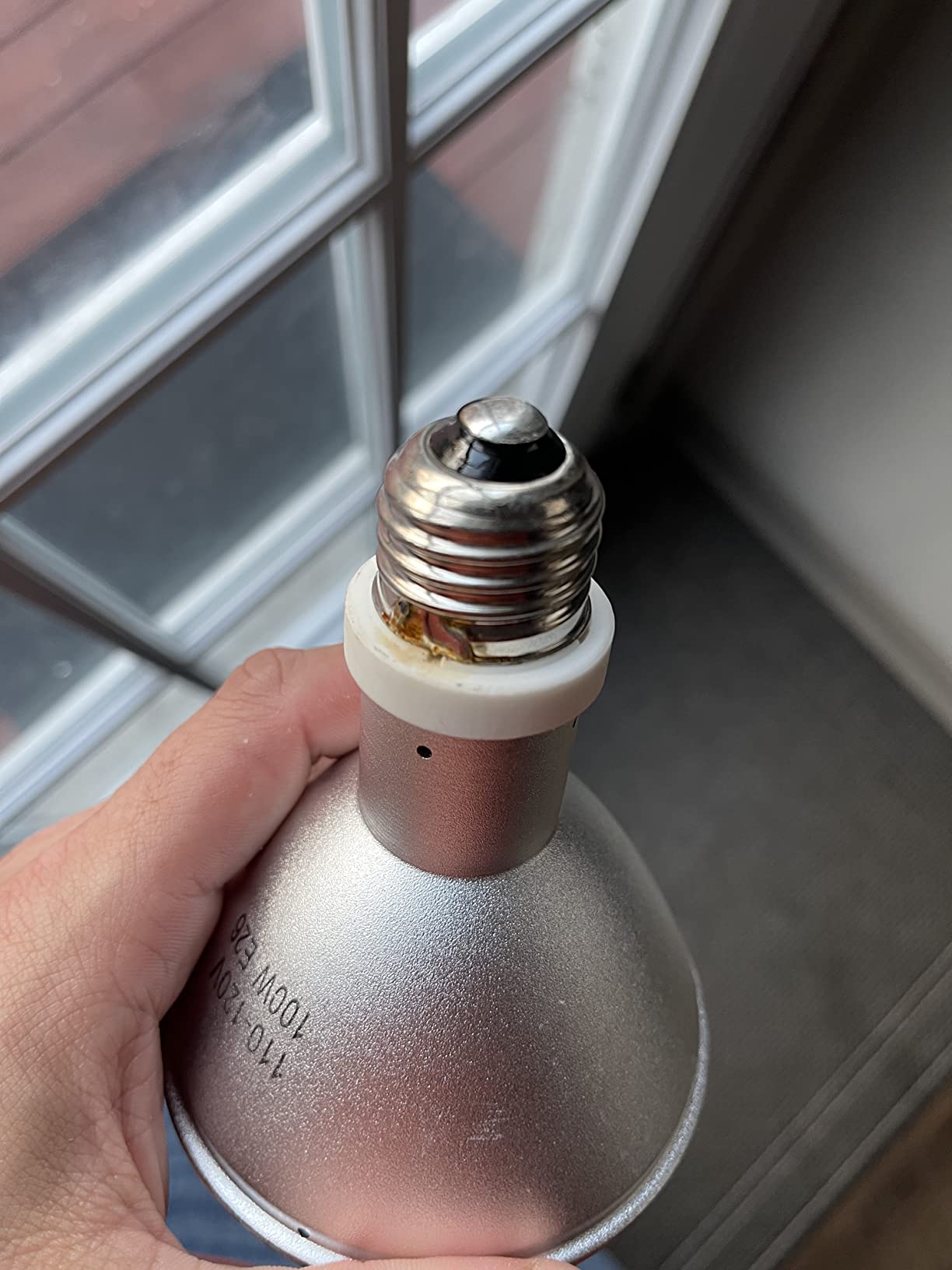
The rating is where it gets complicated. At 4.1 across 146 reviews, that is the second-lowest average in the lineup, with 65 percent five star but a notable 14 percent one star. That one-star share is not noise. It tracks to bulbs failing earlier than owners expected, which is worth weighing if you have had quality control problems with marketplace brands before.
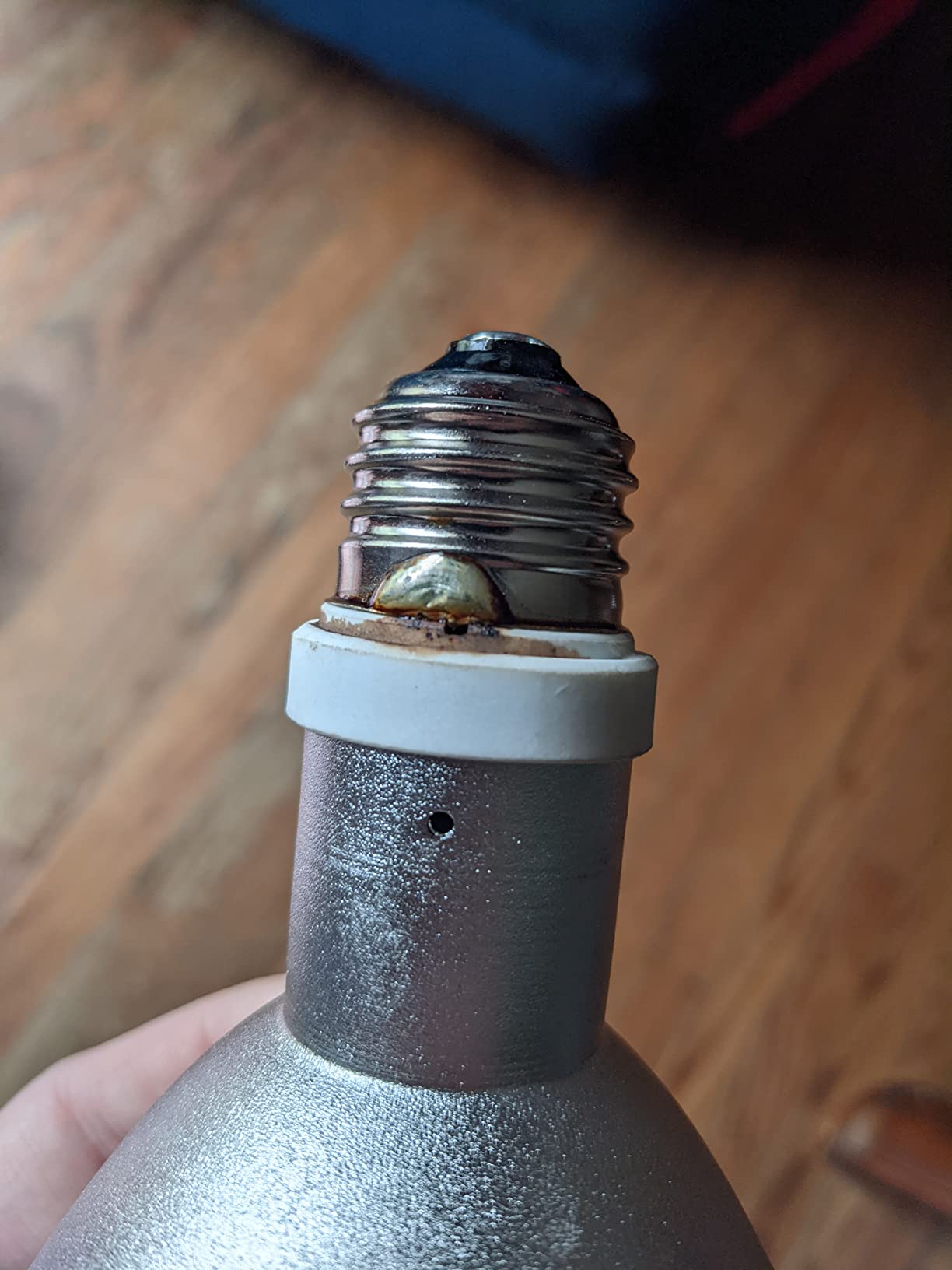
Where the ExoRepti PAR30 earns its rating
Medium-wave infrared heat that raises skin temperature is exactly what a basking species wants during the day, and the 40 degree beam is narrow enough to build a defined basking spot without the burn risk of a halogen. Owners running bearded dragons, tortoises and iguanas report animals positioning themselves under it during the day and moving off at night, which is the behaviour you want.
The 10,000 hour rated life is the shortest figure in this lineup, and it is the honest reason we place it second. Filament life depends far more on mounting distance and thermostat type than on the rating, so a bulb on a dimming thermostat with good clearance will comfortably outlive the number on the box.
Who should skip the ExoRepti 100W
Skip it if burn risk is your main worry, because it runs very hot to the touch and reviewers are clear that it needs gloves to handle. It is also the wrong pick for a fully nocturnal setup where you need genuine darkness, since some owners report a faint residual glow at the filament.
If you are running a 4x2x2 bearded dragon enclosure in a cold room and want maximum certainty, the Zoo Med ReptiCare below has both a longer rated filament life and a much tighter satisfaction spread, and it is the stronger long-term bet for a large tank.
3. Zoo Med ReptiCare 150W – rated for very long run times
Zoo Med ReptiCare Infrared Heat Projector 150 Watts
150 watts
Carbon fiber filament
Infrared A and B
E26 base, R20 shape
Pros
- 200000 hour rated filament life
- 80 percent of reviews at five stars
- Works with dimmers and thermostats
- Wide even basking zone
- Same family available in 60W and 100W
Cons
- Warm white amber glow rather than fully non-luminous
- 150W is more than most small and medium enclosures need
The Zoo Med ReptiCare 150W is the one to consider if you are heating a genuinely large enclosure or if bulb replacement is something you would rather not think about again. The carbon fiber filament carries a 200000 hour rated operating life, twenty times the figure on the ExoRepti listing, and that rating sits alongside the cleanest satisfaction profile of any high-wattage bulb here.
At 4.5 across 100 reviews, with 80 percent at five stars and only 7 percent at one star, the spread is tight. Buyers mention the even basking zone, the metabolism benefit for the animal, and the fact that it drops straight into a thermostat or dimmer without complaint. The line also comes in 60W and 100W, so you can stay in one brand as your setup grows.
The honest caveat is light. The ReptiCare produces a warm white and amber output rather than being fully non-luminous, and that makes it a better fit for a daytime basking position than a blackout night role. The listed wattage of 150W is also more heat than most small and medium tanks want, so this is not the bulb to drop into a 20 gallon leopard gecko setup.
How the 150W behaves in a 4x2x2
At 150W in an E26 R20 reflector, this is a serious heat source, and it belongs on a screen-topped enclosure of 120 gallons or larger, or in a cold room where a 100W unit cannot hold a target basking temperature. The reviews that raise temperature complaints tend to come from owners who mounted it lower than the output required.
Mount it high, give it clearance, and run it on a dimming thermostat. With a deep dome fixture the heat gets trapped at the glass and cuts filament life, so a reflector dome or an open clamp is the correct choice. The wide, even beam the buyers describe is the reason a single unit can cover a large top panel rather than needing two bulbs.
Who should skip the Zoo Med ReptiCare 150W
Skip the 150W specifically if your enclosure is a 40 gallon breeder or smaller. The family covers those setups properly at 60W, and spending the wattage difference on a thermostat and a good fixture will help your animal more than the extra heat will.
Also skip it for a nocturnal species that needs a completely dark night, because of that amber glow. For a crested gecko or leopard gecko housed in a planted tropical vivarium, one of the non-luminous 50W options later on this list is the better decision, and you can then layer a halogen over the same slot for daytime if the species needs it.
4. Arcadia Deep Heat Emitter 50W – the reference projector for small setups
Arcadia Deep Heat Emitter 50watt for Reptile Enclosures
50 watts
Infrared A and B, zero visible light
Aluminum reflector housing
Part RARHP50Z
Pros
- Genuine deep heat zone that reptiles sit under
- No visible light for overnight use
- More even than a small ceramic emitter
- Lower burn risk than ceramic options
Cons
- 50W is underpowered for larger enclosures
- Effectiveness falls off quickly with distance
- Several reviewers report early failures
- Occasional units arrive cracked
The Arcadia Deep Heat Emitter 50W is the unit most keepers name first, and it is the one this whole category was built around. It emits ideal amounts of infrared-A and infrared-B through a silver aluminum reflector housing, and the manufacturer positions it as more energy efficient than tungsten and ceramic emitters at the same job.
Long-term owners are loyal. A keeper on r/hognosesnakes describes running Arcadia projectors for a few years with them still going strong, and another on r/reptiles names the same brand when explaining why they use DHPs for all their snakes. That kind of multi-year report is worth more than any specification sheet, and it is the reason Arcadia has the strongest brand reputation in this niche.
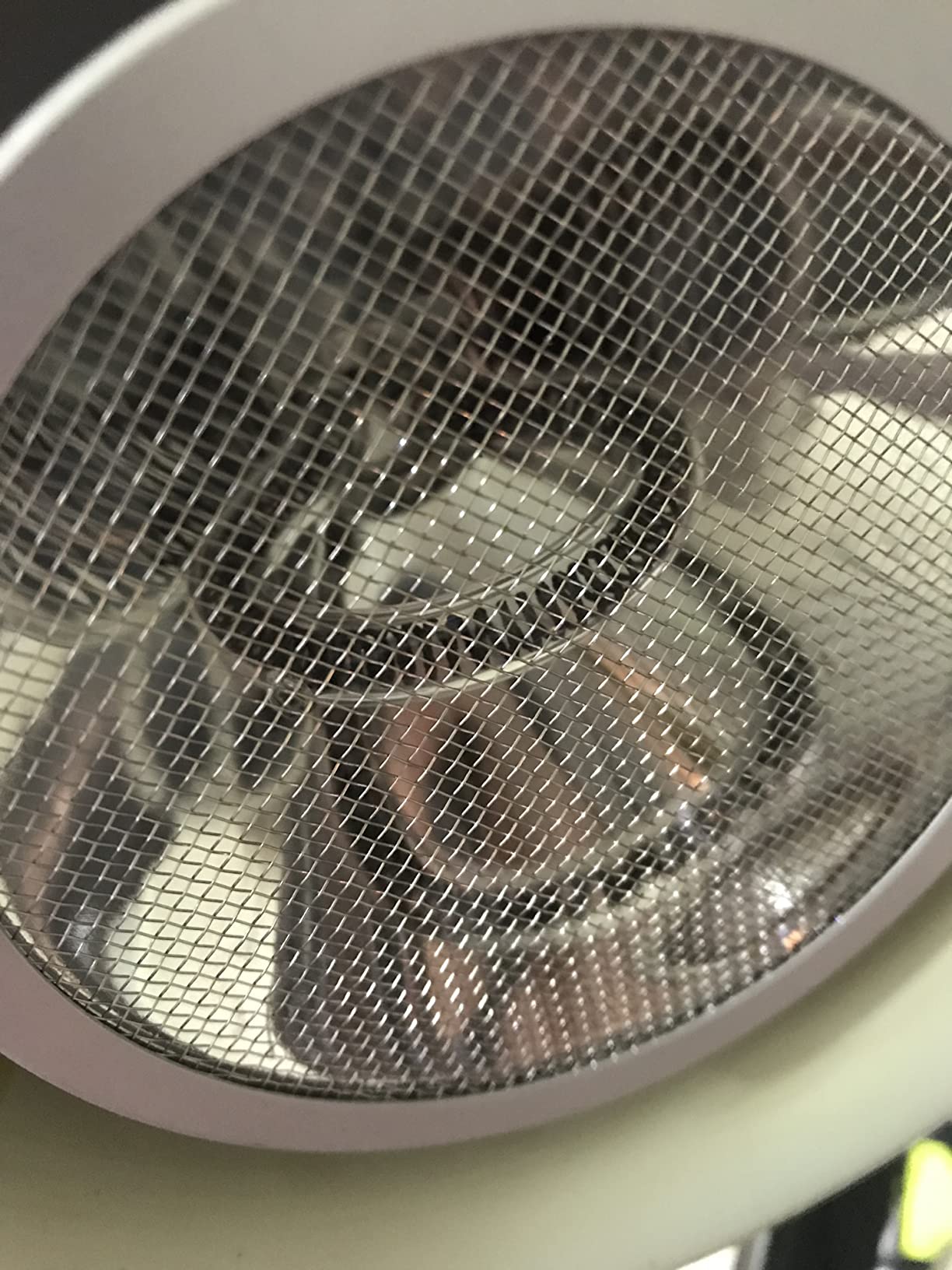
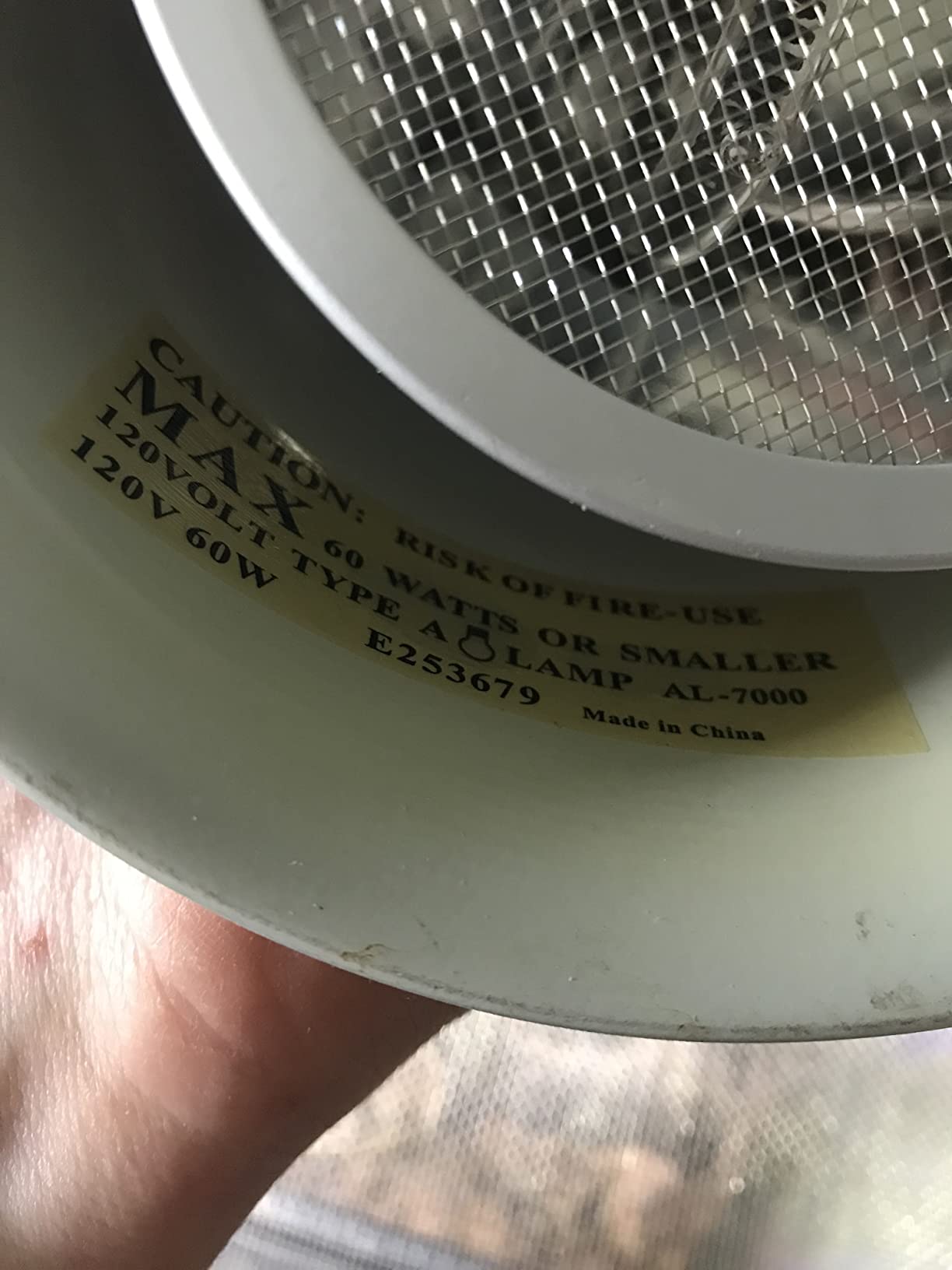
What we would not paper over is the durability record. At a 4.0 average across 84 reviews, 16 percent sit at one star, the highest one-star proportion among the true projectors here. Buyers report bulbs dying within two to six months and occasional cracked bulbs arriving in the box. Keepers on reptileforums.co.uk have dedicated threads on exactly this failure pattern.
Getting the 50W Arcadia to deliver its full output
The single most common complaint is not that the projector is bad, it is that it seems to run cool. That is almost always a mounting height problem. A 50W bulb hung high in a 36 inch tall enclosure heats the top panel and never reaches the animal, and the fix is to bring the fixture down until the basking surface reads your target temperature at the animal’s actual resting height.
Measure with an infrared thermometer, not a thermostat probe guess. Once you find the height that delivers your target basking surface temperature, fix it there and let the thermostat handle the rest. The same Arcadia family includes 40W and 80W versions, so if the 50W is straining in a larger tank the 80W is a straightforward step up within the same brand.
Who should skip the Arcadia 50W
Skip it if your enclosure is 75 gallons or larger. Reviewers of this specific bulb are pushed toward the 80W for exactly that reason, and a 50W at that scale will run the thermostat constantly trying to catch up, which shortens filament life rather than extending it.
Also weigh it carefully if you have already had early failures with a DHP of any brand. If your last projector died in a few months, the REPTI ZOO bulb below has a built-in thermal protector, and if handling hot glass worries you, the Pangea two sections down carries the highest average rating here.
5. REPTI ZOO 100W PAR38 – built-in thermal protector for humid rooms
REPTI ZOO Reptile Basking Heat Lamp Bulb, 100W Splashproof Energy Saving Deep Heater Non-Luminous Carbon Infrared Heat Bulb for Reptile Amphibians
100 watts
PAR38 form factor
E26/E27 base, 110-120V
Self-ballast with thermal protector
Pros
- Thermal protector prevents surface melting and scalding
- Does not pull humidity out of the enclosure
- Works with the REPTI ZOO dimming thermostat
- Carbon filament runs 24 hours
Cons
- Some bulbs arrive defective or flicker
- Actual draw reported below the labelled 100W
- Emits a slight orange glow
The REPTI ZOO 100W is the one with a safety feature built into the hardware rather than asked of the keeper. It is self-ballasting with an integrated thermal protector, and the manufacturer states plainly that the surface will not melt and pets cannot be scalded. In a 4x2x2 full of live rock and misting, that engineering detail is worth more than a slightly higher wattage number.
The other thing owners single out is humidity. Reviewers note that the carbon infrared output heats the animal without pulling the moisture out of the enclosure, and several pair it directly with the REPTI ZOO dimming thermostat. The 3.8 by 3.8 by 4.3 inch PAR38 body and splashproof metal shell suit humid rooms as well as they suit dry ones.
At 4.3 across 62 reviews, with 73 percent at five stars and 7 percent at one star, this is a middle-of-the-pack score with a better consistency story than the rating alone suggests. The recurring negatives are quality control rather than performance: flickering, arriving defective, and a repeated report that the delivered draw comes in below the labelled 100W.
Why the thermal protector matters more than the wattage
Most DHP failures in the field are heat-related, and most heat-related failures start with a bulb mounted too close to the top of an enclosure, or inside a shade that traps heat at the glass. A built-in thermal protector cuts that failure mode at the source, which is why we would run this bulb in a top-heavy screen-topped setup where clearance is hard to guarantee.
Its family also covers 50W and 80W, so the same brand scales with your enclosure. The 80W suits a 40 gallon breeder, the 100W suits a 4x2x2, and if you move up later you stay with a filament type and a control method you already understand instead of relearning them.
Who should skip the REPTI ZOO 100W
Skip it if you need a genuinely dark night and every photon counts, because there is a slight orange glow that some reviewers notice. It is a much better fit for a bearded dragon or a corn snake, where a modest amount of low-level warmth-light during a nocturnal heating phase is not a behavioural problem.
Also skip it if you cannot get a genuine dimming or pulse proportional thermostat, and treat the under-labelled power draw reports as a reason to verify your own readings with a plug-in meter. Measuring the basking surface temperature and the actual draw tells you in five minutes whether the unit is performing, and it removes the guesswork that makes this category frustrating.
6. Pangea 50W – the highest-rated projector and the safest to handle
Pangea 50W Deep Heat Projector Infrared Heater for Reptiles (50 Watt)
50 watts
Infrared A and B, virtually zero light
3.75 inch by 4.25 inch
Silicone covered parabolic reflector
Pros
- Highest average rating here at 4.7 with zero one-star reviews
- Silicone sleeve allows handling through the heat
- Very low visible light for overnight use
- Evaporates water more slowly than standard heat lamps
- Reinforced transit packaging
Cons
- Ceramic fixture required
- no plastic sockets
- 50W is weak beyond very small enclosures
- Very small review sample limits long-term data
The Pangea 50W has the best satisfaction profile of anything we looked at, and it is worth being precise about why. Its 4.7 average comes with zero recorded one-star reviews across 38 ratings, and 84 percent sit at five stars. No other bulb here has a clean sheet like that. The sample is small, and small samples flatter, but the consistency inside it is real.
The design detail that stands out is the silicone cover. It is a parabolic reflector wrapped in a protective sleeve that lets you handle the bulb through the heat, which removes the single most common injury risk in this category. Owners report months of steady 22-hour-a-day runtime and animals sleeping directly under the projector, which for a nocturnal or crepuscular species is the whole point.
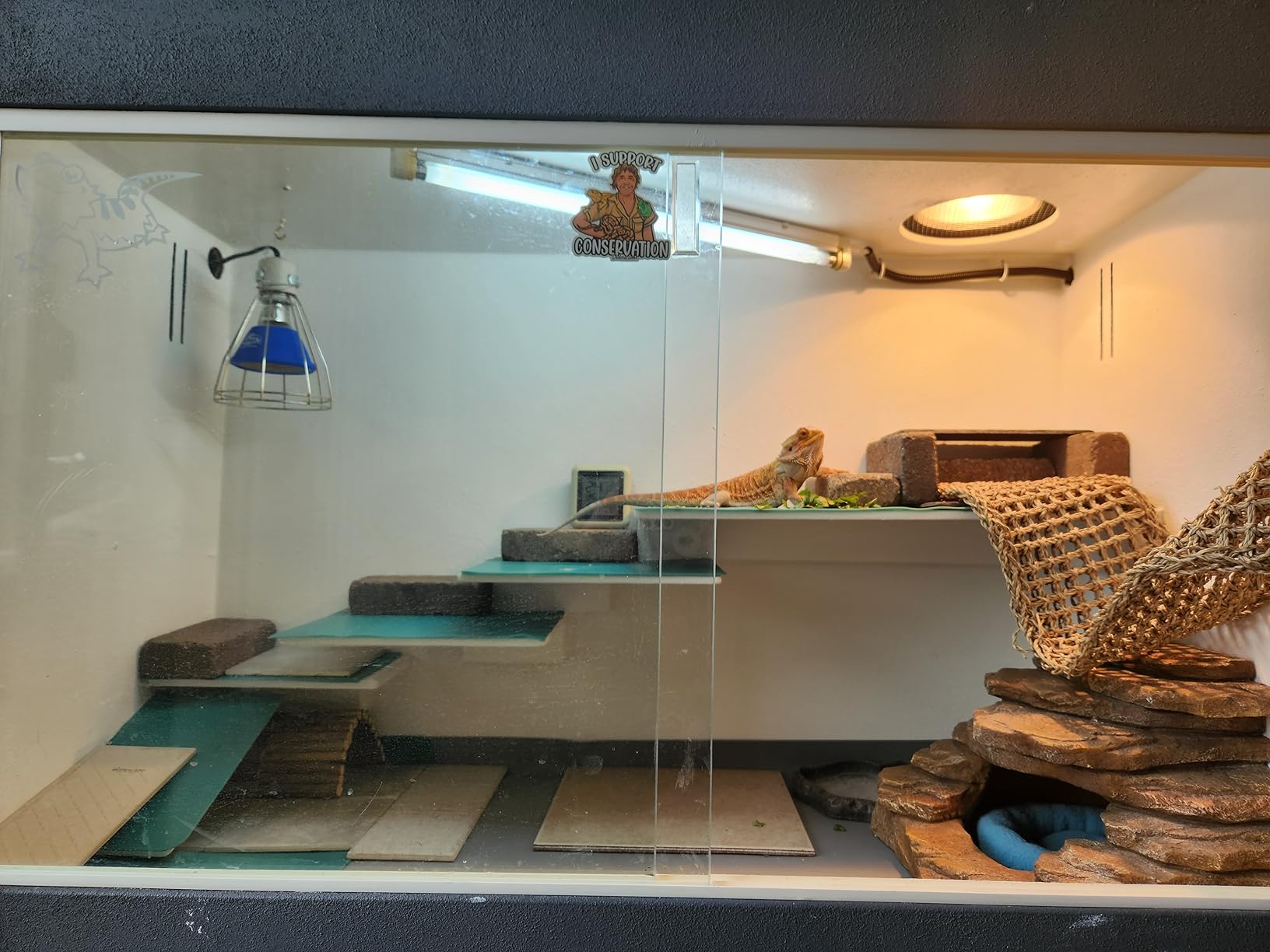
It also evaporates water more slowly than a standard heat lamp, according to both the manufacturer and the buyer reports, and it pairs cleanly with a ceramic heat emitter or a heat mat for a layered setup. Owners with a dimming thermostat report it running happily alongside another projector when dual heat sources are needed for a large tank.
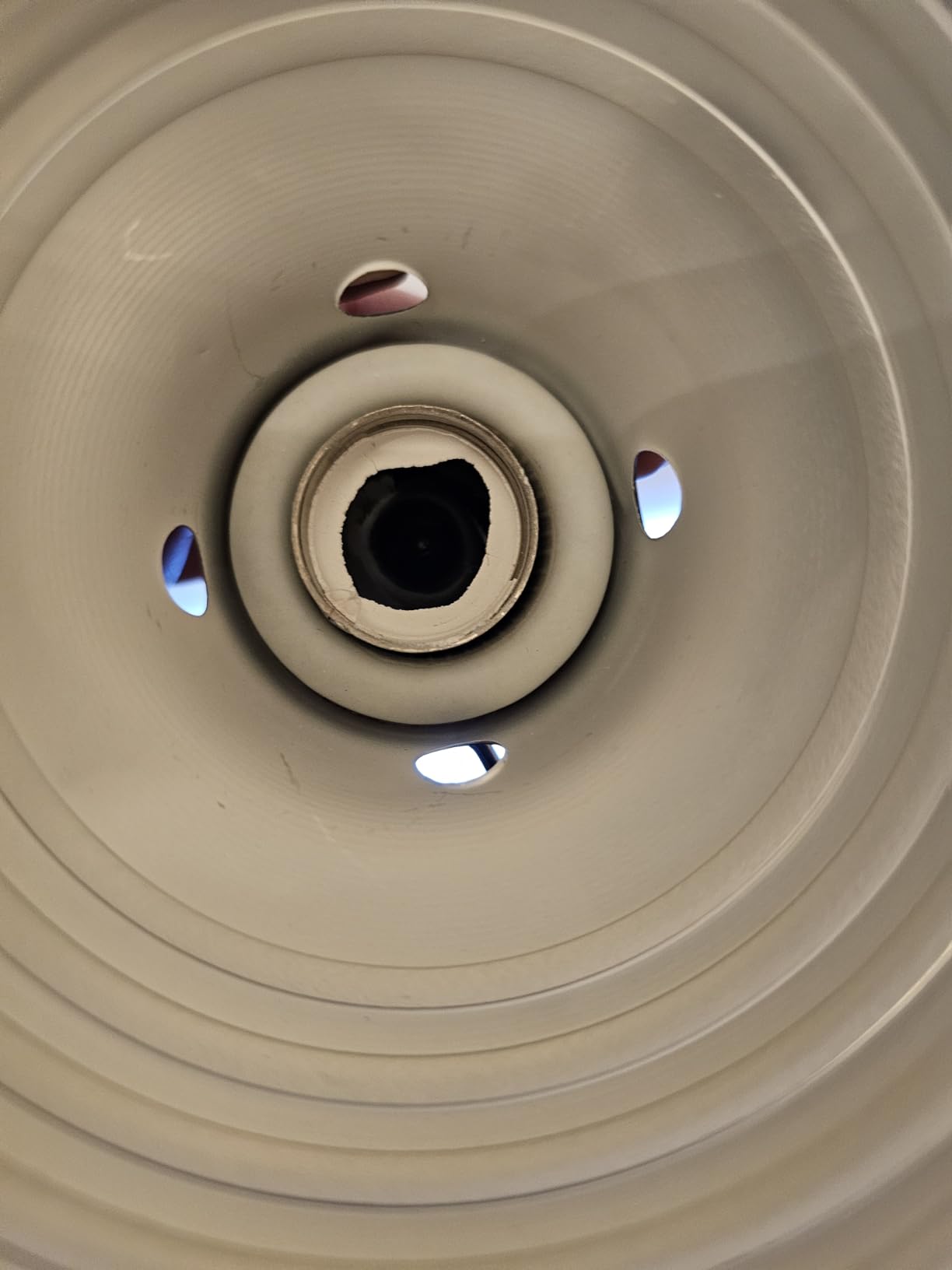
Where the Pangea 50W is the right call
This is the projector for a leopard gecko, a crested gecko or a young ball python in a 20 to 30 gallon enclosure, and specifically for anyone who is nervous about handling a hot bulb. The virtually zero visible light output makes it a natural fit for overnight use in a dark room where you do not want to wake the animal.
It is designed for 100-120V 60Hz US outlets and requires a ceramic fixture, which is the correct constraint rather than a flaw. Pair it with a dimming thermostat, mount it so the animal can move completely out of the beam, and put a piece of slate or a flat stone under the beam as a basking surface that stores heat and radiates it back down through the night.
Who should skip the Pangea 50W
Skip it if you are heating anything larger than a small setup. The 50W output is genuinely modest, and pushing a small bulb to cover a large tank means running the thermostat constantly, which is the hard cycling that shortens filament life. For a 4x2x2, choose a 100W unit instead.
Be aware that the ceramic fixture requirement and the faint hum some owners report during operation are both real. The 38-review sample is genuinely too small to establish a long-term durability record, so if you need certainty above a four-star average, the Fluker’s Deep Thermal at the top of this list is where the evidence sits.
7. AUAAQ 120W – the widest wattage family, and a fixture warning
120W Deep Heat Infrared Projector Lamp for Reptiles, Emits both Infrared A & B Wavelengths, Reptiles Basking Light Heat Lamp Bulbs with Reflector for Bearded Dragons, Turtles, Snakes, Lizards, etc.
120 watts
Carbon fiber filament, infrared A and B
Integrated thick parabolic reflector
Virtually no visible light
Pros
- Widest wattage family at 50W 80W 100W and 120W
- Integrated reflector reduces wasted heat and power use
- Heavy-duty construction
- No visible light for around-the-clock use
Cons
- Must not be used in a deep dome lampshade
- Listed at 220-240V
- Only 34 reviews so limited reliability data
The AUAAQ 120W is the pick for a large enclosure in a cold room, and it comes with the clearest installation warning of any bulb in this list. The reflector is integrated into the lamp, so the manufacturer states plainly that deep dome lampshades are not recommended, because trapped heat shortens bulb life. Use a reflector dome or an open clamp, and read that instruction before you buy a fixture.
That integrated thick parabolic reflector is also the reason this bulb is efficient. It focuses the heatwaves instead of scattering them, which means you get more usable radiant heat per watt and less wasted energy. Owners across the range report near-zero visible light and no disturbance to the animal’s cycle.
At 4.3 across 34 reviews, with 71 percent at five stars, the satisfaction profile is good but the sample is the smallest in the lineup. The one caution that repeats is exactly the installation one, which tells you the product is fine and the fixture is where people go wrong. A related detail worth checking: the listing is published at 220-240V, so confirm the voltage matches your supply before you fit it.
When 120W is the correct call
Reach for this when you have a 4x2x2 or larger, or a tall enclosure where the basking surface is a long way from the lamp, or a room that runs cool at night. Those are the three situations where a 100W unit at a safe mounting height simply cannot hold a target temperature, and where a higher wattage bulb beats fighting the geometry.
The wattage ladder on this listing is unusually broad at 50W, 80W, 100W and 120W, which means you can buy one brand and one filament type and change only the number as your setup changes. That has real practical value for anyone who will end up with a bigger animal in a year or two.
Who should skip the AUAAQ 120W
Skip it for any enclosure under 75 gallons, and skip it entirely if your only fixture is a deep ceramic dome. Those two conditions overlap more often than keepers expect, so the honest advice is to sort out the fixture first, then the bulb.
Skip it if you need long-term certainty and prefer a large body of owner data, because 34 reviews cannot tell you how the unit performs after two years of nightly cycling. In that case the Fluker’s Deep Thermal 100W or the Zoo Med ReptiCare 150W are the more defensible choices, and both come with far more history behind them.
How to Choose the Right Wattage for Your Enclosure?
Wattage is the decision that most often goes wrong, and it goes wrong in one direction: people buy more heat than they need. The forum version of this question is always the same, is 50W enough for my enclosure or do I need 80W, and the answer depends on three variables, not one.
The first is the size of the basking surface, which is really the size of the footprint your lamp covers. A 50W projector suits a 20 gallon tank or a small 30 gallon setup. A 60W to 80W bulb covers a 40 gallon breeder. A 100W bulb is the right default for a 4x2x2, and anything above that, or a 120 gallon enclosure, is where the 100W to 150W range starts to make sense.
The second is height. Heat falls off with distance, and this is the variable owners most often ignore. A bulb mounted high in a 36 inch tall enclosure heats the top panel and never reaches the animal, which is why a keeper on reptileforums.co.uk reported an 80W projector reading only 25 degrees directly below it after an hour of unregulated running. That reading is a mounting problem, not a wattage problem.
The third is the room. A cold room or a basement at 65F ambient changes the calculation completely, because you are fighting the whole enclosure rather than one surface. If your house drops at night, that is the strongest argument for a DHP over a ceramic emitter in the first place, since you can heat overnight without light. The broader physics of radiant versus ambient heat is covered in more detail in our guide to what heat therapy does for you, which covers the same infrared principles from a human application.
Our rule of thumb: buy the lowest wattage that holds your target basking surface temperature at the animal’s actual resting height, measured with an infrared thermometer. If it will not hold temperature, step up one wattage rather than two, and check your fixture before you do.
DHP vs Ceramic Heat Emitter vs Halogen Flood
The three heat sources are not interchangeable, and the right one depends on the species and on whether you can run two fixtures. A ceramic heat emitter heats air, which then heats surfaces, which then warm the animal. It is cheap, universally available, and it gets uncomfortably hot at the surface. Keepers on beardeddragon.org capture the safety perception well when they note the projectors “don’t get nearly as hot to the touch as the CHE, so less burn risk.”
A halogen flood produces genuine visible light and a tight, intense beam. It is the correct daytime basking source for a diurnal species such as a bearded dragon, because those animals need light and heat together to behave normally. The problem is the tight beam, which is a genuine burn risk and is why keepers are cautious about halogen-only setups. A layered arrangement, halogen for the day and a projector for the night, is the answer we would default to for any diurnal species.
A deep heat projector produces no visible light and a broad, safe beam of infrared-A and infrared-B. That makes it the best night source, the best single source for a nocturnal or crepuscular species, and the best partner to a daytime halogen. The trade-off is that on its own it gives very low light levels, which is a real consideration for a diurnal animal.
An under tank heater, for anyone starting out, is the cheapest option and the worst for thermoregulation. It warms from below with no overhead gradient, it decouples heat from the basking surface, and it does nothing for an animal that needs to bask. The logic behind alternating heat sources in general, including the recovery comparisons people ask about, is covered in ice bath versus heat therapy for recovery, where the same contrast between local radiant heat and general cooling shows up again.
Thermostats and Fixtures: What You Actually Need
Never run a deep heat projector without a thermostat. This is not a recommendation, it is a requirement. An unregulated projector will overshoot its target, the overshoot kills filaments, and the on/off cycling an on-off thermostat causes produces exactly the temperature swings that stress an ectotherm. Put a dimming thermostat or a pulse proportional thermostat on it, and expect to never run it at full output once the enclosure is dialed in.
Put the probe where the animal actually sits, not under the lamp. A probe taped to the basking surface reads the temperature of the stone rather than the temperature the animal experiences, and a probe dangling in the top corner of a tall tank will report warm while the animal sits cold at the bottom. Pin the probe to the wall at the level where your reptile rests, at the warm end of the gradient.
On fixtures, the rules are simple. Use a ceramic or metal reflector dome, never plastic, and size the dome to the wattage. A 100W bulb needs an 8 inch dome, and a small dome traps heat at the glass and shortens bulb life. If a projector has an integrated parabolic reflector, as the AUAAQ does, use an open or shallow fixture rather than a deep shade. And give every bulb real clearance from the top of the enclosure, because that gap is what keeps a splashed enclosure and a plastic lid out of an incident.
Handle bulbs by the base or with gloves, and use a surge protector on the circuit. Several early-failure reports in this category trace back to power surges rather than filament quality, and a surge protector costs nothing next to replacing a projector twice.
Best Deep Heat Projector by Reptile Species
For ball pythons, the 50W class is the classic choice and the Pangea 50W is the one we would put in a 20 to 30 gallon enclosure, because the near-zero light output lets it run all night for belly heat during digestion. A Canadian keeper described in a forum thread upgraded a two-month-old corn snake from an under tank heater to a 50W projector mounted overhead, and the reason was heat overnight without light. That logic applies directly to any snake.
For corn snakes and hognose snakes, a 50W unit in a 20 gallon tank covers the requirement well. A keeper on r/reptiles uses a projector for all their snakes specifically because the house gets cold at night, which is the single most cited reason in the community. For a 40 gallon breeder, step up to the 60W to 80W range.
For leopard geckos, a 50W is right and 75W is too hot for a standard 20 gallon enclosure, though a dimming thermostat makes a higher wattage workable in a 30 gallon. A 75W bulb in a 20 gallon is asking for a chronically overheated top and a gradient the animal cannot escape. The Pangea 50W or the Arcadia 50W both fit, and the Arcadia is the more established name for a first projector.
For bearded dragons, no projector replaces a daylight basking lamp. A 4x2x2 adult wants a halogen flood for daytime, and the projector handles the night, or you split the heat with a 100W bulb plus a separate source. Keepers on beardeddragon.org run a 100W Fluker’s and an 80W Arcadia together in that format with separate thermostats, which is the arrangement we would copy for a large adult setup.
For crested geckos, a 50W non-luminous projector is the right night source in a planted tropical vivarium, and a low-wattage UVB lamp handles the day. The non-luminous requirement is the reason the Pangea or Arcadia 50W is preferable to a higher-wattage amber-output bulb, since a planted vivarium at night should be genuinely dark.
Common DHP Problems and How to Fix Them
The most common complaint in this category is a projector that reads cooler than expected. Almost always this is mounting height. Bring the fixture down until your infrared thermometer shows the target basking surface temperature at the animal’s resting height, then lock that position. If it still cannot hold temperature, step up one wattage and check that the dome is not trapping heat at the glass.
The second problem is early burnout, and it has two causes. Hard thermostat cycling wears filaments out faster than steady heat, which is the argument for a dimming or pulse proportional thermostat. Surge events kill bulbs outright, which is the argument for a surge protector. Owners who run a projector on a dimmer at moderate output and protect the circuit report the longest run times.
The third is buying a mislabelled bulb. If a “deep heat projector” glows visibly, has a tungsten filament, or the listing never mentions infrared-B, it is an infrared basking lamp and it will light your enclosure at night. The red flags are simple: visible glow, a warm white or amber light colour, and a listing that talks about basking rather than penetration.
The fourth is humidity loss, particularly in screen-top enclosures where keepers report dropping several percentage points over 24 hours. A projector with a parabolic reflector loses less than a ceramic emitter, but the airflow from a screen top is the real culprit. Cover part of the top, add a humid hide, and measure with a hygrometer rather than guessing.
The fifth is fixture mismatch, and it is the most preventable. A 100W bulb in a 6 inch dome, a 150W bulb in a plastic fixture, or an integrated-reflector bulb in a deep shade will all shorten life or create a hazard. Match the dome to the wattage, use ceramic or metal only, and read the manufacturer’s fixture restrictions before you screw anything in.
Frequently Asked Questions
What is a deep heat projector for reptiles?
A deep heat projector is a reptile heat lamp with a carbon fiber filament that emits infrared-A and infrared-B radiation. Infrared-A penetrates skin and muscle the way sunlight does, warming the animal from inside rather than only heating the air and surfaces around it. It produces no visible light, so it can run day and night without disturbing a reptile’s day/night cycle.
Are deep heat projectors better than ceramic heat emitters?
For most reptiles, yes, and the difference comes down to radiant heat versus air heat. A ceramic heat emitter heats the air, which heats surfaces, which warm the animal indirectly, and it gets very hot at the surface. A projector delivers infrared energy into muscle tissue directly, runs cooler to the touch, and throws a wider, safer beam. A ceramic emitter still makes sense as a cheap secondary heat source or for species that need ambient warmth only.
Do deep heat projectors give off light?
A genuine projector gives off no visible light, which is the feature that lets it run overnight for nocturnal and crepuscular species. Some bulbs in this category emit a faint orange or amber glow, and the Zoo Med ReptiCare lists a warm white and amber output, so check the specification if darkness matters. If a listing glows clearly, it is almost certainly an infrared basking lamp rather than a true projector.
What thermostat should I use with a deep heat projector?
Use a dimming thermostat or a pulse proportional thermostat, and never run a projector on on-off cycling without one. Dimming lowers the wattage smoothly, which is far gentler on the carbon fiber filament than hard on/off switching, and it removes the temperature swings that hard cycling creates. Place the probe on the wall at the animal’s resting height at the warm end of the gradient, not taped to the basking surface.
What wattage deep heat projector do I need?
Match wattage to the footprint you need to heat and to the height of the mount. Around 50W suits a 20 gallon tank, 60W to 80W suits a 40 gallon breeder, 100W is the default for a 4x2x2, and 100W to 150W suits 120 gallon tanks, tall enclosures or cold rooms. Buy the lowest wattage that holds your target basking surface temperature measured with an infrared thermometer at the animal’s resting height.
Do you turn a reptile heat lamp off at night?
With a halogen basking lamp, yes, turning it off at night is what creates the day/night cycle your reptile depends on. With a deep heat projector you do not have to, because it produces no visible light, so it can run all night. That is the main reason keepers choose a projector, especially where the house gets cold after dark. Many people run a halogen for the day and a projector overnight as a layered setup.
Final Verdict
The Fluker’s Deep Thermal 100W is our overall pick among the best deep heat projectors for reptiles, because 247 reviews at a 4.5 average with a 5 percent one-star share is the deepest owner record available here. For a splashy tropical vivarium, take the ExoRepti 100W PAR30 with its metal shell. For a 4x2x2 or larger, the Zoo Med ReptiCare 150W carries the longest rated filament life in the lineup. For a 20 gallon and a nervous handler, the Pangea 50W has the highest average rating and a silicone sleeve you can handle through the heat.
Whichever you choose, buy the dimming thermostat and the correct ceramic dome in the same order, and measure with an infrared thermometer before you trust any temperature claim, including ours. Updated for 2026.