
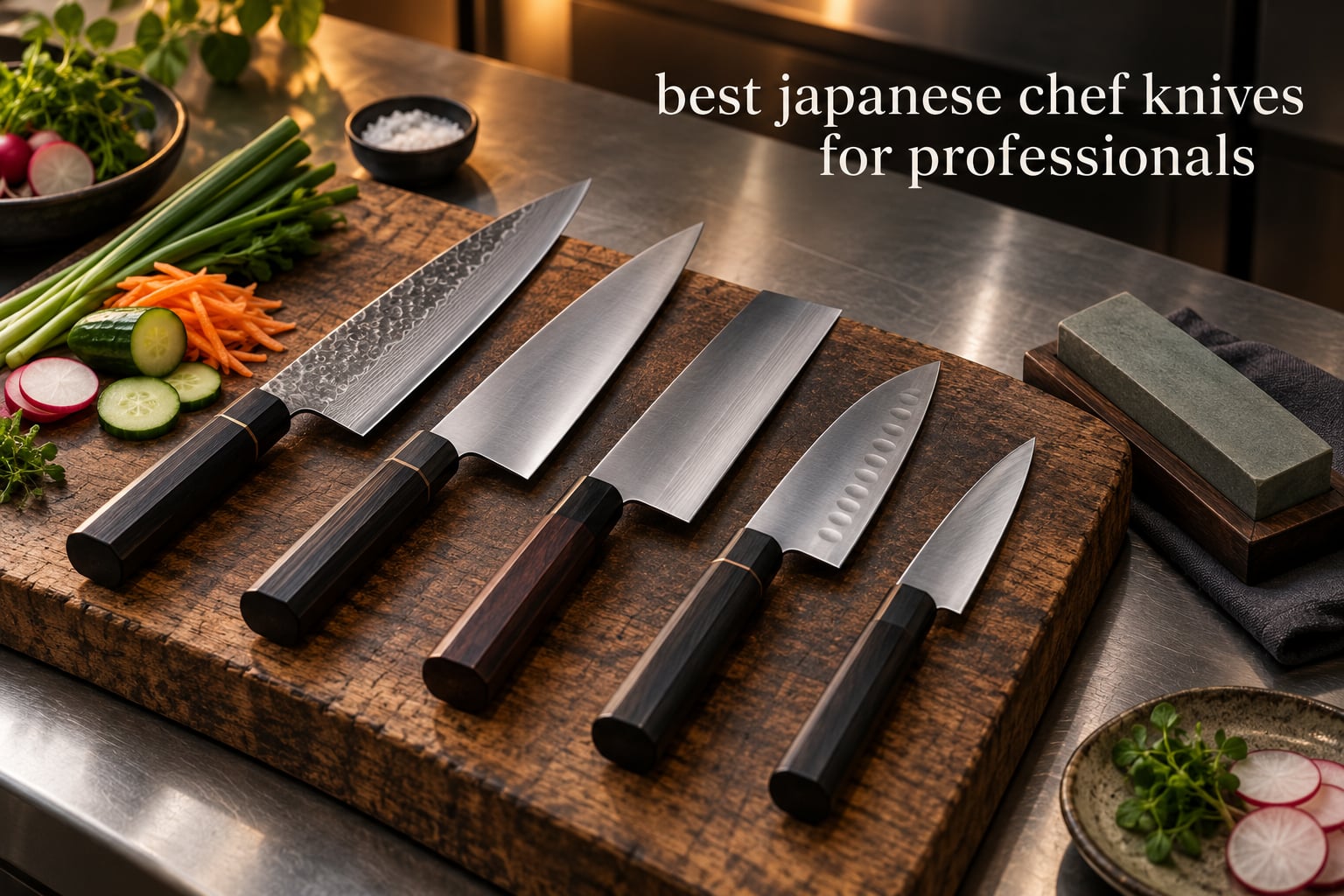
The best Japanese chef knives for professionals are not the prettiest blades in the case, and they are not the ones with the thinnest geometry. They are the ones that still cut clean after the ninth hour of a Friday dinner service, that survive a scullery nobody has time to wipe down properly, and that a cook can put back to a stone on a fifteen-minute break. Our team works through these nine blades the way a line cook would: edge geometry out of the box, weight in the hand after four hours, behaviour against an end-grain board that has seen a decade of service, and how each one responds to a whetstone rather than an electric box sharpener.
That is the difference between this guide and every other Japanese knife roundup on the internet. A home cook uses a good knife for twenty minutes a day. A working cook uses one for eight to ten hours, in a kitchen where the knives get dropped in a bin full of dirty pans, washed in hot water at the end of the night, and put back in a roll at two in the morning. Retention, toughness and the willingness to be sharpened on a schedule matter far more than forge pedigree. If you want the broad consumer view instead, start with our general guide to Japanese knives; this one assumes you are buying for a brigade.
Three decisions do most of the work. First, steel: a commercial kitchen is a stainless environment, and a high-hardness blade that reacts to a wet night is a liability unless you sharpen every shift. Second, blade length: a 210mm gyuto moves fast and stays out of the way, a 240mm covers more board per stroke, and anything past 270mm is a knife for one specific station, not for a roll. Third, and the one most buyers skip, the sharpening commitment. A Japanese blade arrives thinner behind the edge than a German one and often thicker than it should be at the factory, which means real work thinning before it behaves. Decide honestly how much time you will spend at a stone, then buy the steel to match.
Table of Contents
Top 3 Japanese Knives for Professionals (October 2026)
These three cover the widest range of professional duty in the list: a forgiving stainless workhorse with the largest owner base, an all-stainless knife that shrugs off a scullery, and a higher-hardness blade for cooks who sharpen on purpose.

Shun Classic 8 inch Chef’s Knife
- VG-MAX core with 68-layer Damascus cladding
- 16-degree edge angle
- D-shaped Pakkawood handle
- Handcrafted in Seki

Global G-2 8 inch Chef’s Knife
- Molybdenum and vanadium stainless steel
- 7.84 ounce all-stainless build
- Dimpled seamless handle
- Lifetime warranty

Miyabi Kaizen 8-Inch Chef’s Knife
- VG10 CRYODUR ice-hardened to 60 HRC
- 65-layer Damascus
- Honbazuke honing to 9.5-12 degrees
- Micarta D-shape handle
The Best Japanese Chef Knives for Professionals in 2026
Every blade below is a Japanese-made chef’s knife that holds an edge under service conditions. The table compares the four variables that decide whether a knife survives a working kitchen: the steel core, the hardness it is treated to, the handle style, and the task it is actually built for.
| Product | Specs | Action |
|---|---|---|
| Shun Classic 8 inch Chef’s Knife |
|
Check Latest Price |
| Global G-2 8 inch Chef’s Knife |
|
Check Latest Price |
 Miyabi Birchwood SG2 8 inch Chef’s Knife Miyabi Birchwood SG2 8 inch Chef’s Knife |
|
Check Latest Price |
 Enso HD VG10 8 inch Gyuto Enso HD VG10 8 inch Gyuto |
|
Check Latest Price |
 Yoshihiro VG10 210mm Gyuto Yoshihiro VG10 210mm Gyuto |
|
Check Latest Price |
 Misono UX10 No. 712 21cm Misono UX10 No. 712 21cm |
|
Check Latest Price |
 Masamoto VG 210mm Gyuto Masamoto VG 210mm Gyuto |
|
Check Latest Price |
| Miyabi Kaizen 8-Inch Chef’s Knife |
|
Check Latest Price |
 Yoshihiro AUS10 Wa Gyuto 210mm Yoshihiro AUS10 Wa Gyuto 210mm |
|
Check Latest Price |
1. Shun Classic 8 inch Chef’s Knife – the most forgiving pro workhorse
Shun Classic 8″ Chef’s Knife
VG-MAX core steel
68-layer Damascus cladding
16-degree edge
206 g
8 inch blade
Pakkawood D-handle
Pros
- Razor-sharp 16 degree edge
- VG-MAX core with 68-layer cladding
- Comfortable D-shaped Pakkawood handle
- Handcrafted in Seki Japan
- Lifetime warranty with free sharpening
Cons
- Premium price point
- Requires hand washing and careful maintenance
Our most-shared recommendation in professional forums is blunt: for someone working a restaurant kitchen, buy a forgiving stainless workhorse that will take a beating and ask nothing back. The Shun Classic is the version of that advice with the most owner history behind it, and its 3805 reviews across 4.7 stars reflect a knife that does the same job on day four hundred as it did on day one.
The core is VG-MAX steel, a Japanese stainless that sits a touch harder and finer than most VG-10, wrapped in 68 layers of Damascus cladding. The factory edge is set to a 16 degree angle per side, which is more forgiving than a 9.5 degree laser edge but still fine enough for a clean slice on beef or onion. The D-shaped Pakkawood handle is a resin-impregnated hardwood, so it will not swell or crack in a wash station the way a plain octagonal wa handle can.
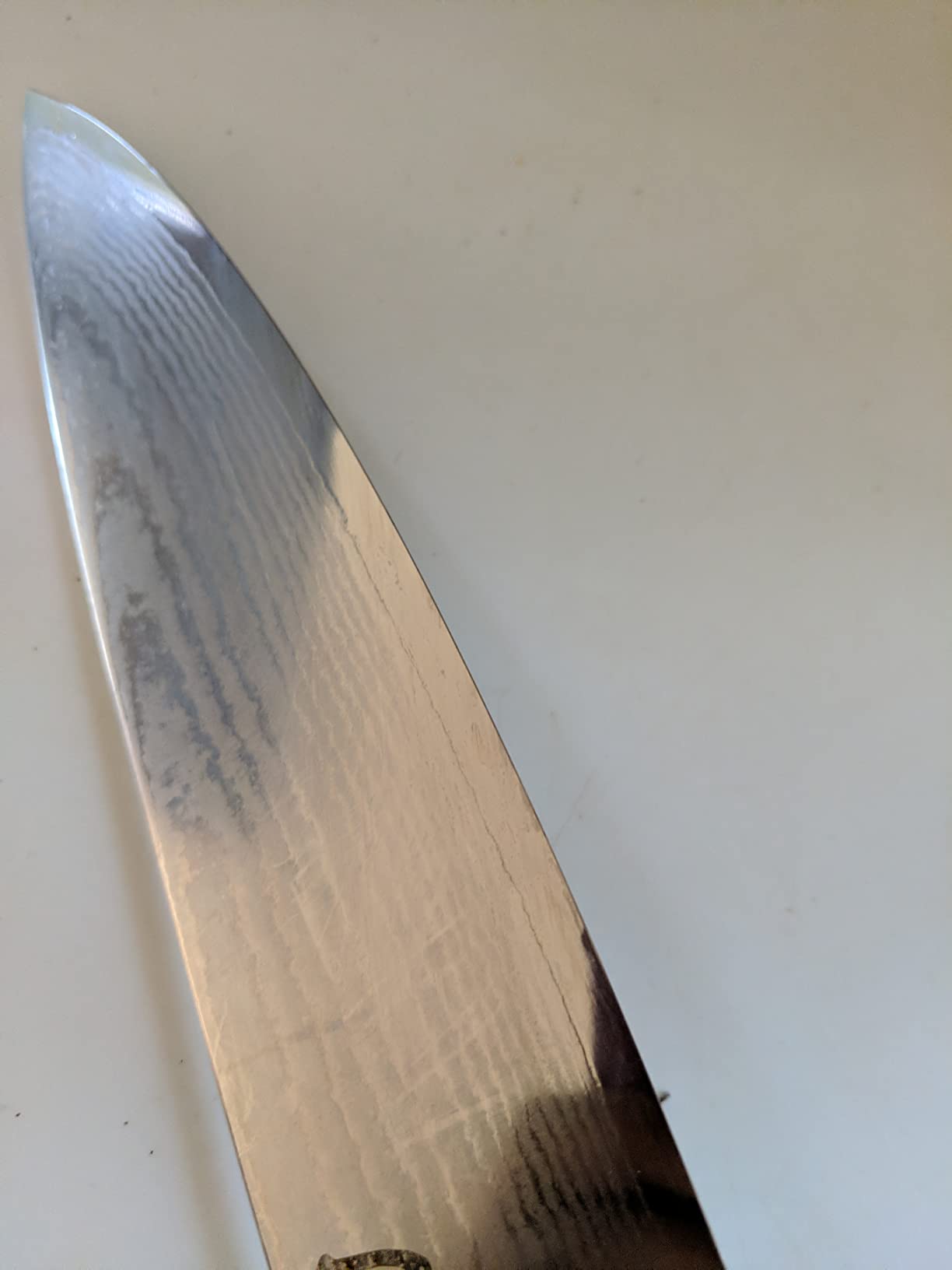
What sold us is how little it asks of you. It takes a wire wool scrub and a hot rinse without complaint, it does not care about an hour of onion and garlic, and the 206 g weight is low enough that a nine-hour prep does not leave your wrist tired. For a cook who buys one Japanese blade and wants it to be the blade, this is the one we hand over most often.
Two honest limits. The edge angle means it is not going to behave like a thin laser on fine sashimi work, and the Damascus pattern is decorative at the edges – the exposed steel is the core, which is the part that matters for sharpness and retention. It is a daily prep knife, not a knife for a sushi counter.
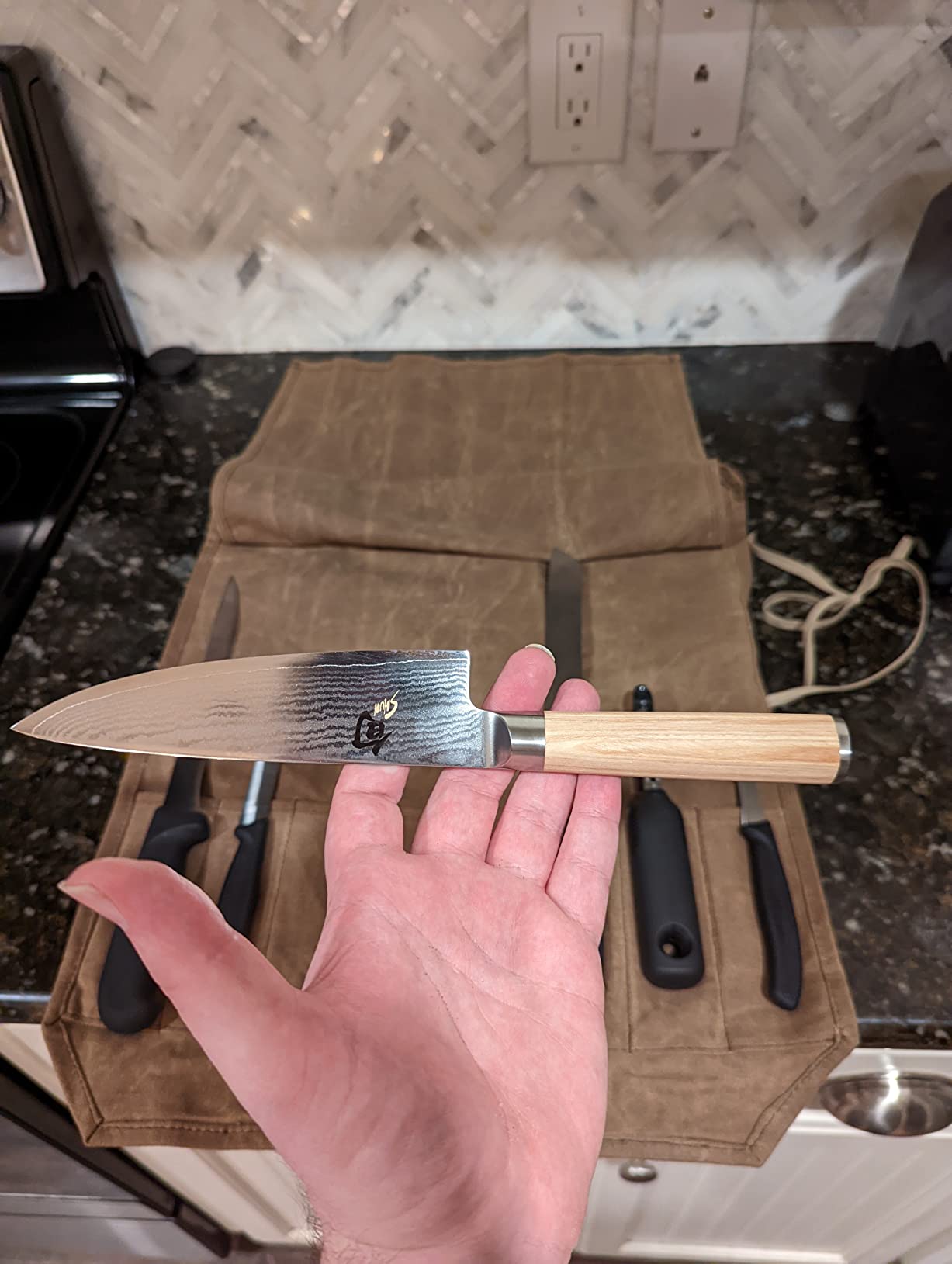
Who the Shun Classic suits in service
It suits a line cook, sous chef or prep cook who preps for volume and wants one blade that covers brunoise, baton, slicing and protein work without a sharpening routine attached to it. It is also the safest recommendation we can make to a culinary student who will lose the knife at least once.
Because it is all stainless and resin-impregnated, it survives the nightly wash without the anxiety that comes with a carbon blade left wet overnight in a roll. The lifetime warranty and free sharpening service also mean a young cook can send it back rather than abandon it.
What to watch out for
Watch for the 16 degree angle. If your station is fine slicing, fish, or anything where a thinner edge matters, this is the wrong blade and you should look at a thinner option. The 68-layer cladding is a manufacturing and grind description, not a performance tier, and paying up for pattern count buys you nothing at the stone.
Also watch the handle. The D-shape is excellent for a palm-forward grip, but cooks who prefer a pinch grip on the spine or who switch to a knife roll with a narrow slot may find it bulkier than a slim wa handle. Check it against your own hands before service.
2. Global G-2 8 inch Chef’s Knife – the scullery-proof all-stainless
Global – 8 inch, 20cm Chef’s Knife,Silver
Molybdenum and vanadium stainless
7.84 oz
Stamped construction
Seamless dimpled handle
Lifetime warranty
Pros
- Exceptional sharpness out of the box
- Lightweight and well balanced
- Excellent edge retention
- All-stainless build is easy to clean
- Lifetime warranty
Cons
- Metal handle feels slippery when wet
- Handle sizing suits smaller hands
- Needs correct technique to shine
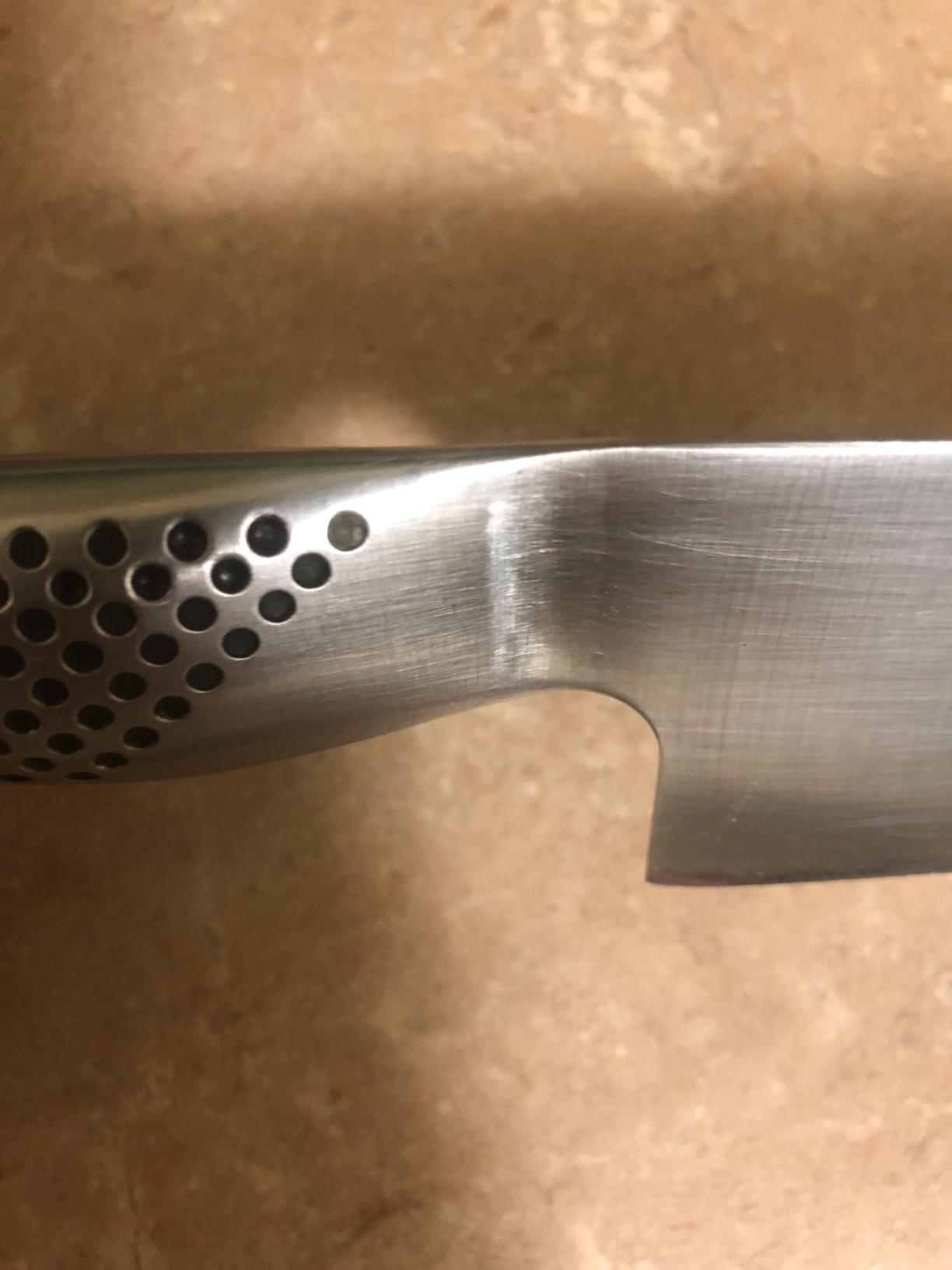
The Global G-2 is the highest-rated blade in this list at 4.8 stars across 3173 reviews, and it earns that with a simple design decision: there is no wood, no resin, no join line, nothing to infiltrate. The blade and handle are one continuous piece of stainless steel, and in a kitchen where knives go through a hot scullery at the end of every service, that is not a gimmick.
The steel is a molybdenum and vanadium stainless, the same family of alloy used in high-volume European and Japanese commercial blades, and it is stamped rather than forged. At 7.84 ounces the whole knife is light, and it is balanced forward of the bolster, which makes fast repetitive work less tiring over a long prep.
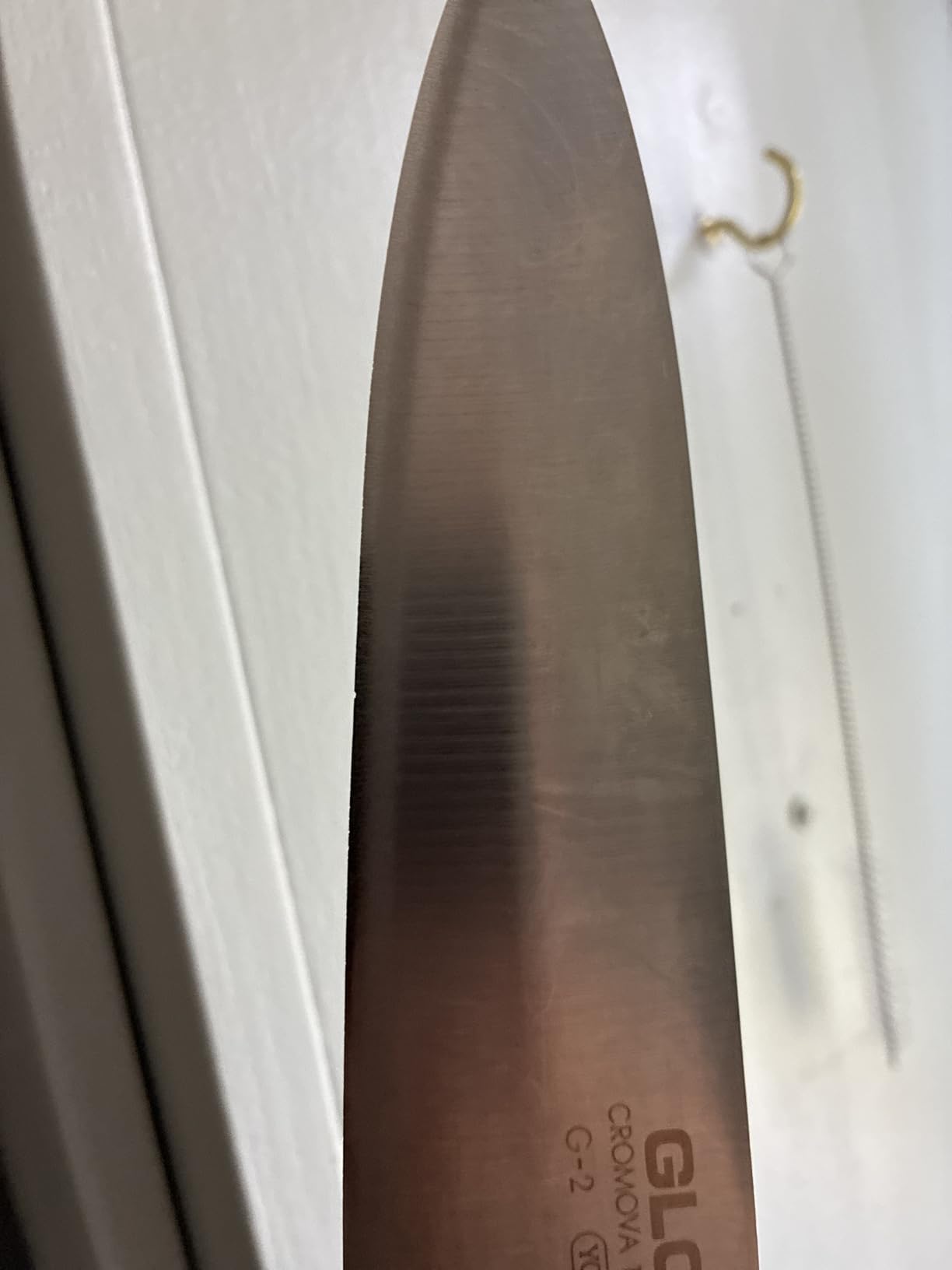
Reviewers consistently point at one thing: it arrives sharp enough to go straight into service. The hollow-ground indentations along the blade are the real reason, because they reduce the contact area between food and steel, so onions and potatoes stop sticking halfway through a dice. Between that and a 4.8 rating across more than three thousand owners, it is the most consistent out-of-the-box performer here.
It also holds its edge longer than its price suggests it should. That matters more for a professional than any hand-forged pedigree, because an edge that survives a double service is an edge you do not stop working to rebuild at the end of the night.
Who the Global G-2 suits in service
It suits any cook in a high-volume kitchen where a knife gets banged against a steel bench, dropped, and washed within minutes of being dirty. It is the safest single blade to recommend to a cook with no sharpening routine at all, and the best choice for a knife roll that has to live in a damp environment.
It also suits cooks who work with a lot of sticky produce. If your station is vegetable prep, the hollow-ground geometry does real work for you every shift, and the stamped stainless means a dropped knife is a bent-blade problem rather than a handle-shattering problem.
What to watch out for
Watch the handle shape. A seamless hollow steel handle is a poor match for large hands, and it gets slick when wet even with the dimpled grip. Cooks coming off a German chef’s knife may find the all-metal handle colder and less positive than a riveted handle they are used to.
Watch the edge angle too. It is a Western-styled 8 inch with a fairly substantial grind, so it will slice and rock fine but it will not do thin paper cuts out of the box the way a Japanese laser-edged blade will. It also rewards a proper grip: a pinch grip near the bolster and a smooth rocking motion produce noticeably better results than a chop.
3. Miyabi Birchwood SG2 8 inch Chef’s Knife – the highest-retention blade
Miyabi Birchwood SG2 Japanese Chef’s Knife, 8-inch, Chef’s Kitchen Knife, Karelian Birch Handle, 100-layer flower Damascus pattern, Handcrafted in Seki, Japan
SG2 powder steel core
100-layer Damascus
Honbazuke honed to 9.5-12 degrees
Karelian birch handle
Pros
- SG2 steel holds an edge far longer than VG-10
- 100-layer flower Damascus cladding
- Three-step Honbazuke hand honing
- Exquisite Karelian birch handle
Cons
- Highest price in this roundup
- Needs water stones to sharpen
- Delicate and not suited to heavy abuse
The Miyabi Birchwood SG2 holds the sharpest steel in this roundup, and that single fact explains both its strengths and its limits. SG2 is a powder steel loaded with micro-carbides, and powder metallurgy is the reason a Japanese mill can treat it hard enough to hold a fine edge for days and still ship it as a practical chef’s knife.
The construction is honest: SG2 core, 100 layers of Damascus cladding, an authentic thin Japanese profile, and a three-step Honbazuke hand hone that brings the edge to 9.5 to 12 degrees per side. That is thinner than almost anything else here, and a thin edge is the whole reason a Japanese knife out-cuts a European one on a push cut.
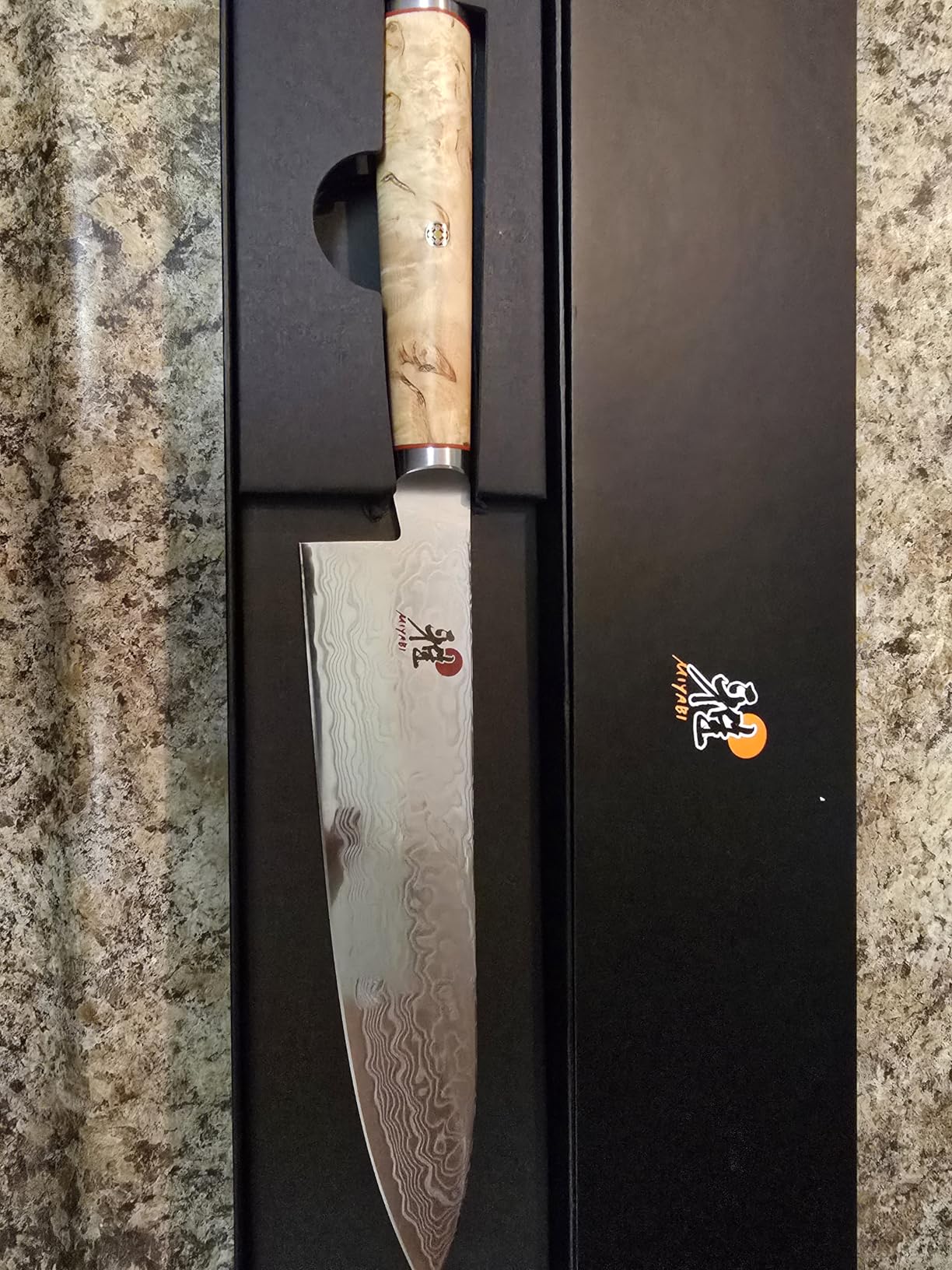
In service it behaves like a blade that has been sharpened well and then left alone. On beef, on hard cheese, on a full day of boneless prep, the edge holds its bite far longer than a VG-10 or a Swedish stainless, and the fine tip will do detail work on shallots and garnish that most 8 inch chef’s knives cannot reach.
The Karelian birch handle is the part people are paying for. It is feather light, it warms to the hand within a minute, and it is shaped so the blade balances toward the front, which is exactly what you want for a knife you use with a push-cut motion all day.
Who the Miyabi Birchwood SG2 suits in service
It suits a cook who already sharpens, or who has a sharpener on call, and who preps at a station that rewards precision rather than volume. Fine slicing, butchery trimming, cold kitchen garnish and sushi-adjacent work are where this blade earns its place on a roll.
It also suits anyone who wants their first serious Japanese knife with a warranty behind it. The Seki craftsmanship is not decoration on this model, and a 4.7 rating from 579 owners is a strong signal that the factory edge survives delivery.
What to watch out for
Watch the price relative to the review count. Fewer owners have run this blade in service than the Shun or the Global, so you are buying on build quality and steel spec rather than on a decade of accumulated service reports. That is a reasonable bet, but it is a bet.
Watch the maintenance requirement. At 9.5 to 12 degrees, a water stone sharpener is not optional and a honing rod alone will not save you. It is also a thin, delicate blade, and owners report chipping when it meets frozen product, bone, or a hard board corner. If your station is a protein-heavy one, keep it off the bone and expect to resharpen more often than the SG2 steel’s retention reputation suggests.
4. Enso HD VG10 8 inch Gyuto – the vegetable prep workhorse
Enso Chef’s Knife – Made in Japan – HD Series – VG10 Hammered Damascus Stainless Steel Gyuto – 8″
37-layer VG10 Damascus
61 HRC
12 degree hand-ground edge
Tsuchime hammered finish
Micarta handle
Pros
- Exceptional sharpness out of the box
- Tsuchime hammered finish cuts food adhesion
- VG10 steel at 61 HRC
- Triple-rivet Micarta handle
- Lifetime warranty
Cons
- Tip guard sometimes arrives loose
- VG10 needs careful maintenance
- Not for bones or frozen food
The Enso HD is a straight 8 inch gyuto in VG10 at 61 HRC, hand-ground to roughly a 12 degree edge, and it is the blade we would hand to a cook doing eight hours of vegetables in a row. Nothing about it is exotic, and that is the point.
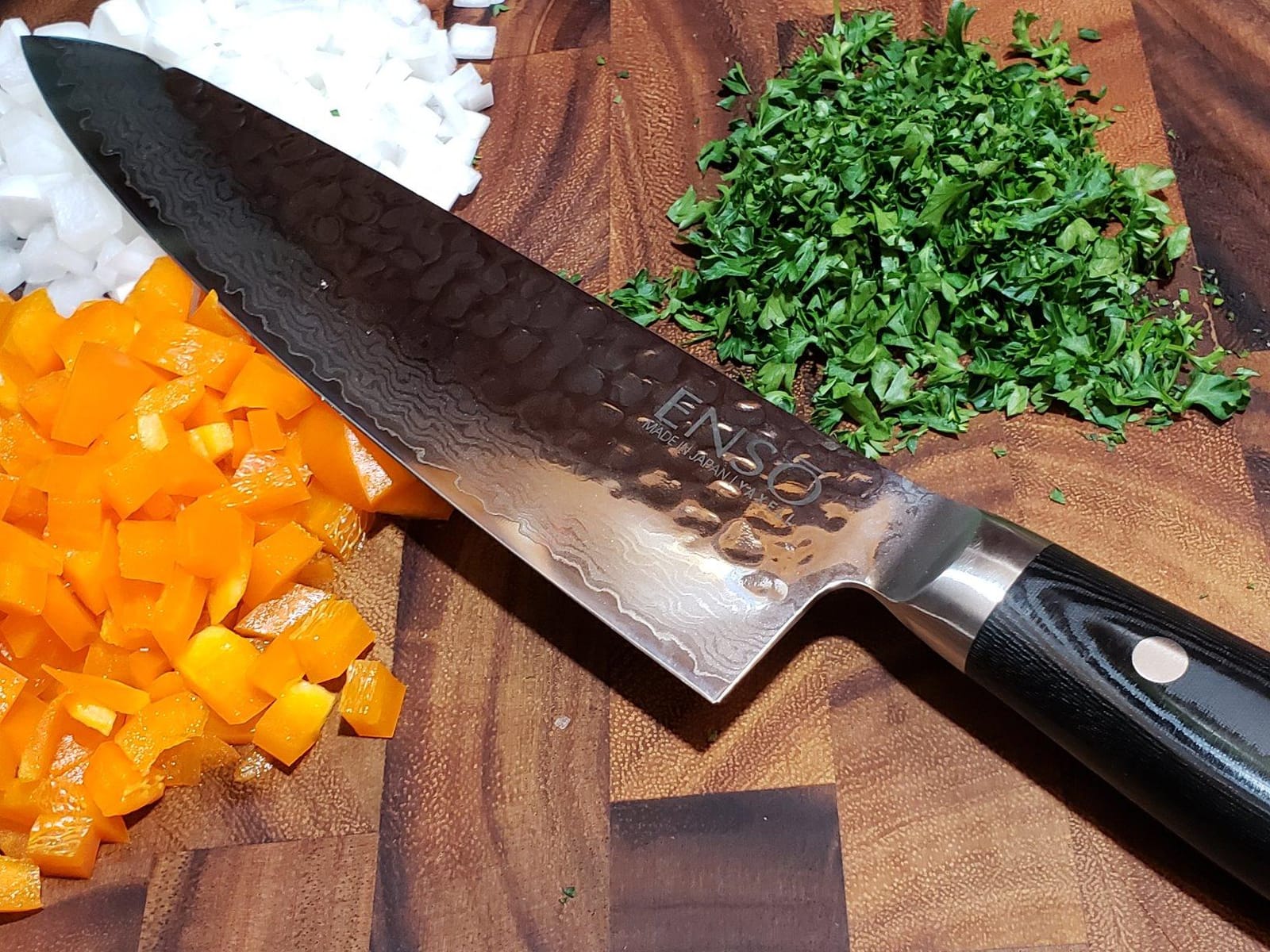
The tsuchime hammering is a real functional feature rather than a pattern to look at. Dimples across the blade face reduce the contact area between food and steel, so a mirepoix batch for a weekend service does not weld itself to the side of the blade halfway through the shift. On a stationary blade, that is a genuine time saving measured in knives per hour.
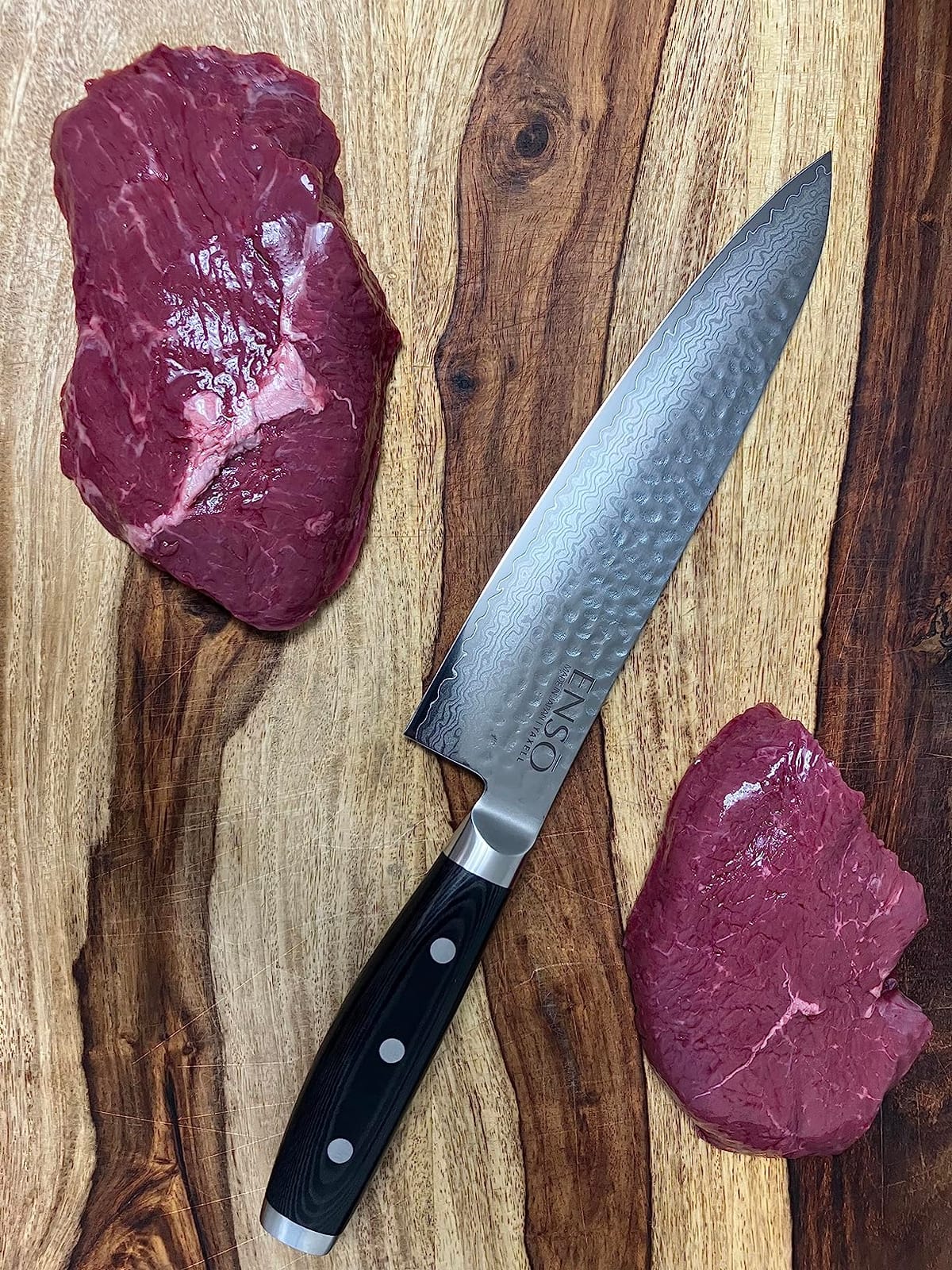
Specifications worth noting for service use: 61 HRC is at the harder end of what you can comfortably sharpen on a water stone, the spine at the heel is listed at 2 mm, and the double bevel works for either hand without a specialist sharpener. The black canvas Micarta handle with three rivets and a steel end cap is a robust Western-style grip that shrugs off moisture and does not need oiling.
Owners rate the factory edge as exceptional out of the box, and at 531 reviews with a 4.7 average there is enough history here to trust that rather than take it on faith. Expect to put it on a stone sooner than the Shun, because 61 HRC is working steel, not forgiving steel.
Who the Enso HD suits in service
It suits a cook whose station is vegetables, sauces and starches, and who wants a blade that stays sharp through a long prep without needing a reset. The hammered surface earns its keep specifically on high-moisture work, and the double bevel means one knife covers a left- or right-handed setup.
It also suits a cook who is moving up from a European chef’s knife. The weight, the balance point and the grip diameter are all conventional, so the transition to a Japanese edge angle happens without your hand learning a new shape.
What to watch out for
Watch the quality control. Owners report a tip guard that occasionally arrives loose, which is minor but tells you the final assembly is not the tightest in the category. Check it on arrival.
Watch VG10 honestly. Forum cooks who sharpen daily describe it as fussy to deburr, and it will not tolerate being put down on a board and dragged. Keep it off bone, nutshells and frozen product, and expect a stone session every week or two rather than every few weeks. If you want easier living at that hardness, a Swedish stainless is the more forgiving choice.
5. Yoshihiro VG10 16 Layer Gyuto 210mm – the balanced all-rounder
Yoshihiro VG10 16 Layer Hammered Damascus Gyuto Japanese Chefs Knife (8.25” (210mm))
VG10 stainless core
60 HRC
16-layer hammered Damascus
6.4 oz
210mm blade
Pros
- VG10 steel with good edge retention
- Lightweight at 6.4 ounces
- Full tang mahogany handle
- Hammered finish reduces sticking
- Handcrafted in Japan
Cons
- Needs water whetstone sharpening only
- Not for bones or frozen food
- Must be hand washed and dried
The Yoshihiro HDGY21 is a 210mm gyuto, which is the Japanese chef’s knife length that most professionals actually carry. It is 6.4 ounces, forged, double-edged with a 50/50 balance, and it is built with a Western-style full tang mahogany handle, so it feels familiar to anyone who came up on a German or American chef’s knife.
VG10 at 60 HRC is the industry default for a reason. It takes a fine edge, holds it well against acidic and wet food, and a 16-layer hammered Damascus jacket gives the blade some flex forgiveness along the length. That balance between hardness and toughness is what makes it the safest Japanese steel to hand to a cook who does not sharpen daily.
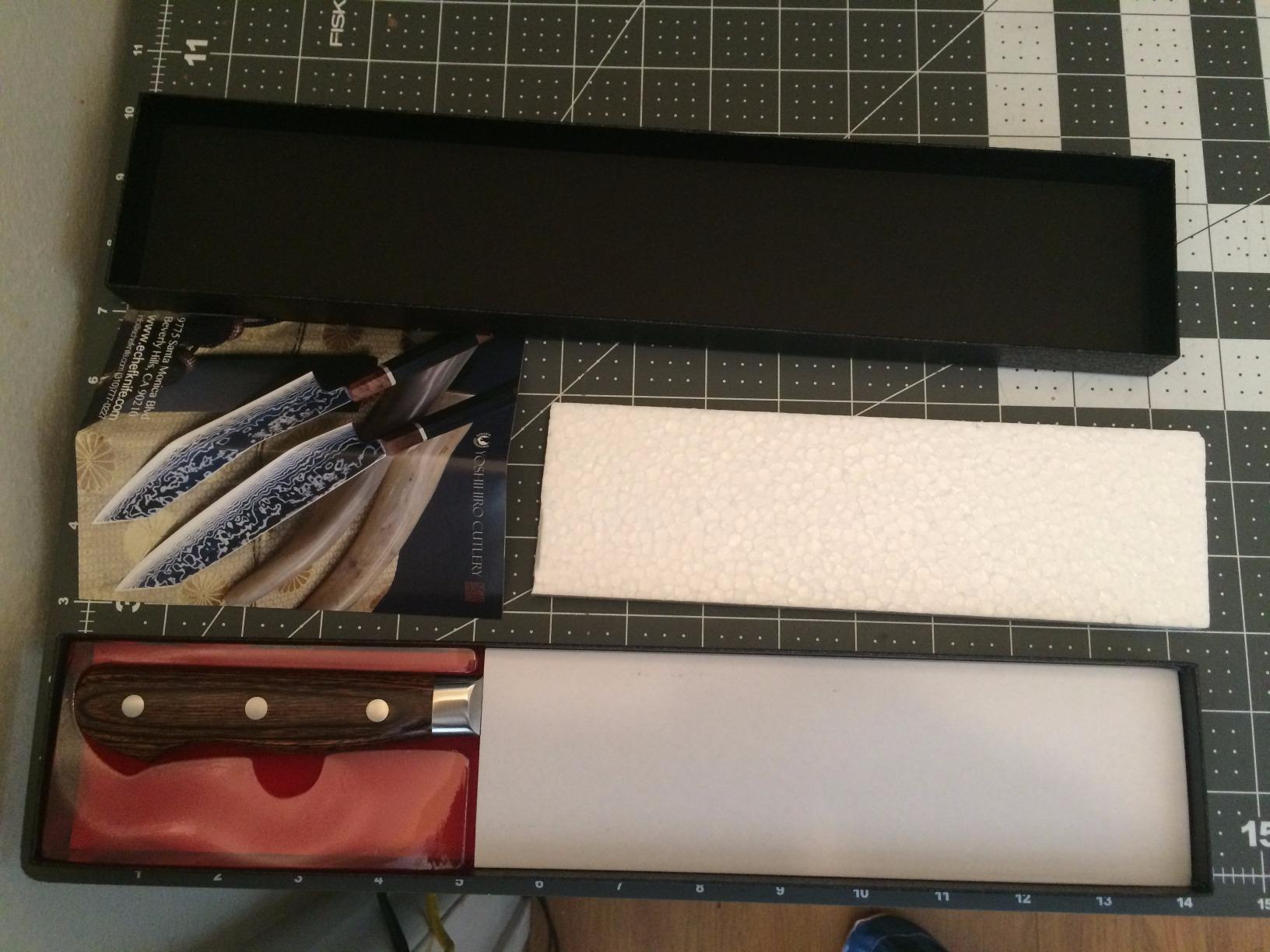
The blade is a 210mm, and that is a deliberate professional choice rather than a compromise. Shorter than a 240mm means less travel per stroke, faster recovery on a dense board, and far less wrist extension over a repetitive dice. On a night when you are doing nothing but prep for four hours, that adds up.
The hammered texture gives it the same food-release benefit as the Enso, and the mahogany handle with a full tang is a shape you can grip with a pinch or a fist without thinking about it. The handle is the least Japanese part of this knife, and that is precisely why it works for a Western-trained cook.
Who the Yoshihiro VG10 suits in service
It suits a cook who wants a traditional Japanese edge and geometry without relearning how to hold a knife. The 210mm length, the double bevel and the full tang make it the easiest transition in this roundup, and 468 owners at 4.6 stars suggest it delivers once you make it.
It also suits a travelling or rotating cook who needs one knife that covers prep, slicing and general protein work without a second blade in the roll. It is also available in 7 inch, 8.3 inch and 9.5 inch versions, so a cook can size up or down without changing makers.
What to watch out for
Watch the maintenance instruction: water whetstones only. That is a real constraint if the only sharpener at work is a machine box, and it is the reason so many working cooks end up in a harder steel they cannot maintain.
Watch the limits of the geometry. It is not a bone knife, not a frozen-product knife, and a thin edge at 60 HRC will chip if you treat it like one. Hand wash and dry it immediately, keep it off the drop rack, and do not let it sit wet inside a roll overnight.
6. Misono UX10 No. 712 21cm – the fine slicing specialist
Misono UX10 Chef’s Knife No.712/21cm
Swedish stainless steel
59-60 HRC
Asymmetrical edge
5.6 oz
21cm blade
Wood handle
Pros
- Professional kitchen standard for 40 plus years
- Extremely light at 5.6 ounces
- Asymmetrical edge slices cleanly
- Holds an edge very well
- Stain resistant and low maintenance
Cons
- Asymmetrical edge needs specialist sharpening
- Very thin blade unsuited to heavy work
- No grantons so food can stick
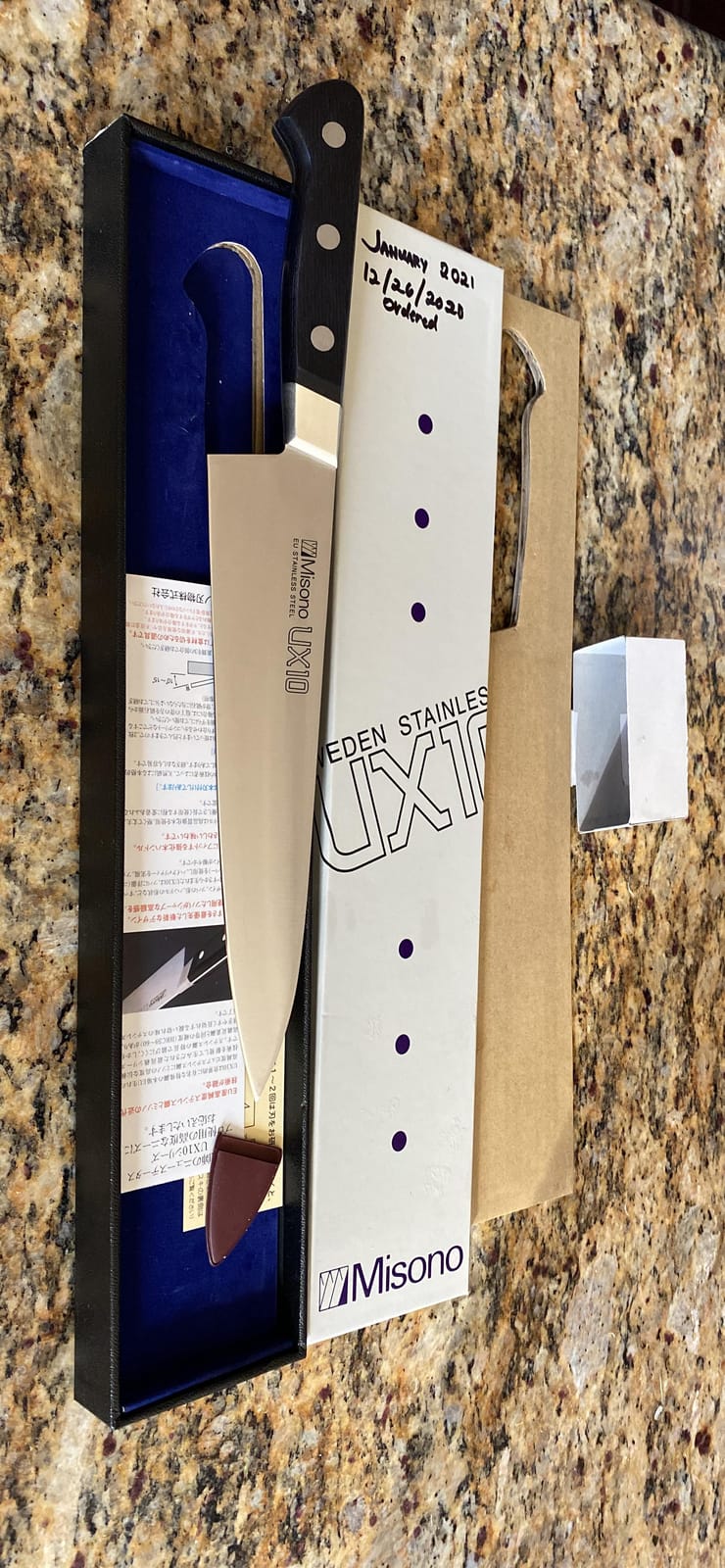
The Misono UX10 is the only blade in this roundup with a genuine professional pedigree claim attached to it: the UX10 line is Misono’s top tier and has been a working standard in professional kitchens for more than forty years. At 5.6 ounces it is also by far the lightest thing here, and that is not a gimmick in a ten-hour shift.
The steel is Swedish stainless, hardened to 59 to 60 HRC. That is a slightly softer treatment than most of the Japanese knives on this list, and it is a deliberate trade: you give up a little absolute hardness and get back a steel that is far more willing to take an edge and far more forgiving of a slightly imperfect sharpening stroke.
The asymmetrical edge is the thing that makes it a slicer. Rather than a symmetrical grind, the bevel is weighted toward one side, which concentrates the edge angle on the cutting side and produces a cleaner, finer cut on a thin-sliced vegetable or a fillet. The blade profile is very thin, and there are no grantons, so food does contact more of the blade face.
That lack of grantons is also a real drawback, and owners mention it. On a wet, sticky prep, expect to wipe the blade more often than you would with a hollow-ground or dimpled design. For a cook doing dry slicing, brunoise, or fine knife work, the trade is clearly worth it.
Who the Misono UX10 suits in service
It suits a station that slices: a garde manger position, a sushi-leaning kitchen, a banquet line doing a lot of fine vegetable and garnish work. At 5.6 ounces with a balance near the bolster, it is the least tiring knife to hold in this roundup, and that is a genuine professional advantage over a nine-hour shift.
It also suits a cook who wants a professional-grade blade that is not hard steel. At 59 to 60 HRC in Swedish stainless, it is the most achievable to sharpen in this group, and it tolerates a less-than-perfect angle far better than anything in the 61 HRC range.
What to watch out for
Watch the sharpening requirement. The asymmetrical bevel needs a sharpener who knows what they are doing, and a general-purpose two-sided technique will not restore the geometry properly. If your kitchen has no one who can do that, this is a poor choice despite the quality of the steel.
Watch the weight and the thinness together. At 5.6 ounces with a very thin blade, this is not a knife for deboning, not a knife for squash, and not a knife that will forgive a dropped pan. The wood handle also needs occasional oiling if you want it to stay smooth, which is one more task in a kitchen that does not have spare minutes.
7. Masamoto VG 210mm Gyuto – the one built for larger hands
MASAMOTO VG Japanese Chef Knife 8.3″ (210mm) Gyuto Professional Chef’s Knife, Ultra Sharp Japanese Stainless Steel Blade, Duracon Handle, Made in JAPAN
Hyper molybdenum vanadium steel
58-59 HRC
70/30 asymmetrical grind
7.04 oz
Duracon POM handle
Pros
- Tall heel gives knuckle clearance
- Duracon POM handle is durable and hygienic
- Full tang with stainless bolster
- 70/30 grind releases food well
- Made by a brand working since 1866
Cons
- Food still sticks for some users
- Smaller review base than the leaders
- Higher price than similar workhorses
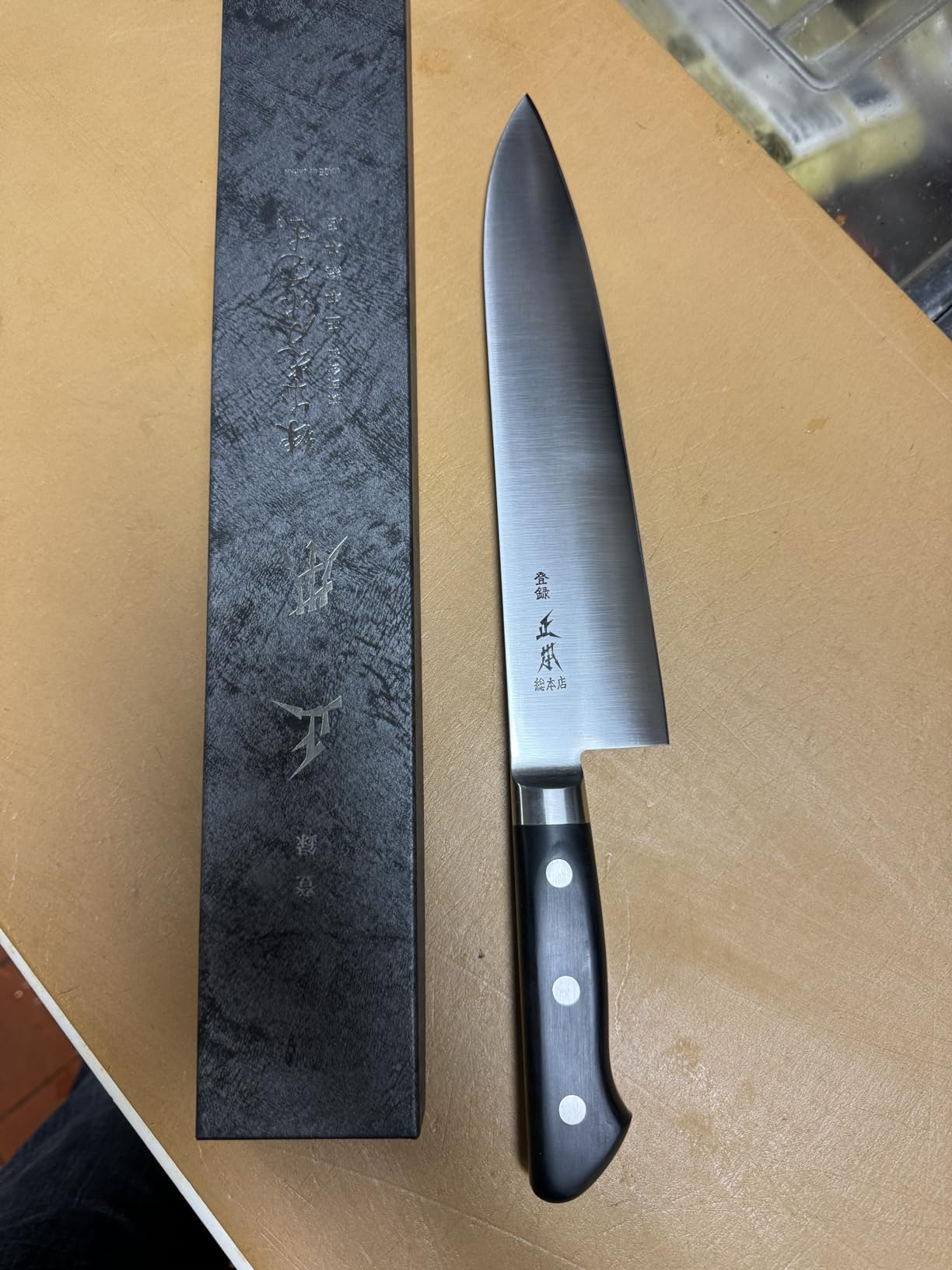
Most complaints about Japanese chef’s knives come down to handle geometry, and the Masamoto VG is the answer for a specific hand. The heel is tall, which means the bolster does not hit your knuckles when you grip the handle hard, and that single design choice converts a lot of disappointed purchases into happy ones.
It is a 210mm gyuto at 7.04 ounces, forged, full tang, with a stainless steel bolster and a Duracon POM handle. The POM is a high-durability polyacetal resin: it does not absorb water, does not need oiling, will not crack in a wash station, and can be scrubbed with anything. In a commercial kitchen that is a genuinely better material choice than wood, even if it is less traditional.
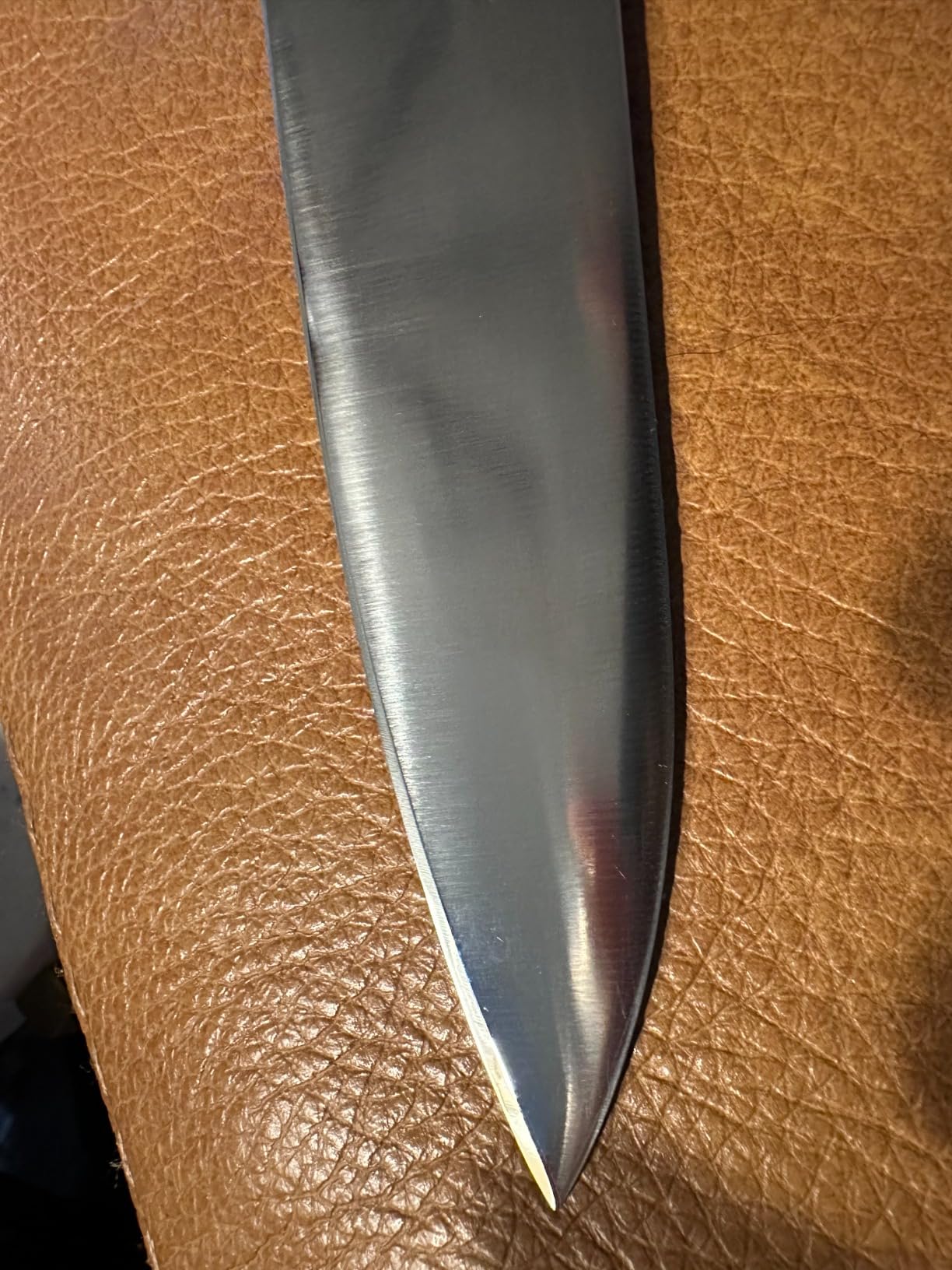
The steel is described as a hyper molybdenum vanadium stainless at 58 to 59 HRC, and the 70/30 asymmetrical grind is the functional detail worth knowing: the bevel is weighted toward the cutting side, so the food releases off the blade as you cut instead of staying welded to the face. It is less aggressive than a full single bevel and much easier to maintain than one.
That hardness rating is the most approachable in this roundup. 58 to 59 HRC means less steel comes off per sharpening session, the edge is easier to bring up, and the steel is more forgiving of a rock-cut or push-cut technique that is not perfectly consistent. For a working cook, that is often the difference between sharpening on Sunday and skipping it.
Who the Masamoto VG suits in service
It suits cooks with larger hands, or anyone who has bounced off the small handles on conventional Japanese knives. The tall heel, the full tang and the substantial bolster make it feel solid and positive in the hand in a way a slim wa-handle gyuto does not.
It also suits cooks building a professional roll at a single price point. Masamoto has made knives in Japan since 1866, and the same construction is available in four lengths, from 7.1 inch to 10.6 inch, so a cook can pick the size that matches the station rather than changing makers.
What to watch out for
Watch the review base. At 129 reviews, this is the thinnest evidence pool of the workhorse-tier knives here, and the 4.6 average carries a 79 percent five-star share, so there are more mixed experiences in there than in the 4.8-rated leaders. Ask yourself whether the handle fit is worth that, because it is the main reason to choose it.
Watch the fact that some owners still report food sticking despite the 70/30 grind. There are no hollow-ground indentations on this blade, so on wet prep you will still be wiping down between tasks. That is a minor cost, but on a line it is a real one.
8. Miyabi Kaizen 8-Inch Chef’s Knife – the sharpest rated workhorse
Miyabi Kaizen 8-Inch Chef’s Knife
VG10 CRYODUR at 60 HRC
65-layer Damascus
Honbazuke honed to 9.5-12 degrees
11.2 oz
Micarta handle
Pros
- Highest rating in the roundup at 4.8
- CRYODUR VG10 ice-hardened to 60 HRC
- Honbazuke three-step hand honing
- Ergonomic Micarta handle with steel end cap
- Lifetime warranty
Cons
- Heavier than lighter rivals at 11.2 oz
- Resin handle is not to every taste
- Hard steel can chip if misused
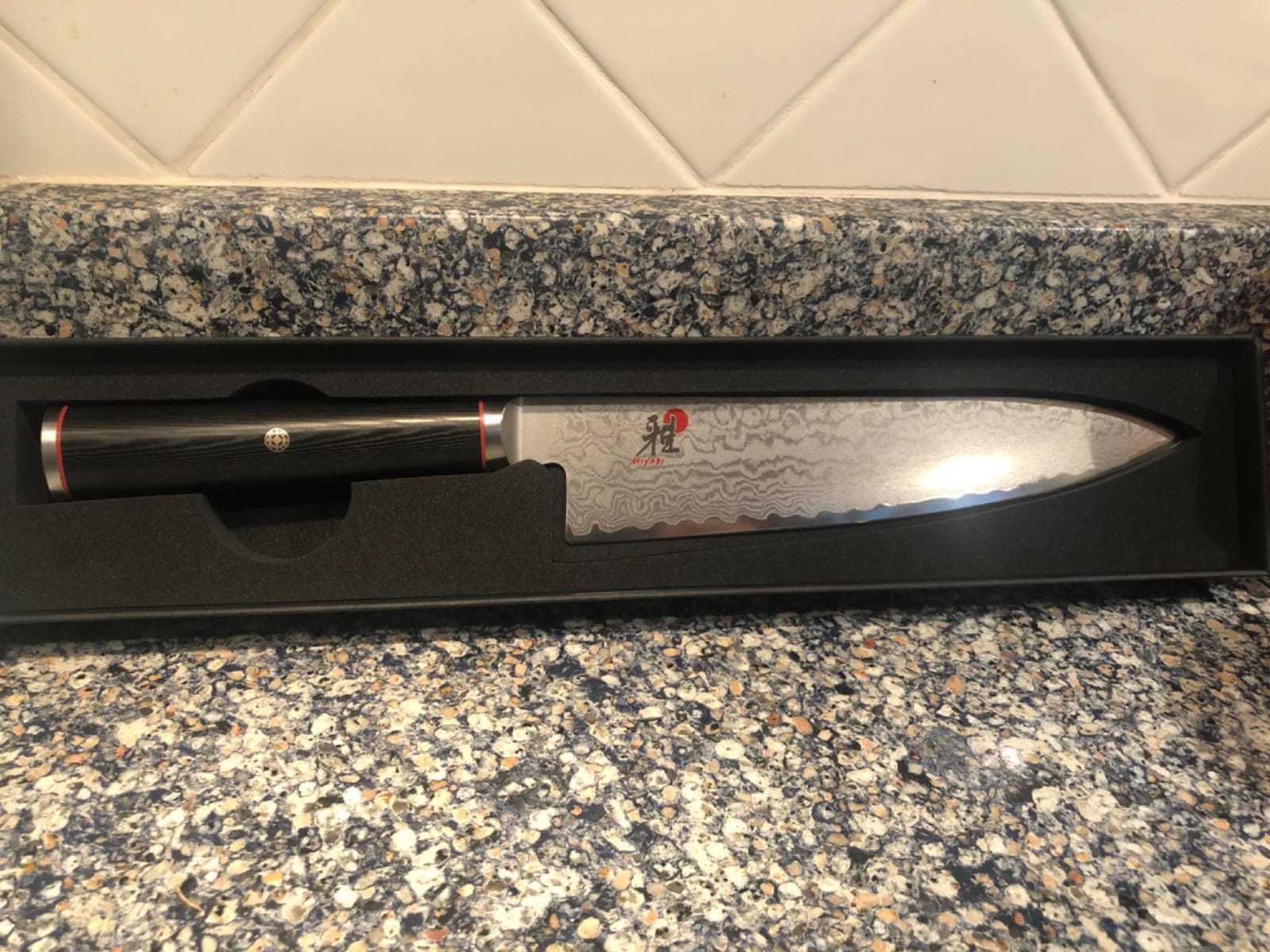
The Miyabi Kaizen carries a 4.8 average across 479 reviews, which makes it the highest-rated blade in this roundup, and the construction is the most traditional of the group. A VG10 CRYODUR core ice-hardened to 60 HRC, 65 layers of Damascus cladding, and an authentic thin Japanese profile honed by hand through a three-step Honbazuke process down to 9.5 to 12 degrees per side.
CRYODUR is the part to understand. It is a cryogenic treatment: the steel is cooled to well below freezing after quenching, which refines the structure and reduces the brittleness that a hard Japanese stainless can develop. The practical result is a steel that is hard but less brittle than an untreated equivalent, which is precisely the property you want in a blade that will hit a board.
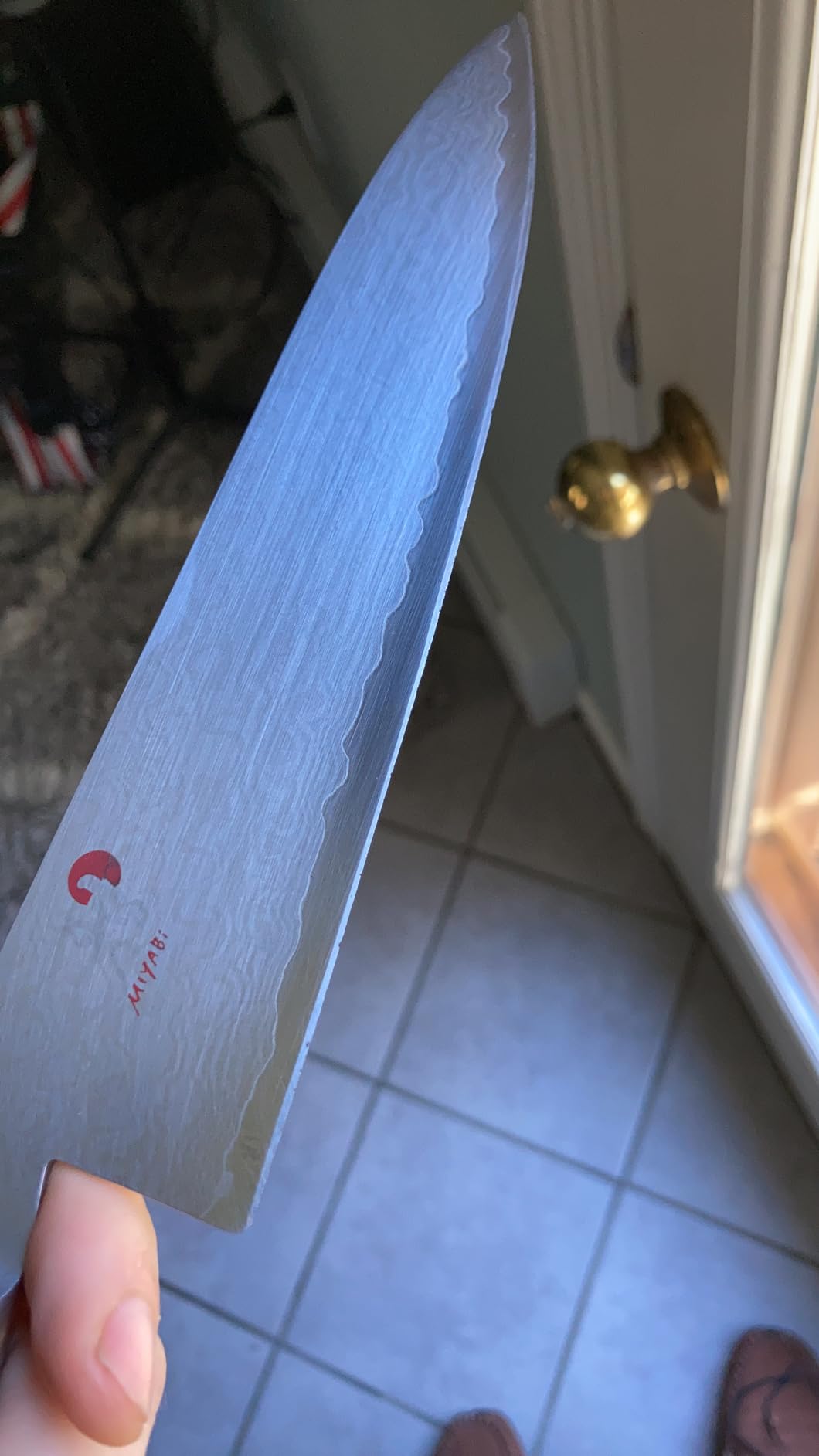
At 11.2 ounces it is the heaviest blade on this list, and we would not hide that. A 210mm light gyuto is quicker for pure prep volume, but a heavier blade with a hand-honed fine edge travels through a dense sweet potato or a firm cabbage with less force, and for many cooks the weight is an advantage rather than a problem. The Micarta handle with a linen pattern, mosaic pin and red accent spacers is a positive grip with real texture when your hands are wet.
Owners praise the balance and comfort over extended use, which is the specific thing a professional should be checking. A blade that feels great for a demo in a kitchen showroom can feel wrong after six hours of repetitive prep, so a comfortable handle under fatigue is worth more than a beautiful finish.
Who the Miyabi Kaizen suits in service
It suits a cook who wants a genuinely Japanese edge angle, on a knife that still feels sturdy in a Western hand. The thin profile, the 9.5 to 12 degree Honbazuke edge and the ice-treated core mean it will make cleaner push cuts and finer garnish work than any of the 60 degree-plus-angle knives here.
It also suits anyone building a roll slowly over a few years, because the lifetime warranty and the fact that Seki production quality is consistent mean the second and third knife from this maker will match the first.
What to watch out for
Watch the weight if your shift is pure high-volume prep. At 11.2 ounces it is nearly double the weight of the Global G-2, and over a full day that difference is felt in the wrist. If you do a lot of fine dicing, weigh it in your hand before committing.
Watch the resin handle preference and the chipping risk. Not every cook likes a composite handle over wood, and at 60 HRC owners do report chipping when the blade is used on frozen product or bone. Keep it hand washed, dry it immediately, and store it away from the drop rack.
9. Yoshihiro AUS10 Wa Gyuto 210mm – the traditional handle option
Yoshihiro AUS10 Ice Hardened Stainless Steel Wa Gyuto Japanese Chef Knife Ebony Triple Ring Handle (Blade Length: 8.25″ (210mm))
AUS10 stainless at 61 HRC
Wa octagonal ebony handle
Single-piece forging
8.25 inch blade
Includes wood saya
Pros
- Traditional octagonal wa ebony handle
- AUS10 ice-hardened to 61 HRC
- Includes a magnetic wood sheath
- Thin blade for precision work
- Double bevel for versatility
Cons
- Ebony handle needs maintenance
- Some reports of edge chipping
- Wood sheath may not hold the blade firmly
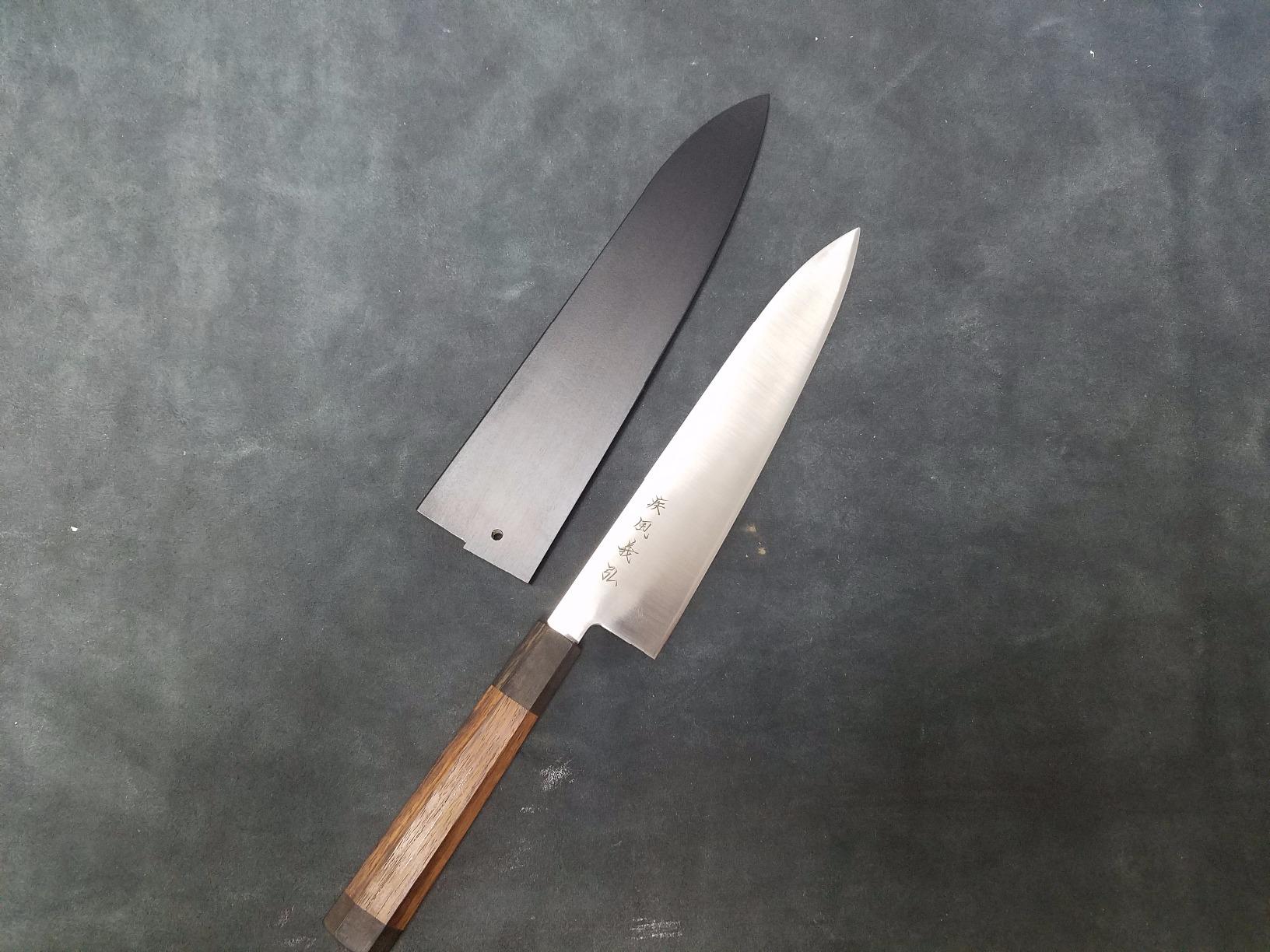
This is the only wa-handled knife in the roundup, and that is the reason to consider it. A traditional octagonal ebony handle with a triple ring ferrule gives you a thinner, more neutral grip than any bolstered Western handle, and the balance point moves forward into the blade, which is what a push-cut technique actually wants.
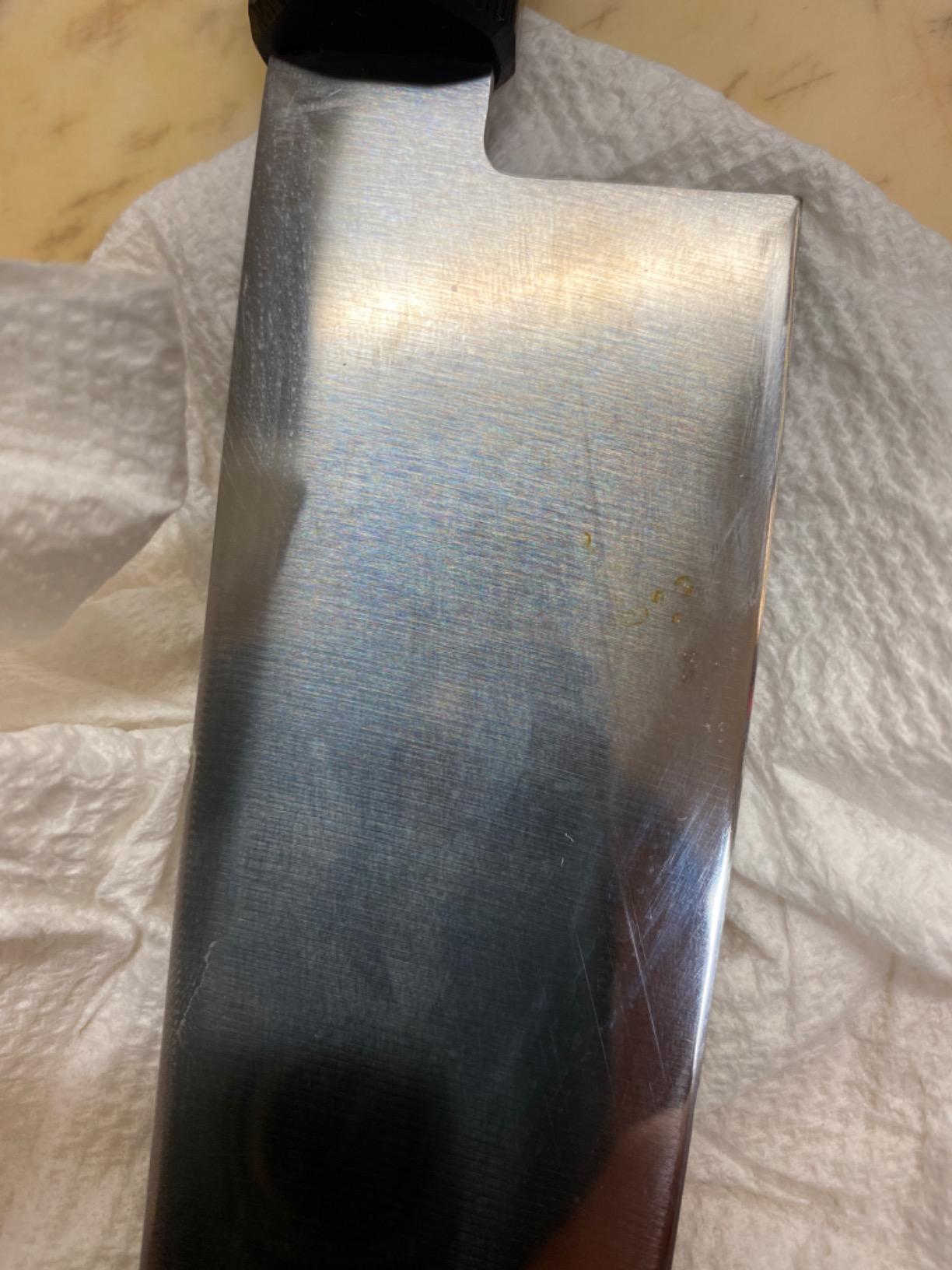
The steel is AUS10, an ice-hardened stainless at 61 HRC, single-piece forged and double-edged. AUS10 is a slightly softer and more forgiving alloy than VG10, which in practice means an edge that is easier to bring up on a water stone and less brittle when the geometry is not perfect.
It arrives with a magnetic wood saya, and that sheath is a genuine part of the design rather than an accessory. A professional knife that lives in a roll does not need a sheath, but a traditional-handle knife that travels does, and a wood sheath protects both the edge and your other kit in a bag.
The thin blade profile is the trade for the traditional handle. It slices and minces beautifully, and a knife this thin is very good at a pull-through cut through a firm vegetable. It is also, by definition, less able to take a shock, and at 61 HRC that combination is where chips come from.
Who the Yoshihiro AUS10 suits in service
It suits a cook who has decided they want a traditional Japanese grip, and who understands that a wa handle is lighter and gives more control than a bolster. For a cook who spends the day doing fine, controlled cuts rather than high-volume chopping, the forward balance is a real advantage.
It also suits a cook building a travelling or teaching kit, because the included sheath and the octagonal handle are the configuration most people picture when they think of a Japanese chef’s knife, and it will not be out of place on a sushi counter or a kaiseki line.
What to watch out for
Watch the numbers, honestly. A 4.5 average from 104 reviews is the thinnest and lowest-rated evidence base in this roundup, and the five-star share sits well below the 85 to 90 percent the leaders command. That does not mean it is a bad knife, but it means you are buying on design principle rather than on a large body of service reports.
Watch the maintenance. Ebony needs occasional oiling to stay smooth, the magnetic sheath may not hold the blade firmly enough for a bag that gets tossed, and owners do report some edge chipping. This is the knife in the list most likely to reward an owner who maintains it and disappoint one who does not.
How to Choose a Japanese Chef Knife for a Professional Kitchen?
Buying well means answering four questions in order, and the order matters. Get the steel right for your kitchen’s wetness, get the profile right for your station, get the handle right for your hand and grip, and only then decide how thin an edge you want to live with.
Choose the profile by station
Match the profile to the work, not to the brand. A gyuto is the Japanese chef’s knife and the right default for a cook who preps for volume, a santoku is shorter and slightly more compact for a cook who wants one blade to do everything, a bunka or a nakiri is a specialist for vegetables, and a deba is a thick, single-bevel fish knife for a seafood house. If you want the wider picture on shape and size, our chef’s knife comparison covers the general case.
Stainless, carbon, or clad: the steel decision
For a commercial kitchen, stainless is the right default. It survives a hot scullery, it tolerates an edge that sits wet, and it does not punish a cook who sharpens twice a week instead of daily. Carbon steel, the Aogami White #2 and Blue #2 family, gives you a finer and more responsive edge and noticeably better bite on hard vegetables, but it patinas, it stains, and it will spot if it is left wet. Forum cooks with long careers tend to say the same thing about both: the question is not which steel is better, it is whether you will actually maintain the knife you choose.
Ginsan and Silver 3 sit in the middle and deserve more attention than they get. They are stainless steels that sharpen more easily than VG-10, and experienced forum members regularly describe them as the practical answer for a cook who wants a Japanese edge without a VG-10’s difficult deburring. Among the nine knives here, the Misono UX10 in Swedish stainless at 59 to 60 HRC plays a similar role, and the Masamoto at 58 to 59 HRC is the most forgiving of the lot.
Length, handle and weight
Choose 210mm if you prep all day, 240mm if you work on larger boards and whole proteins, and treat anything past 270mm as a station knife rather than a roll knife. Then choose the handle. A wa octagonal handle gives you a lighter, more neutral grip and a forward balance, which suits a push-cut technique; a Western bolstered handle gives you more control for heavy work and is easier to grip with a wet hand. Test both against your own hand before you commit.
Budget for thinning, not just for the knife
Expect to do work on a new Japanese blade before it performs. Many mid-range Japanese knives arrive thicker behind the edge than a good one should, which is what experienced forum cooks call work thinning: taking steel away with a 1000 grit stone to restore the intended geometry. Rounding the spine and finishing the choil is the same kind of job, and forum members note it is quick work with wet sandpaper. Budget two or three evenings per knife before you put it into service.
Understand that you cannot simply return it
Specialist knife retailers run short return windows and charge a return fee, and a blade that has been sharpened or developed a patina is effectively non-returnable. Professional buyers say plainly that they cannot trial a knife the way a casual buyer can, which means the decision has to be right the first time. If you travel to Japan to buy, forums consistently point to Kama-Asa in Tokyo as the best all-round store and to the Sakai Traditional Crafts Museum near Osaka for selection, but you still carry the blade home, and a sharpening service in your own country is worth having.
What to skip
Skip decorative Damascus that is cladding over an ordinary core with no hardness rating published, skip knives that arrive with no factory edge and no instruction, and skip anything you only want because a video made it look fast. A knife with a published steel, a published HRC figure and a real factory grind is worth more than a beautiful blade with no specifications at all.
Frequently Asked Questions
Which is better for Japanese knives, stainless steel or carbon steel?
For a commercial kitchen, stainless is the better choice. It survives a hot nightly scullery, tolerates an edge left wet, and asks nothing of you between shifts. Carbon steel, including Aogami White #2 and Blue #2, gives a finer, more responsive edge and better bite on hard vegetables, but it patinas, stains, and spots if left wet. The honest framing is that carbon is not much harder to live with than people say, provided you dry the blade and sharpen it on a schedule.
Do chefs prefer carbon steel or stainless steel knives?
Most working cooks default to stainless for practical reasons: a busy kitchen has no time for a blade that needs drying, oiling and attention between orders. The cooks who actively prefer carbon are usually the ones who sharpen daily anyway and want a finer edge on the board. A common professional compromise is a stainless chef’s knife for prep and a single carbon or clad blade reserved for a station where the finer edge genuinely pays.
What size gyuto should a professional chef buy?
A 210mm gyuto is the size most professionals carry, because it moves fast on a small board and keeps wrist extension down over a long prep. A 240mm covers more surface per stroke and suits cooks working on large boards and whole proteins. Anything above 270mm is a station knife rather than a roll knife, and it demands a dedicated sharpening setup. If you are buying your first professional Japanese blade, 210mm is the safer default.
Can Japanese knives go in the dishwasher?
No. The heat, the detergent and the tumbling in a commercial wash rack will damage a Japanese edge, loosen handle adhesive, and strip a carbon blade’s patina. Wash by hand with hot water and a neutral soap, dry immediately with a towel rather than air drying, and store the blade away from the drop rack. The all-stainless Global is the most forgiving of the blades here, but even it should be hand washed if you want the factory grind preserved.
How often should a professional chef sharpen their knives?
A professional should hone on every shift and sharpen on a whetstone about once a week, adjusting to how hard the steel is and how much volume you cut. A 61 HRC VG10 or SG2 blade loses its bite faster and needs a stone session more often than a 58 HRC Swedish stainless. Work thinning is a separate job: check a new knife behind the edge before its first service and take steel away with a 1000 grit stone if it feels resistant.
Are professional Japanese knives worth buying in Japan?
Often, but the savings are not the whole story. Forums point to Kama-Asa in Tokyo as the best all-round store and to the Sakai Traditional Crafts Museum near Osaka for selection, and buying direct avoids the retailer margin. Budget for shipping the blade home, for customs on the return, and for sharpening once you get it back to your own kitchen. Warranty service in your own country is worth more to a professional than a modest saving.
Which Japanese Chef Knife Should You Buy First?
Buy one knife first, sharpen it properly, and add the rest of the roll once you know what your hand actually wants. For most working cooks, the best Japanese chef knife for professionals in 2026 is the Shun Classic, because it is the most forgiving blade in service and the least demanding maintenance. If your kitchen is wet and you sharpen rarely, take the Global G-2. If you sharpen on purpose and want the finest edge available here, the Miyabi Kaizen or the Birchwood SG2 are the two to compare.
Whichever one you choose, buy a 1000 grit water stone before you buy the knife, set aside an evening to thin and finish it, and the blade will outlast the roll it sits in. Start with one, use it hard, and come back for the rest when you know what the work demands.