
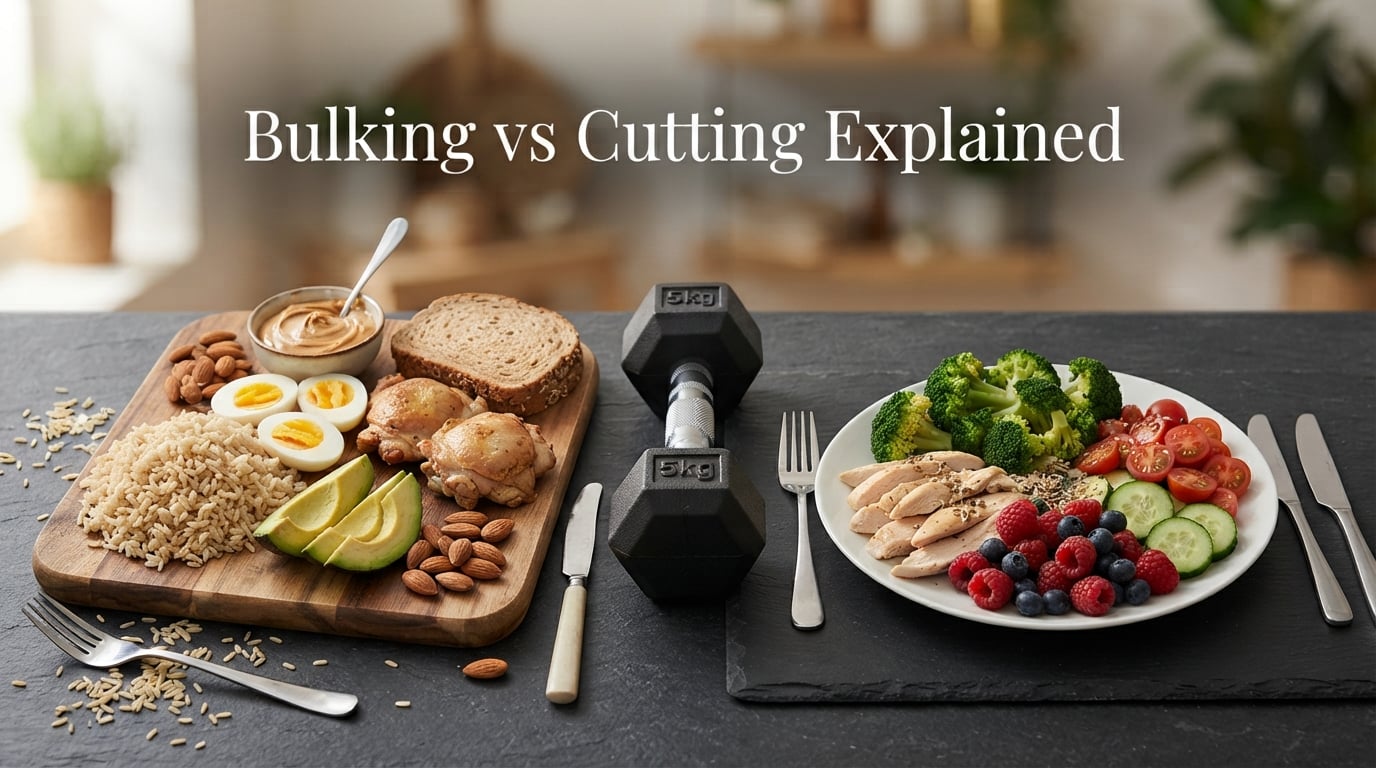
If you have spent any time in a gym or scrolling fitness content online, you have probably heard the terms “bulking” and “cutting” thrown around like they are gospel. But what do they actually mean, and how do you know which one to do first? In this guide, I will walk you through the bulking vs cutting explained in plain English, with the numbers, food lists, and timelines I wish someone had given me on day one.
Whether your goal is to build muscle, drop fat, or just look better without your shirt, understanding these two phases is non-negotiable. The same logic that drives competitive bodybuilders drives anyone who wants real, lasting body composition change. The benefits of regular exercise always start with knowing what you are actually feeding your body.
By the end of this article, you will know exactly what each phase does, how to calculate your own numbers, which to start with based on your current body fat, and the mistakes that keep most people stuck. I have personally used both approaches for years, and the differences between doing them right versus doing them loosely are night and day.
Table of Contents
Bulking vs Cutting at a Glance
- Bulking: Eating in a calorie surplus (typically 10-20% above maintenance) to build muscle mass. Goal: gain weight on the scale, gain strength in the gym, accept some body fat increases.
- Cutting: Eating in a calorie deficit (typically 300-500 calories below maintenance) to lose body fat while preserving muscle. Goal: drop body fat, reveal muscle definition, maintain strength.
- Strategy for bulking: High protein (0.8-1g per pound of body weight), progressive overload training, calorie-dense whole foods, sleep 7-9 hours.
- Strategy for cutting: High protein (1-1.2g per pound), continued heavy lifting, fiber-rich vegetables, careful tracking.
- Typical timeline: Bulking lasts 3-6 months, cutting lasts 8-16 weeks depending on starting body fat and target.
- Downside of bulking: You will gain some fat along with muscle. Downside of cutting: hunger, lower energy, risk of muscle loss if done poorly.
| Phase | Calorie Target | Primary Goal | Typical Duration |
|---|---|---|---|
| Bulking | +10-20% over maintenance | Build muscle mass | 3-6 months |
| Cutting | -300 to -500 below maintenance | Lose body fat | 8-16 weeks |
| Maintenance | At maintenance (TDEE) | Recomposition or rest | Indefinite |
The two phases are not opposites you choose between forever, they are a cycle. Most lifters alternate them across years to keep making progress, with each cycle teaching you something new about your own metabolism and training tolerance.
What Is Bulking?
Bulking is the practice of eating in a sustained calorie surplus to provide your body with the raw materials and energy it needs to build new muscle tissue. When you consume more calories than you burn, you create an anabolic environment where protein synthesis can outpace protein breakdown, especially when paired with resistance training.
In simple terms, bulking is when you intentionally eat more food than your body needs to maintain its current weight. That extra fuel gets stored as glycogen, used to repair muscle after training, and, yes, packed away as some body fat. The whole point is to give your body permission to grow.
Without a surplus, muscle growth is painfully slow. Your body is engineered to survive, not to add tissue it does not think it needs. A surplus is the signal that says “we have more than enough, build something with it.”
Clean Bulk vs Dirty Bulk
A clean bulk aims for a small, controlled surplus, usually 200-400 extra calories per day from mostly whole, nutrient-dense foods. A dirty bulk involves eating anything and everything in sight, often 800-1500 calories over maintenance, with the goal of maximum muscle gain regardless of fat gain.
Most coaches and forum regulars agree that dirty bulking leads to excessive fat gain that takes months to strip back off. A clean bulk gives you roughly 80% of the muscle-building benefit with 20% of the fat gain, hence the popular 80/20 rule for bulking: spend 80% of your calories on whole foods and allow 20% for flexibility.
From personal experience, a clean bulk feels more sustainable. You keep your abs visible (if barely), your cardiovascular health stays solid, and the cut afterward is short and painless instead of a six-month slog.
What Is Cutting?
Cutting is the opposite approach. You eat in a calorie deficit to force your body to tap into stored fat for energy. The trick is doing this while keeping your muscle mass intact, which is why cutting is technically harder than bulking for most people.
Cutting means reducing calories below your maintenance level so your body burns stored fat for fuel. Done properly, you lose fat while keeping the muscle you worked so hard to build. Done poorly, you lose muscle along with fat, kill your energy, and end up looking skinny-fat instead of defined.
The body cannot selectively burn fat from one area, but it can selectively preserve muscle if you give it enough protein and enough training stimulus. That is the entire game during a cut.
Why Protein Matters Most During a Cut
When calories drop, your body looks for energy anywhere it can. To stop it from eating your hard-earned muscle, you keep protein high, lift heavy, and keep the deficit moderate. There is no magic to it, just discipline and math.
Forum users consistently note that cutting is more rewarding than bulking for one reason: you see visible changes in the mirror within weeks. Motivation stays higher because the scale and the tape measure both move in the direction you want.
Aim for 1-1.2 grams of protein per pound of body weight during a cut, slightly higher than during a bulk. Spread it across 4-5 meals of 30-40 grams each to maximize muscle protein synthesis throughout the day.
How to Bulk: Step-by-Step
If you decide bulking is your next move, follow these steps in order. Each one builds on the last, and skipping ahead is the most common reason people spin their wheels.
- Calculate your maintenance calories (TDEE): Use the Mifflin-St Jeor equation. Men: (10 x weight in kg) + (6.25 x height in cm) – (5 x age) + 5. Women: (10 x weight in kg) + (6.25 x height in cm) – (5 x age) – 161. Multiply the result by 1.2-1.55 based on your activity level to get Total Daily Energy Expenditure.
- Add a 10-20% surplus: Multiply your TDEE by 1.1 to 1.2. A 500-calorie surplus is roughly 1 pound per week of weight gain, which is the sweet spot for lean muscle growth with minimal fat gain.
- Set your macros: Protein at 0.8-1g per pound of body weight. Fat at 20-30% of total calories. Carbs fill the rest.
- Train with progressive overload: Focus on compound lifts (squat, deadlift, bench, overhead press, rows) for 3-5 sets of 5-10 reps. Add weight or reps each week.
- Track and adjust weekly: Weigh yourself daily, average the week. If you are not gaining about 0.5-1% of body weight per week, add 100-200 calories.
- Sleep 7-9 hours per night: Growth hormone peaks during deep sleep. Cutting sleep short undoes a lot of your surplus work.
Resistance training is what tells your body where to send the extra calories. Without it, the surplus just becomes fat. Read more about the strength training benefits that make this process work at any age.
One mistake I made early on was bulking too aggressively because I was impatient. Gaining 3-4 pounds per week sounds exciting until you realize most of it is fat and water. Slow is fast here, both for muscle growth and for keeping your long-term sanity.
How to Cut: Step-by-Step
Cutting follows the same logic in reverse. The goal is fat loss without muscle loss, and the rules are tighter than for bulking because the margin for error is smaller.
- Calculate maintenance calories the same way. Same equation as above. Be honest about your activity level.
- Subtract 300-500 calories. This produces a loss of about 0.5-1 pound per week, which is fast enough to see progress and slow enough to keep muscle.
- Set protein at 1-1.2g per pound of body weight. This is higher than during a bulk because you are actively trying to prevent muscle breakdown.
- Keep lifting heavy. Drop sets and reps, not load. Maintain your top-end strength on the big lifts as long as possible.
- Add cardio if progress stalls. Two to three sessions of 25-35 minutes of moderate-intensity cardio per week is plenty. Walking counts and works surprisingly well for fat loss when you cannot outrun your fork.
- Track weekly averages. If you are not losing 0.5-1% of body weight per week, reduce calories by another 100 or add a single cardio session.
Smart cardio integration can be the difference between a 12-week cut and a 24-week grind. Walk 8-12k steps daily on top of your lifting sessions, and you have nailed the basics of cardiovascular training for fat loss.
Expect to feel hungrier and have lower energy on some days, especially in the final weeks. This is normal. Refeeds (eating at maintenance for a day or two) every 1-2 weeks can help reset hormones like leptin and keep training quality high.
Which Should You Start With?
This is the most common question I hear, and the answer depends mostly on your current body fat percentage and training experience.
If you are a beginner with a higher body fat percentage (over 25% for men, over 32% for women), start with a cut. You have plenty of energy stored, and revealing some muscle definition will do more for your motivation than any surplus will. Beginners with a normal or lower body fat percentage (12-18% for men, 22-28% for women) can start with either, but a lean bulk is usually more rewarding because the muscle gains come quickly.
Skinny-fat individuals, the people who look thin in clothes but soft without them, are a unique case. The forum consensus is to cut first to drop the stubborn fat layer, learn fitness habits, and build discipline. Then bulk slowly once you have a clean base to add muscle to.
Body Recomposition: The Third Option
Body recomposition means eating at maintenance calories while training hard, allowing you to build muscle and lose fat at the same time. It works best for beginners, people returning after a long break, and those with significant fat to lose but who also have minimal muscle.
Recomposition is slower than a dedicated bulk or cut, but it spares you the yo-yo effect of bouncing between phases. For most people, it is the realistic middle ground that no one talks about in fitness magazines.
If you are an intermediate or advanced lifter, recomposition becomes much harder because your body is already close to its genetic ceiling for muscle mass. At that point, dedicated bulk and cut cycles are the only way to keep progressing.
Common Mistakes to Avoid
Most people fail at bulking or cutting because of one of these five mistakes. Avoid them and you will be ahead of most gym-goers.
1. Dirty Bulking
Eating 1500 calories over maintenance because you “want to make sure I have enough” only makes you fat, not muscular. A clean 300-400 calorie surplus builds almost as much muscle with a fraction of the fat gain.
2. Cutting Calories Too Aggressively
Dropping to 1000 calories a day does not double fat loss, it doubles muscle loss. Stick to 300-500 below maintenance unless you are already lean and have specific competition prep goals.
3. Dropping Protein During a Cut
Many people drop protein first when cutting because meat fills them up. This is backwards. Keep protein at 1g+ per pound or you will lose muscle along with fat.
4. Quitting Resistance Training
Long cardio-only cuts strip muscle. Keep lifting 3-4 times per week, even if you cannot maintain all your numbers. The signal to keep muscle is tension, not calories alone.
5. Not Tracking Anything
“Eating intuitively” works once you have years of experience. Until then, weigh your food, log it for at least 4 weeks, and learn what portion sizes actually look like.
A sixth mistake I see constantly is bouncing between phases every two weeks because progress feels slow. Pick a phase, commit for at least 8-12 weeks, and trust the process. Body composition change is measured in months, not workouts.
Foods to Eat During Each Phase
You do not need fancy meal plans. You need to hit your calories and protein, then fill in with whatever whole foods you enjoy.
Bulking Foods (Calorie-Dense and Easy)
For bulking, focus on calorie-dense foods that hit your macros without making you feel over-stuffed. Rice, oats, peanut butter, whole milk, eggs, chicken thighs, ground beef, salmon, sweet potatoes, bananas, nuts, olive oil, and protein powder. These have been my staples for years.
If you struggle to eat enough, drink some of your calories. Whole milk with a scoop of protein and a banana is an easy 500+ calories that takes 60 seconds to make.
Cutting Foods (High-Volume, Low-Calorie)
For cutting, fill your plate with vegetables, lean proteins, and whole grains. Chicken breast, white fish, egg whites, Greek yogurt, cottage cheese, broccoli, cauliflower, zucchini, bell peppers, lettuce, berries, and rice cakes. You can eat a huge volume of food and still hit your deficit.
Volume eating is the cheat code for cutting. A pound of broccoli is around 150 calories. A pound of chicken breast is around 700. Compare that to a pound of peanut butter at over 2,500 calories, and the strategy becomes obvious.
Recovery matters more than most people think during both phases. Read about the recovery strategies that actually move the needle between sessions.
Frequently Asked Questions
Is it better to bulk or cut?
It depends on your starting body fat percentage. Beginners or anyone above 25% body fat (men) or 32% (women) should start with a cut to drop body fat and reveal existing muscle. Anyone leaner can start with a lean bulk because the muscle gains come faster when you are not carrying excess fat. Beginners with average body fat can also try body recomposition at maintenance calories.
Is 3000 calories a day a bulk?
Not necessarily. Whether 3000 calories is a bulk depends on your maintenance calories. For a 200-pound man with an active job, 3000 calories might be a cut. For a 120-pound sedentary woman, 3000 calories is a massive surplus. Always calculate your own TDEE first, then add 10-20% to determine your bulk target.
What is the 80/20 rule for bulking?
The 80/20 rule for bulking means spending about 80% of your daily calories on whole, nutrient-dense foods like lean proteins, whole grains, vegetables, and healthy fats. The remaining 20% is flexibility for foods you enjoy, like pizza, ice cream, or takeout. This approach keeps you sane, hits your macros, and minimizes excessive fat gain.
How long should you bulk before cutting?
Most people bulk for 3-6 months before cutting. A good rule is to stop the bulk when you reach about 18-20% body fat for men or 28-30% for women, then cut for 8-16 weeks to get back to a lean starting point. The exact duration depends on how fast you are gaining weight and how lean you want to be between phases.
Can you build muscle and lose fat at the same time?
Yes, especially if you are a beginner, returning after a long break, or significantly overfat. Eating at maintenance calories with high protein and progressive overload training can produce simultaneous muscle gain and fat loss, though at a slower rate than a dedicated bulk or cut. Advanced lifters usually cannot pull this off.
Should women bulk and cut differently than men?
Women generally use smaller calorie surpluses and deficits because their total calorie needs are lower. Women should also keep protein proportionally higher relative to body weight (1g per pound) to preserve muscle during a cut. Hormonal fluctuations across the menstrual cycle can affect water retention and hunger, so timing phases around your cycle may help adherence.
Final Thoughts on Bulking vs Cutting Explained
Now you have the full picture of bulking vs cutting explained in a way you can actually use. Bulking builds muscle with a small, controlled surplus and heavy lifting. Cutting strips fat with a moderate deficit, high protein, and continued resistance training. Both phases work together as a long-term cycle for body composition change.
Start by calculating your TDEE, decide which phase matches your current body fat, and commit for at least 12 weeks. Track your weight, photos, and lifts weekly. Adjust calories by 100-200 if progress stalls. Most importantly, stay consistent, because the boring plan you follow beats the perfect plan you abandon.