
If the words “fat-burning zone” or “steady-state” feel confusing, you’re not alone. I remember scrolling through fitness videos years ago wondering why some trainers swear by long walks while others push 30-second sprints.
This guide on LISS cardio explained for beginners cuts through the noise. I’ll walk you through what low-intensity steady-state cardio really means, how to know you’re doing it right, and a starter plan you can follow this week.
LISS stands for Low-Intensity Steady-State cardio. It is cardiovascular exercise performed at a steady, moderate pace for an extended period, usually 30 to 60 minutes, while keeping your heart rate between 50 and 70 percent of your maximum.
By the end, you’ll know how to pick an activity, calculate your target heart rate, and build a weekly routine that fits your schedule without leaving you exhausted.
Table of Contents
What Is LISS Cardio?
LISS cardio is any aerobic workout you perform at a low, consistent effort for a sustained period. “Steady-state” means your pace stays roughly the same from start to finish. There’s no sprinting, no pausing for burpees, and no heart-rate spikes.
The acronym expands to Low-Intensity Steady-State cardio. You may also hear it called “steady-state training,” “Zone 2 cardio,” or simply “easy cardio.” All four phrases describe the same training style.
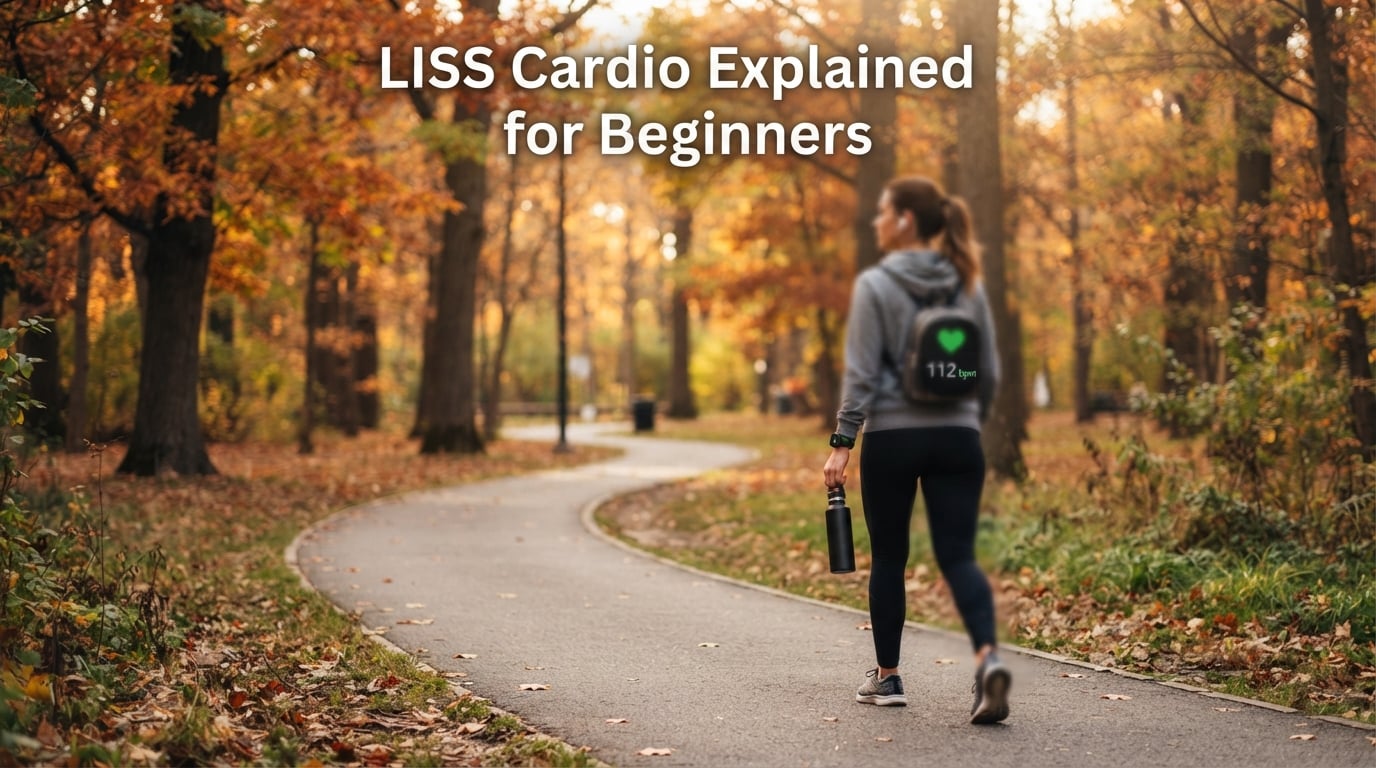
Walking at a brisk pace is the textbook example. If you can chat with a friend without gasping but feel your body warming up, you’re in the right zone. Other popular LISS activities include cycling, swimming, hiking, and rowing at a comfortable resistance.
The science is straightforward. When you keep your heart rate between 50 and 70 percent of maximum, your body relies primarily on fat as fuel. Carbohydrates still get used, but stored fat becomes the main energy source during longer sessions.
LISS Cardio at a Glance
Think of LISS as the opposite of high-intensity interval training (HIIT). Where HIIT pushes you to your limit in short bursts, LISS lets you settle into a rhythm you could maintain for an hour if needed.
Intensity: Low to moderate (50 to 70 percent of max heart rate).
Duration: Typically 30 to 60 minutes per session.
Rest between sessions: Often daily or 4 to 5 days per week.
Best for: Beginners, recovery days, fat loss, endurance building.
How LISS Cardio Works: Heart Rate Zones Explained?
LISS targets your aerobic, fat-burning heart rate zone, the range where your body uses oxygen efficiently and burns a higher percentage of fat for fuel. To find your zone, you first need an estimate of your maximum heart rate.
The classic formula is straightforward: subtract your age from 220. A 35-year-old’s estimated max heart rate is 220 minus 35, which equals 185 beats per minute. Their LISS zone would fall between about 93 bpm (50 percent) and 130 bpm (70 percent).
You don’t need a chest strap to track this. Most wrist-based fitness watches and smartphone apps can measure heart rate reasonably well for steady-state cardio. A simple finger pulse check against a clock for 15 seconds, multiplied by four, also works.
The Talk Test: A No-Equipment Intensity Check
If math feels like too much effort, the talk test is your friend. While doing your LISS activity, try reciting a sentence out loud or chatting with a walking partner.
You should be able to speak in full sentences without gasping for air. You’re in the right zone if conversation feels comfortable but you can feel your heart working.
If you can only manage two or three words before needing a breath, you’re pushing too hard and sliding into moderate or vigorous territory. Slow down to bring yourself back into the LISS range.
Zone 2 Training and LISS
Zone 2 training is a term gaining traction in endurance sports circles. It refers to a low-aerobic effort that overlaps closely with LISS. Both approaches target the same intensity range and develop your aerobic base.
You can think of Zone 2 and LISS as siblings. The names differ, but the training effect is similar: improved fat oxidation, better mitochondrial function, and a stronger cardiovascular system.
Top Benefits of LISS Cardio for Beginners
Steady-state cardio offers a long list of benefits, especially if you’re just starting out or returning after time away from exercise. Here are the biggest wins our team has seen when beginners commit to LISS consistently.
1. Builds Heart Health and Endurance
Regular LISS sessions strengthen your heart muscle and improve circulation. Over time, your resting heart rate may drop, a sign that your cardiovascular system is becoming more efficient.
Studies suggest that 150 minutes of moderate-intensity cardio per week can lower blood pressure and reduce the risk of heart disease. LISS is one of the most sustainable ways to hit that target.
2. Burns Fat Efficiently
At LISS intensity, your body pulls a larger share of energy from fat compared to higher-intensity efforts. While HIIT burns more total calories per minute, LISS produces strong fat utilization over longer sessions.
A 45-minute brisk walk can burn roughly 200 to 300 calories for most adults, with a meaningful percentage coming from stored fat. That’s a solid return for a low-stress workout.
3. Low Impact and Joint-Friendly
Walking, cycling, swimming, and the elliptical place far less stress on your joints than running sprints or plyometrics. This makes LISS ideal if you’re overweight, older, recovering from injury, or just starting to move.
I’ve personally cycled through a knee issue by switching my cardio from running to indoor cycling. The training effect stayed, but the pain disappeared within three weeks.
4. Sustainable and Easy to Stick With
LISS doesn’t leave you lying on the floor afterward. You can do it daily without crushing fatigue, which makes habit-building far easier. Most beginners find it mentally lighter than HIIT.
Many forum users report that they keep doing LISS months or years after they quit other workout styles. Consistency beats intensity over the long haul.
5. Supports Active Recovery
On rest days from strength training, LISS keeps blood flowing to muscles without adding fatigue. A 30-minute walk between heavy lifting sessions can reduce soreness and speed up recovery.
This is why many coaches program LISS on rest days rather than treating it as a separate “cardio day.” It complements strength work instead of competing with it.
6. Improves Mood and Energy
Steady-state cardio boosts endorphins and circulation without draining you. Many of our readers report better sleep, calmer moods, and a noticeable lift in daily energy after two to three weeks of consistent LISS.
Even a 20-minute walk in fresh air can shift your mental state for the better. It’s one of the lowest-effort, highest-return habits you can build.
LISS vs HIIT: Which One Is Better for Beginners?
LISS and HIIT both build cardiovascular fitness, but they train your body in different ways. Beginners usually get better results starting with LISS and adding intervals later if desired.
HIIT involves short bursts of near-maximum effort followed by recovery periods. A typical session lasts 15 to 25 minutes. LISS involves sustained moderate effort over 30 to 60 minutes.
Quick Comparison
Intensity: LISS sits at 50 to 70 percent max HR. HIIT pushes 80 to 95 percent during work intervals.
Duration: LISS sessions run 30 to 60 minutes. HIIT sessions fit inside 20 to 25 minutes.
Calorie burn: HIIT burns more per minute. LISS burns more total during a longer session.
Recovery: LISS allows daily sessions. HIIT usually needs 24 to 48 hours between sessions.
Joint stress: LISS is gentle. HIIT can be hard on joints and the heart in beginners.
Skill needed: LISS needs none. HIIT requires form awareness under fatigue.
Best for beginners? LISS, almost always, at least for the first 8 to 12 weeks.
The two training styles aren’t enemies. Many people rotate LISS on easy days and HIIT once or twice a week for variety. As a beginner, though, LISS gives you a stronger aerobic base on which to build anything else.
Best LISS Cardio Exercises You Can Start Today
You don’t need a gym or fancy equipment to do LISS. Almost any movement that keeps your heart rate in that 50 to 70 percent zone qualifies. Here are activities our team has tested and recommends.
Brisk Walking
The simplest entry point. Walking at about 3.5 to 4.5 mph keeps most adults inside the LISS zone, especially if the terrain includes gentle hills. No equipment, no cost, no excuses.
Cycling (Outdoors or Stationary Bike)
Cycling is joint-friendly and lets you adjust intensity with gear or resistance. A steady pace on flat ground or a moderate resistance setting on a stationary bike both qualify.
Swimming
Swimming supports your whole body in water, making it one of the lowest-impact LISS options available. A steady pace of laps for 30 to 45 minutes delivers a serious aerobic workout without joint stress.
Rowing (Steady Pace)
Using a rowing machine at conversational pace works your legs, core, and arms in one motion. Keep resistance moderate and pace steady to stay in the LISS zone.
Elliptical or Arc Trainer
These machines mimic walking or running without the impact. They’re common in gyms and easy to use for 30 to 45 minutes while watching a show or listening to a podcast.
Hiking
Outdoor hiking adds fresh air, scenery, and a gentle change in terrain. A 60-minute hike on moderate trails is a perfect weekend LISS session.
Jogging at an Easy Pace
For some beginners, light jogging qualifies. The key is keeping the pace so slow that you can still chat. If you can’t carry a conversation, slow down or walk.
How to Get Started With LISS Cardio?
Starting a new habit is easier when the first steps are small. Here’s a practical 4-week plan our team uses with clients who are completely new to exercise or returning after a long break.
Step 1: Pick One Activity You Enjoy
The best LISS activity is the one you’ll actually repeat. Walking is fine. So is dancing, cycling, or rowing. Pick something that doesn’t feel like punishment.
Step 2: Start at 15 to 20 Minutes
Don’t start with 60 minutes if you’ve been sedentary. Begin with three sessions per week at 15 to 20 minutes each. That alone meets the minimum recommended weekly cardio for healthy adults.
If 15 minutes feels too long, do 10. Consistency matters far more than volume in the early weeks.
Step 3: Add a Session or Extend Duration Each Week
In week 2, add one more session (four total) or extend each session by 5 minutes. By week 4, you’ll likely be doing 30 to 40 minutes per session, four to five days per week.
Step 4: Use the Talk Test Every Time
Before increasing speed, master the talk test at your current pace. Conversation-check yourself during every session. Slow down if words are hard to complete.
Step 5: Layer in Strength Training
Once you’re comfortable with four LISS sessions per week, add two short strength sessions (20 to 30 minutes) on alternate days. LISS and strength training complement each other beautifully.
Beginner Sample Week (Week 4 and Beyond)
Monday: 35-minute brisk walk.
Tuesday: Strength training (upper body, 25 minutes).
Wednesday: 40-minute easy bike ride.
Thursday: Strength training (lower body, 25 minutes).
Friday: 30-minute walk or light jog.
Saturday: 45 to 60 minute hike.
Sunday: Rest or gentle yoga.
Tips to Beat the Boredom
Long steady-state sessions can feel tedious. Here are fixes that work.
Pair it with audio: Podcasts, audiobooks, or playlists turn minutes into entertainment.
Walk with a friend: Conversation makes 45 minutes feel like 15.
Change scenery: Different routes or trails keep your brain engaged.
Break it up: Two 25-minute sessions can replace one 50-minute session on busy days.
When to increase intensity: only after you can comfortably complete 60 minutes at your current pace. Then, and only then, try a slightly faster walk or a small hill. Most beginners stay at conversational LISS for months, and that’s perfectly fine.
Frequently Asked Questions
What is a LISS cardio routine?
A LISS cardio routine is a workout plan built around low-intensity, steady-state exercise performed at a consistent pace for an extended period. Typical routines include 30 to 60 minutes of brisk walking, cycling, swimming, or rowing at 50 to 70 percent of your maximum heart rate, repeated 3 to 5 times per week.
Does LISS actually burn fat?
Yes, LISS does burn fat, especially during the session itself. At 50 to 70 percent of max heart rate, your body pulls a higher percentage of energy from stored fat compared to higher-intensity work. Over time, regular LISS also improves your metabolic flexibility, which helps your body switch between fat and carbohydrate fuels more efficiently.
How many days a week should you do LISS?
Most beginners do well with 3 to 5 LISS sessions per week, depending on recovery and other training. A solid starting plan is 3 sessions at 20 to 30 minutes, building to 5 sessions at 30 to 45 minutes over 4 to 6 weeks. Listen to your body and add rest days if you feel unusually tired.
LISS or HIIT, which is better for beginners?
LISS is generally better for beginners because it is lower impact, easier to recover from, and requires no technical skill under fatigue. HIIT has its place once you have built a fitness base, but starting with LISS reduces injury risk, supports consistency, and still delivers strong fat-burning and cardiovascular benefits.
Is LISS cardio good for beginners?
Yes, LISS cardio is one of the best starting points for beginners. It is gentle on joints, requires no special skills, and fits easily into most schedules. Beginners can start with as little as 15 minutes per session and build up gradually, which improves adherence and reduces the risk of burnout or injury.
What are examples of LISS cardio?
Common examples of LISS cardio include brisk walking, casual cycling, swimming at a steady pace, rowing on a moderate setting, using an elliptical or arc trainer, light jogging where you can still talk, and hiking on moderate trails. Any activity that keeps your heart rate in the 50 to 70 percent zone qualifies.
Is 20 minutes of LISS enough?
Yes, 20 minutes of LISS is enough to start, especially if you are new to exercise. Research shows that even short moderate-intensity sessions produce meaningful health benefits when done consistently. As your fitness improves, you can extend sessions to 30, 45, or 60 minutes for additional endurance and fat-burning benefits.
Final Thoughts: Making LISS Cardio Work for You
LISS cardio explained for beginners doesn’t have to be complicated. Pick an activity you enjoy, keep the pace conversational, start small, and build up by a few minutes each week.
The real power of low-intensity steady-state cardio isn’t in dramatic calorie burns. It shows up in the habits you keep, the energy you gain, and the cardiovascular strength you build over months. Most people who stick with LISS for 12 weeks report that it becomes the workout they look forward to, not the one they dread.
Your next step is simple: schedule three 20-minute walks this week. Use the talk test, focus on consistency, and let the habit grow from there. Your future self will thank you.