
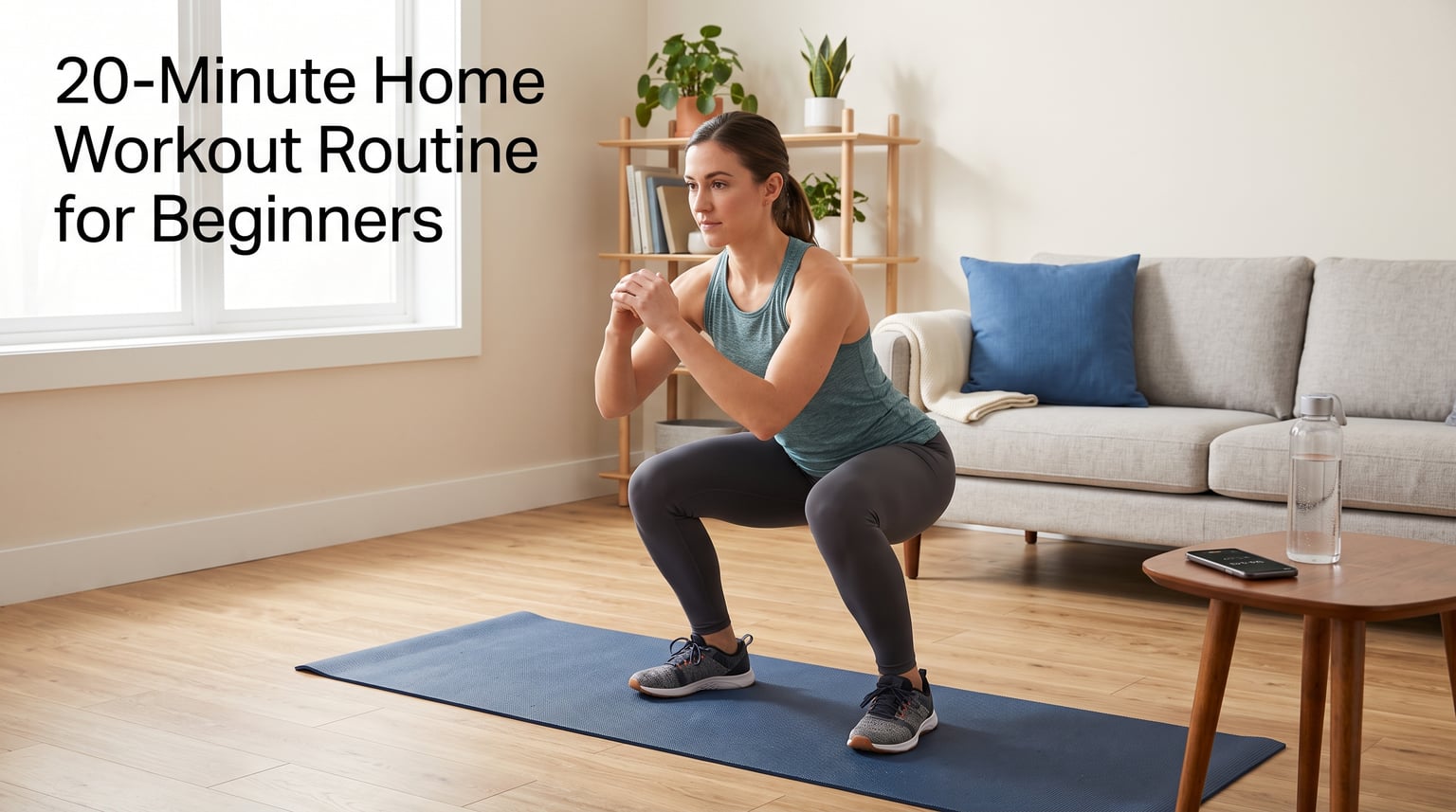
If you have never worked out before, the idea of a “routine” can feel intimidating. Gyms are loud, plans online are confusing, and most beginner programs assume you already know what a goblet squat is. I built this 20-minute home workout routine for beginners to remove every one of those barriers. There is no equipment. There is no jargon. Just eight simple bodyweight exercises you can do in your living room, with a timer and twenty minutes to spare.
I have coached absolute beginners through this exact sequence for years, and I have seen it work for 50-year-old desk workers, college students in dorm rooms, and new moms who only had twenty minutes between feedings. The routine below is the same one I share with my own family. It is short, it is effective, and it respects the fact that you are starting from zero. Let me walk you through it.
Table of Contents
Why 20 Minutes Is the Sweet Spot for Beginners?
Most beginners quit fitness programs in the first three weeks. The biggest reason is not laziness; it is that the workouts are too long. A one-hour session feels like punishment when your body is not used to moving. Twenty minutes removes that psychological wall. You can finish a workout before your favorite show starts, and that small win builds momentum.
Research on exercise adherence shows that shorter, consistent sessions dramatically outperform longer, sporadic ones. A 20-minute home workout routine for beginners hits the minimum threshold for cardiovascular benefit and muscle activation, especially when the intensity is moderate and the exercises are full-body. You will not build a bodybuilder physique in twenty minutes, but you will build the habit that gets you there.
There is also a recovery benefit. Beginners need more rest than advanced lifters because their joints, tendons, and nervous system adapt more slowly. A short daily or near-daily session lets you recover properly between workouts. Overtraining is the hidden reason most beginners hit plateaus or get injured in the first month. Twenty minutes solves that problem before it starts.
If you are coming back from a long break or you have never exercised as an adult, this is also the safest entry point. Every exercise below has a beginner modification, and none of them require equipment. You can read more about how short, focused sessions build real-world strength in this story about consistency in your workout routine.
What You Need Before You Start
You need four things, and three of them are free. First, a timer. Your phone works fine. Second, about six feet of floor space. Third, a pair of shoes with flat soles or bare feet on a non-slip surface. Fourth, the willingness to start imperfectly.
The timer structure is simple. We use a 45-second work interval followed by 15 seconds of rest. You perform each exercise for 45 seconds, rest for 15, then move to the next. That pacing keeps your heart rate in a healthy zone without leaving you gasping. By the end of 20 minutes, you will have completed the warmup, eight main exercises, and a cooldown stretch. Total movement time is roughly 15 minutes; the rest is transitions and the cooldown.
If you have a yoga mat, use it. If not, a folded towel on carpet works just as well for knee comfort. Drink a glass of water before you start and keep a bottle nearby. Do not eat a heavy meal in the 90 minutes before the workout. That is all the preparation you need.
The 20-Minute Home Workout Routine for Beginners (Full Breakdown)
This routine follows a proven three-part structure used by NASM-certified trainers and physical therapists: warmup, main set, cooldown. Here is the time breakdown:
Minutes 0 to 3: Cardio warmup (three movements)
Minutes 3 to 17: Main bodyweight strength circuit (eight exercises, 45 sec on, 15 sec rest)
Minutes 17 to 20: Cooldown stretch (three static holds)
You can run this three times per week with a rest day between sessions, or every other day. Most beginners do well with Monday, Wednesday, Friday workouts. After four weeks, add a fourth day if your energy and sleep stay strong. For more on how beginner-friendly home workout modifications can fit different fitness levels, see this guide to home workout modifications for beginners.
Warmup (Minutes 0 to 3)
The warmup is not optional. Skipping it is the fastest way to tweak a shoulder or pull a hamstring on day one. We spend three full minutes raising your core temperature, lubricating your joints, and priming the muscle groups we are about to use. Run through each of these three movements for 60 seconds.
1. March in Place with High Knees
Stand tall and march in place, bringing each knee up toward your chest. Swing your arms naturally. The goal is to get blood flowing, not to break a sweat. Lift the knees to hip height if you can, but even waist height works. Keep your core lightly braced and your shoulders relaxed.
Modification: Hold onto a wall or chair for balance, and lift your knees only as high as is comfortable. Most beginners start here and progress quickly.
2. Arm Circles
Extend your arms straight out to the sides at shoulder height. Make small forward circles for 30 seconds, then reverse the direction for the next 30 seconds. This warms up the rotator cuff and shoulder joints, which you will need for push-ups.
Modification: Keep the circles smaller and slower. If your shoulders feel cranky, do the circles with bent elbows instead.
3. Hip Openers
Stand with feet shoulder-width apart. Place your hands on your hips and draw slow, controlled circles with your pelvis. Do 15 seconds forward, 15 seconds backward. Then switch directions. This wakes up the hip flexors and glutes, two muscle groups that sleep all day at a desk.
Modification: Reduce the size of the circles. The point is gentle mobility, not a deep stretch.
Main Workout (Minutes 3 to 17)
Here is where the real work happens. You will cycle through eight bodyweight exercises in order. Each one runs for 45 seconds, then you rest for 15 seconds, then move on. No equipment. No jumping. Just controlled movement. Form always beats speed. Slow down before you add intensity.
Exercise 1: Bodyweight Squats
Squats are the king of beginner exercises. They train your quadriceps, hamstrings, glutes, and core all at once, which is why trainers call them a “compound movement.”
How to do it: Stand with feet slightly wider than shoulder-width, toes pointed slightly out. Push your hips back as if sitting into a chair. Lower until your thighs are at least parallel to the floor, then drive through your heels to stand back up. Keep your chest up and your knees tracking over your toes.
Form cues: Weight in your heels, knees out, core braced. Do not let your knees cave inward.
Beginner modification: Hold onto a doorknob or chair back for balance. Or only squat halfway down until you build strength.
Common mistake: Letting your chest drop forward. Keep your eyes on the wall ahead, not the floor.
Exercise 2: Wall Push-Ups
Push-ups train your chest, shoulders, triceps, and core. Wall push-ups are the right starting point if you cannot yet do a floor push-up. There is no shame in starting here. Most beginners need four to six weeks before moving to incline or floor push-ups.
How to do it: Stand arm’s length from a wall. Place your hands on the wall at shoulder height, slightly wider than your shoulders. Bend your elbows and lower your chest toward the wall, then push back to start. Keep your body in a straight line from head to ankles.
Form cues: Core tight, elbows at about 45 degrees from your body (not flared straight out), neck neutral.
Beginner modification: Move closer to the wall to make it easier, or do fewer reps and rest longer.
Progression: When wall push-ups feel easy, move to a counter or sturdy table. Then to the floor on your knees. Then full push-ups.
Exercise 3: Stationary Lunges
Lunges train each leg independently, which fixes strength imbalances between your left and right sides. They also challenge your balance, which is a real-world skill that protects your ankles and knees as you age.
How to do it: Stand tall, then step your right foot back about two feet. Lower your back knee toward the floor until your front thigh is parallel to the ground. Push through your front heel to return to standing. Alternate legs or do all reps on one side, then switch.
Form cues: Front knee over the front ankle, back knee under the hip, torso upright. Do not let the front knee drift past your toes.
Beginner modification: Hold onto a wall. Take a smaller step back. Do not lower as deep.
Exercise 4: Glute Bridges
Glute bridges wake up your posterior chain (the muscles on the back of your body), which most beginners underuse. Strong glutes protect your lower back and improve every other exercise.
How to do it: Lie on your back with knees bent, feet flat on the floor hip-width apart, arms at your sides. Squeeze your glutes and lift your hips toward the ceiling until your body forms a straight line from shoulders to knees. Hold for one second at the top, then lower with control.
Form cues: Press through your heels, do not arch your lower back at the top, keep your ribs down.
Beginner modification: Lift only a few inches. Squeeze and hold for longer at the top instead of doing more reps.
Exercise 5: Incline Plank
The plank is the foundation of every core exercise. An incline plank against a wall or counter is the right starting place if a full floor plank hurts your wrists or lower back.
How to do it: Place your forearms on a sturdy surface (counter, table, or wall). Step your feet back until your body is in a straight line. Engage your core, squeeze your glutes, and hold. Breathe normally. Do not hold your breath.
Form cues: Shoulders over elbows, hips in line with shoulders, no sagging or piking.
Beginner modification: Hold for 15 to 20 seconds instead of 45. Rest longer if needed. The point is quality, not duration.
Progression: Drop to the floor on your knees, then full plank, then side plank.
Exercise 6: Bird Dogs
Bird dogs train core stability and coordination. They also relieve lower back tension, which makes them perfect for desk workers.
How to do it: Start on all fours with hands under shoulders and knees under hips. Extend your right arm forward and left leg back at the same time, keeping both parallel to the floor. Hold for two seconds, then return to start. Switch sides.
Form cues: Keep your back flat like a table. Do not rotate your hips. Move slowly and deliberately.
Beginner modification: Lift only the arm or only the leg, not both at once.
Exercise 7: Standing Side Leg Raises
Side leg raises strengthen the glute medius, a small but critical muscle on the outside of your hip. Weak glute medius is one of the most common causes of knee pain in beginners.
How to do it: Stand tall holding a wall or chair for balance. Lift your right leg out to the side, keeping your toes pointing forward. Lift as high as is comfortable, then lower with control. Do 45 seconds on the right, then switch.
Form cues: Stand tall, do not lean your upper body to compensate. Keep the working leg straight but do not lock the knee.
Exercise 8: Dead Bugs
Dead bugs train deep core muscles without putting any pressure on your lower back. They are the safest core exercise for beginners.
How to do it: Lie on your back with arms extended toward the ceiling and knees bent at 90 degrees (shins parallel to the floor). Press your lower back gently into the floor. Slowly extend your right arm back and your left leg forward until they hover just above the floor. Return to start and switch sides.
Form cues: Lower back glued to the floor the entire time. Move slowly. Exhale as you extend.
Beginner modification: Only extend the arm or only the leg. Keep the other limbs still.
Cooldown and Stretch (Minutes 17 to 20)
The cooldown brings your heart rate down and lengthens the muscles you just worked. Skipping it is why so many beginners feel stiff the next day. Hold each of these three stretches for 30 seconds. Breathe slowly.
1. Standing Quad Stretch
Stand on your left leg, bend your right knee, and grab your right ankle behind you. Gently pull your heel toward your glute. Keep your knees together and your torso upright. Hold 30 seconds, then switch sides. This stretches the front of your thigh.
2. Figure-Four Hip Stretch
Lie on your back, knees bent, feet flat. Cross your right ankle over your left knee. Lift your left foot off the floor and pull your left thigh toward your chest until you feel a stretch in your right hip. Hold 30 seconds, then switch. This opens the hips after squats and lunges.
3. Child’s Pose
Kneel on the floor, sit back onto your heels, then walk your hands forward until your forehead rests on the floor. Let your chest sink toward the ground. Hold 30 to 60 seconds. This stretch releases your lower back and shoulders.
How Often Should You Do This Workout, and What Comes Next
For most beginners, three sessions per week on non-consecutive days works best. Monday, Wednesday, Friday is a clean rhythm. Your body needs at least one rest day between workouts to repair muscle and adapt. Working out the same muscle group every day usually leads to soreness, fatigue, or injury within two to three weeks.
In your first 30 days, expect two things: muscle soreness for the first week, and a small but real boost in energy and mood by week three. Soreness is normal and fades as your body adapts. Sharp pain during an exercise is not normal; if you feel it, stop and try the modification. For more on how to recover well between sessions, see this guide to recovery tips for beginners.
Signs you are doing too much include feeling wiped out for more than 24 hours after a workout, trouble sleeping, or losing motivation. If that happens, drop to two sessions per week for a week and let your body catch up. Progress comes from consistency, not intensity. A 20-minute home workout routine for beginners done three times a week beats a one-hour session you skip every other day.
To progress after four to six weeks, add a fourth workout day, increase the work interval from 45 to 60 seconds, or move to harder exercise variations (floor push-ups instead of wall, full plank instead of incline). Do not increase everything at once. Pick one change per week.
Frequently Asked Questions
What is a good 20-minute workout at home?
A good 20-minute workout at home is a short, full-body routine built from bodyweight exercises like squats, push-ups, lunges, planks, and glute bridges. Start with a 3-minute cardio warmup, cycle through 6 to 8 strength exercises for 45 seconds each with 15 seconds of rest, then finish with a 3-minute stretch. No equipment is needed, and the format keeps your heart rate in a healthy zone for the entire session.
Is a 20-minute workout every day enough?
A 20-minute workout every day is enough for beginners to build the exercise habit and improve basic fitness, but it is not ideal for muscle growth in the long run. Beginners should aim for three to four sessions per week with rest days in between. Daily 20-minute sessions work for short bursts (two to three weeks), but muscles and joints need 48 hours to recover and adapt.
What is the 3 3 3 rule for working out?
The 3 3 3 rule for working out is a simple framework that means three days a week, three months commitment, three exercises per session. It is a beginner-friendly plan that focuses on building consistency rather than chasing intensity. After three months, you reassess and either stay with the same plan or layer in more exercises and days.
What is the 20 20 20 rule workout?
The 20 20 20 rule workout is a guideline that suggests 20 minutes of moderate cardio, 20 minutes of strength training, and 20 minutes of stretching or mobility per session. For absolute beginners, the strength and cardio portions can be combined into one 20-minute circuit, with stretching reserved for after the workout to reduce total time to 20 to 25 minutes.
Your First 20-Minute Home Workout Routine for Beginners Starts Tomorrow
You do not need a gym membership, a fancy app, or an hour of free time to start. You need twenty minutes, a small patch of floor, and the willingness to do the first rep imperfectly. This 20-minute home workout routine for beginners is the exact one I use with clients on day one. Do it three times this week, pay attention to how your body feels, and trust the process. Consistency, not intensity, is what builds the habit that changes everything.