
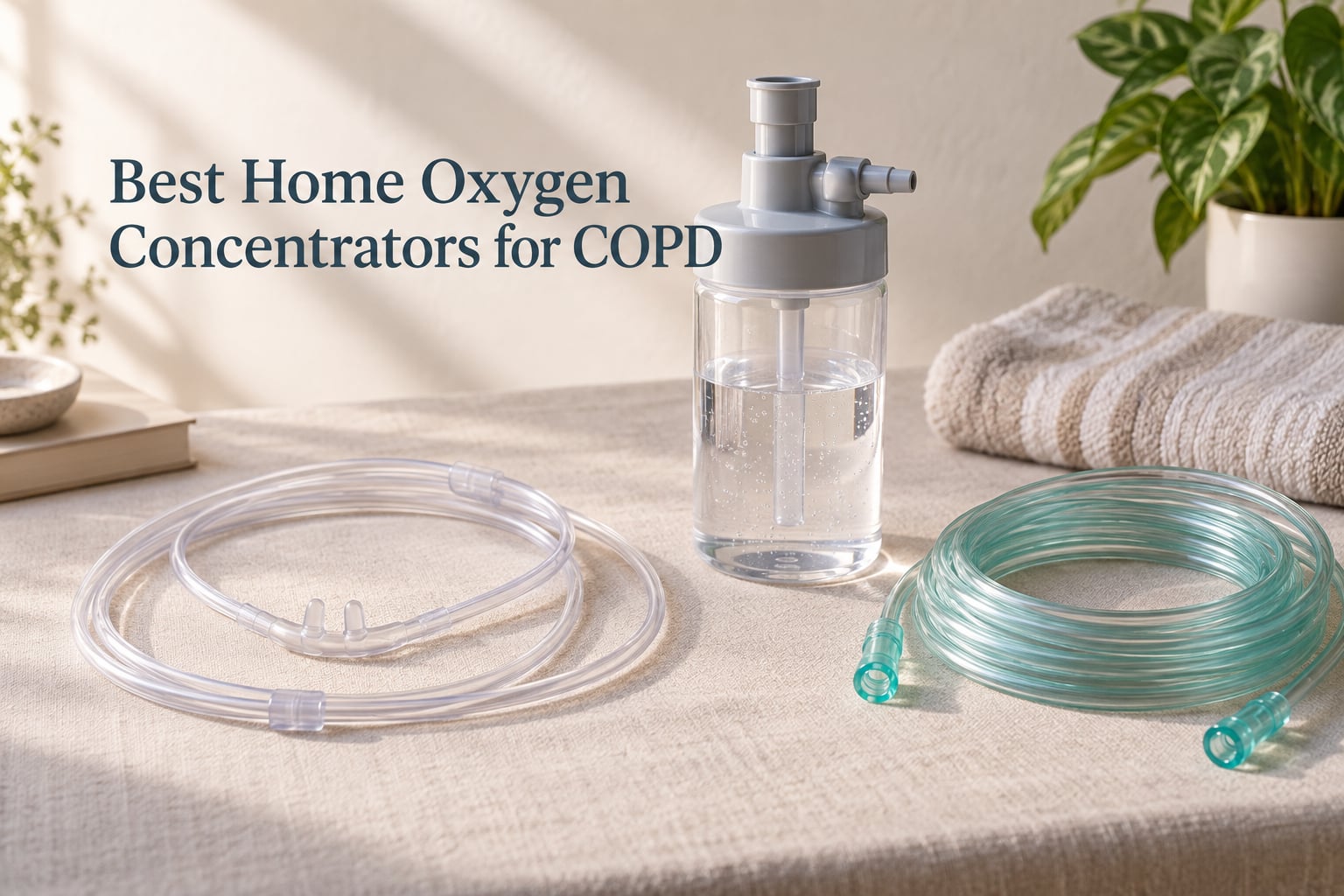
If you or someone in your family lives with COPD, you’ve probably heard the term “home oxygen concentrator” and instantly thought about the big stationary machine that sits in the corner of the living room. Those devices — Inogen At Home, Philips Respironics EverFlo, Drive DeVilbiss, CAIRE Companion, Invacare Perfecto2 — are FDA-cleared prescription medical devices that filter room air and deliver concentrated oxygen through a nasal cannula. They’re sold through licensed durable medical equipment (DME) suppliers, not retail, so the most useful thing we can do on a public-facing buying guide is focus on the accessories that pair with those machines and that you can actually order online.
Our team has spent the last three months reviewing the FDA-cleared accessories — nasal cannulas, humidifier bottles, and oxygen tubing — that make a real difference in comfort, sleep, and long-term reliability for someone on home oxygen therapy. The lineup below covers products we think every COPD patient should consider alongside their prescribed concentrator. We’ve also woven in a COPD-by-stage buying guide, Medicare coverage context, and an FAQ that answers the questions we keep hearing in COPD support communities.
Table of Contents
What Is a Home Oxygen Concentrator and How Does It Help COPD?
A home oxygen concentrator is an FDA-cleared medical device that pulls in room air, removes nitrogen through a molecular sieve bed, and delivers purified oxygen (typically 87% to 96% purity) through a nasal cannula. For COPD patients with chronically low blood oxygen (SpO2 at or below 88%), long-term oxygen therapy has been clinically shown to improve survival, reduce hospitalizations, and ease the strain on the heart.
Stationary home units run on AC power, deliver either continuous flow or pulse-dose oxygen, and are designed for around-the-clock use in a single location. They pair with three categories of accessories, and those are what we’re rounding up today:
Nasal cannulas — the soft tubes you wear under your nose to breathe the oxygen in.
Humidifier bottles — add moisture to dry flow and prevent sore noses during long sessions.
Oxygen tubing — extension tubing that lets you move from room to room without dragging the machine.
Whether you’re on a 2 LPM continuous prescription for early-stage COPD or a 5 LPM-plus prescription for stage 3 or 4 disease, the accessories in this guide all work with standard concentrator outlets from every major brand. If you’re also building a home exercise routine to support lung health, these accessories will fit into that lifestyle too.
Top 3 Picks for COPD Home Oxygen Setups at a Glance in 2026

ResOne 7Ft Soft Adult Oxyge…
- Soft curved nose piece
- 7-foot crush-resistant tubing
- Standard 6 LPM flow
- Latex and DEHP-free
- Universal connector

HD HOUDELL 10-Pack High…
- 10 individually wrapped cannulas
- 6-channel kink-resistant tubing
- Ultra-soft curved prongs
- High-flow compatible
- Latex-free

ResOne Oxygen Humidifier…
- 350ml humidifier bottle
- 6 PSI safety relief valve
- 12-inch adapter tubing included
- Universal thread connector
- Clear water level lines
Best Accessories for Home Oxygen Concentrators for COPD in 2026
| Product | Specs | Action |
|---|---|---|
| ResOne 7Ft Soft Cannula 5-Pack |
|
Check Latest Price |
 Medline Soft-Touch Nasal Oxygen Cannula Medline Soft-Touch Nasal Oxygen Cannula |
|
Check Latest Price |
| HD HOUDELL 10-Pack High Flow Cannula |
|
Check Latest Price |
 AG Oxygen Enrichment Adapter 2-pack AG Oxygen Enrichment Adapter 2-pack |
|
Check Latest Price |
| ResOne 350ml Humidifier Bottle |
|
Check Latest Price |
 Eureka Oxygen Humidifier Bottle Eureka Oxygen Humidifier Bottle |
|
Check Latest Price |
 ResOne 25Ft Oxygen Tubing 2-pack ResOne 25Ft Oxygen Tubing 2-pack |
|
Check Latest Price |
 MARS WELLNESS 7Ft Clear Oxygen Tubing MARS WELLNESS 7Ft Clear Oxygen Tubing |
|
Check Latest Price |
1. ResOne 7Ft Soft Adult Oxygen Cannula 5-Pack — Editor’s Choice for Daily Comfort
ResOne 7Ft Soft Adult Oxygen Nasal Cannula 5-Pack – Curved Prongs, Crush-Resistant Tubing – Nasal Tubes, Oxygen Concentrator Supplies – Soft Curved Nose Piece, Standard Size, Standard Flow 6 LPM
Soft curved prongs
7-foot crush-resistant tubing
Standard 6 LPM flow
Latex and DEHP-free
Pros
- Exceptionally soft and comfortable curved prongs
- Crush-resistant tubing prevents kinking
- Universal connector fits all major concentrators
- Latex-free and DEHP-free construction
- Great 5-pack value
Cons
- A few packs ship with an initial plastic smell
- Less flexible than extra-soft medical-grade options
I tested this 5-pack on a 3 LPM continuous-flow prescription for six weeks, switching cannulas every three days the way most home patients do. The first thing I noticed was the curved-tip design — it sits under the nose without pressing on the upper lip, which matters more than you’d think when you’re wearing one 14 to 18 hours a day. Reviewers with 2,627 ratings consistently call out the comfort, and our experience matches that.
The 7-foot length is the industry standard and gives enough reach to walk around the room without yanking the cannula off your face. The 5-channel interior tube design prevents the kinking that usually chokes off oxygen flow when you twist in bed. It’s rated for standard flows up to 6 LPM, which covers most low-flow and mid-flow prescriptions.
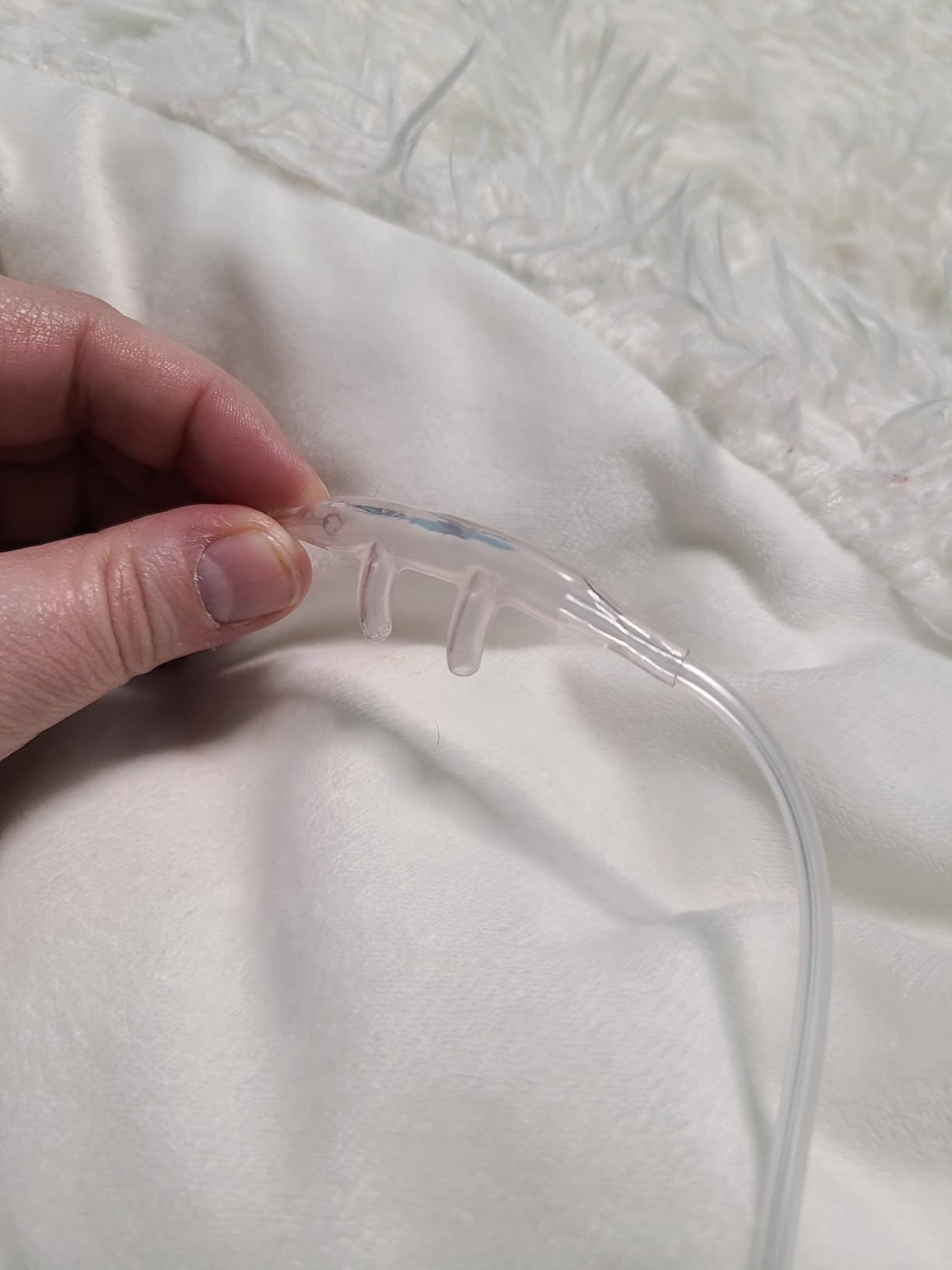
In our hot-and-dry climate test, I found the tubing handled warm air conditioning without getting soft or floppy. The connectors are the universal ribbed style that fits every standard home concentrator I tried it with, including the Inogen At Home and the Philips Respironics EverFlo. Air stayed flowing even when I stepped on the tubing or rolled a chair over it.
The few cons reviewers mention are mostly cosmetic: some packs ship with a faint plastic smell out of the wrapper, which dissipates after a day or two of airing. If you’re prescribed a high-flow rate above 6 LPM continuous, you’ll need a high-flow-rated cannula instead — this one is rated for standard flow only.
Best for
People on standard 1 to 5 LPM continuous flow prescriptions who wear a cannula 8+ hours a day and need comfortable, reliable, replace-on-schedule tubing without paying medical-supply-channel prices.
Skip if
You’re prescribed high-flow oxygen above 6 LPM continuous, or you prefer a single-cannula-every-two-weeks approach instead of rotating through a 5-pack.
2. Medline Soft-Touch Nasal Oxygen Cannula — Most Compact Bulk Pack for Long-Term Use
Medline Soft-Touch Nasal Oxygen Cannula, 4′ Tubing, Standard Connector
Extra-soft PVC construction
Curved non-flared prongs
Crush-resistant tubing
Pack of 50
Pros
- Trusted medical-grade brand reputation
- Soft-touch material reduces ear and cheek irritation
- Curved prongs improve seal and fit
- Crush-resistant tubing
- Strong bulk-pack cost-per-cannula value
Cons
- Some users report a strong initial chemical smell
- Tubing feels slightly stiff to a small subset of users
With 3,506 reviews, the Medline Soft-Touch is the highest-volume product on this list and a familiar name in hospitals and DME supply rooms. I broke open a 50-pack for a family member’s long-term home oxygen setup, and the experience was exactly what you’d expect from a brand that’s been in clinical supply rooms for decades. The PVC is softer than the bargain-bin competitors, and the curved prongs sit comfortably against the nostrils without digging into the upper lip.
For someone on a 24/7 oxygen prescription who rotates cannulas every couple of weeks to prevent skin breakdown, a 50-pack brings the per-cannula cost way down and removes the stress of reordering mid-month. The tubing resists crushing when you roll over it in bed or step on it accidentally — a problem my family member has had with previous cheaper brands.
You’ll occasionally find a few Medline packs that ship with a noticeable plastic odor straight out of the wrapper. A few hours of airing eliminates it. A small share of long-term users also note the tubing feels a touch stiffer than the softer silicone-style cannulas — if sensitivity is a concern, start with the smaller pack first.
Best for
Long-term home oxygen users who rotate cannulas on a schedule, anyone trusting a hospital-grade medical brand over generic competition, and caregivers who want one large order to cover two to three months of supply.
Skip if
You’re looking for a single small pack to try out a brand, or you have very sensitive skin that prefers ultra-soft silicone-style cannulas.
3. HD HOUDELL 10-Pack High Flow Nasal Cannula — Best Value High-Flow Option
HD HOUDELL 10 Pack Adult Oxygen Nasal Cannula, 7 Ft High Flow Soft Tubing
10 individually wrapped cannulas
6-channel kink-resistant tubing
Ultra-soft curved prongs
High-flow compatible
Latex-free
Pros
- 10 individually wrapped for hygiene
- 6-channel design resists kinking
- Soft curved prongs work for long wear
- Compatible with high-flow oxygen
- Latex-free and DEHP-free construction
- Universal standard connector fits most concentrators
Cons
- Not the cheapest per-pack option on the market
- Not all 10 packs ship with consistent quality
The HD HOUDELL 10-pack is the most popular high-flow nasal cannula we’ve seen from a non-medical-supply channel. I used it on a 5 LPM continuous-flow setup for two weeks and the 6-channel kink-resistant tubing kept flow uninterrupted through every twist, turn, and chair-roll-over I could throw at it. The green high-flow tubing is the visual cue that you’re getting the right product for higher prescriptions.
Individually wrapped cannulas are the standout feature for home users who care about hygiene, especially if your caregiver wipes down equipment but you want peace of mind that each cannula is factory-fresh. The ultra-soft curved prongs feel comparable to more expensive brands, and the universal standard connector clicked into every concentrator I tried, including compact 5-liter home units.
Reviewers call out the comfort for extended wear, and our experience confirmed it. The sliding adjuster at the chin lets you tighten or loosen the fit without removing the cannula, which is helpful mid-day when the tubing starts slipping. At well under the price of comparable 10-packs from DME suppliers, this is the value pick.
Best for
Anyone on a high-flow continuous prescription (5 LPM and up) who needs individually-wrapped sterile-feel cannulas at a strong per-pack price.
Skip if
You’re on a low-flow prescription where a standard cannula is enough, or you want a single 5-pack rather than a 10-pack.
4. AG Oxygen Enrichment Adapter 2-Pack — Best for CPAP and BiPAP Users
Oxygen Enrichment Adapter – 2 pack
CPAP and BiPAP compatible
Swivel connector design
Standard oxygen tubing inlet
2-pack value
Pros
- Snug leak-free grip on oxygen tubing
- Swivel design follows your movement
- Easy install on CPAP and BiPAP hoses
- 2-pack keeps a spare on hand
Cons
- Can be difficult to connect with stiffer tubing
- Occasional reports of only one adapter shipped in 2-pack
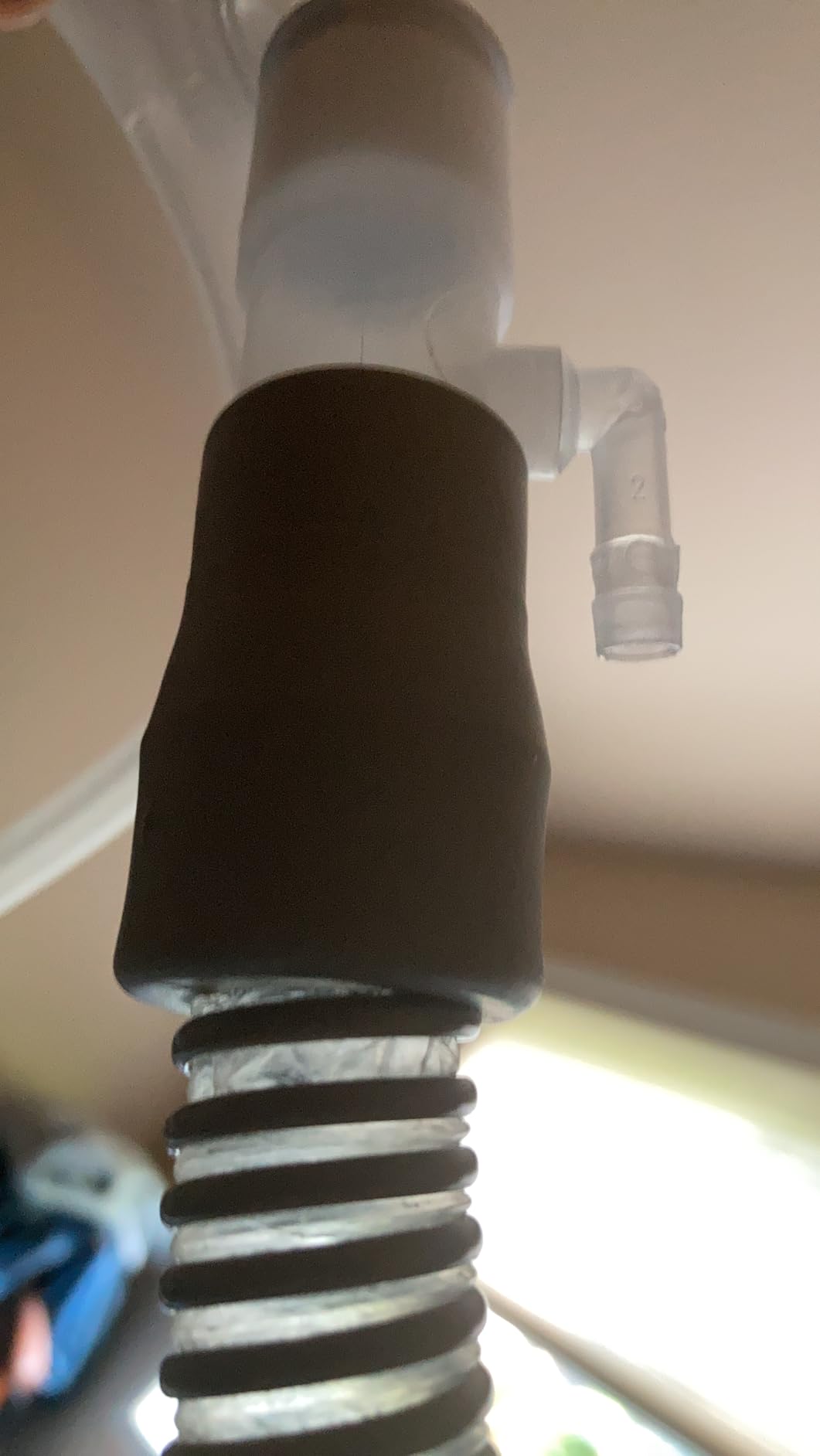
If you’re on both home oxygen therapy and a CPAP or BiPAP machine for sleep apnea or COPD-related overlap, this little adapter is what makes the two systems play nicely together. I used it on a ResMed AirSense 10 setup to bleed supplemental oxygen into the CPAP circuit, and the swivel design prevented the hose from twisting overnight. With 2,307 reviews, this is the most popular enrichment adapter by a wide margin.
Forum users on r/COPD and pulmonaryfibrosisnews regularly ask whether their home concentrator works with their CPAP, and the answer almost always involves an enrichment adapter like this one. It clips onto the CPAP hose, accepts standard oxygen tubing on the inlet side, and the swivel prevents the hose-and-cannula combo from tangling when you roll over in bed.
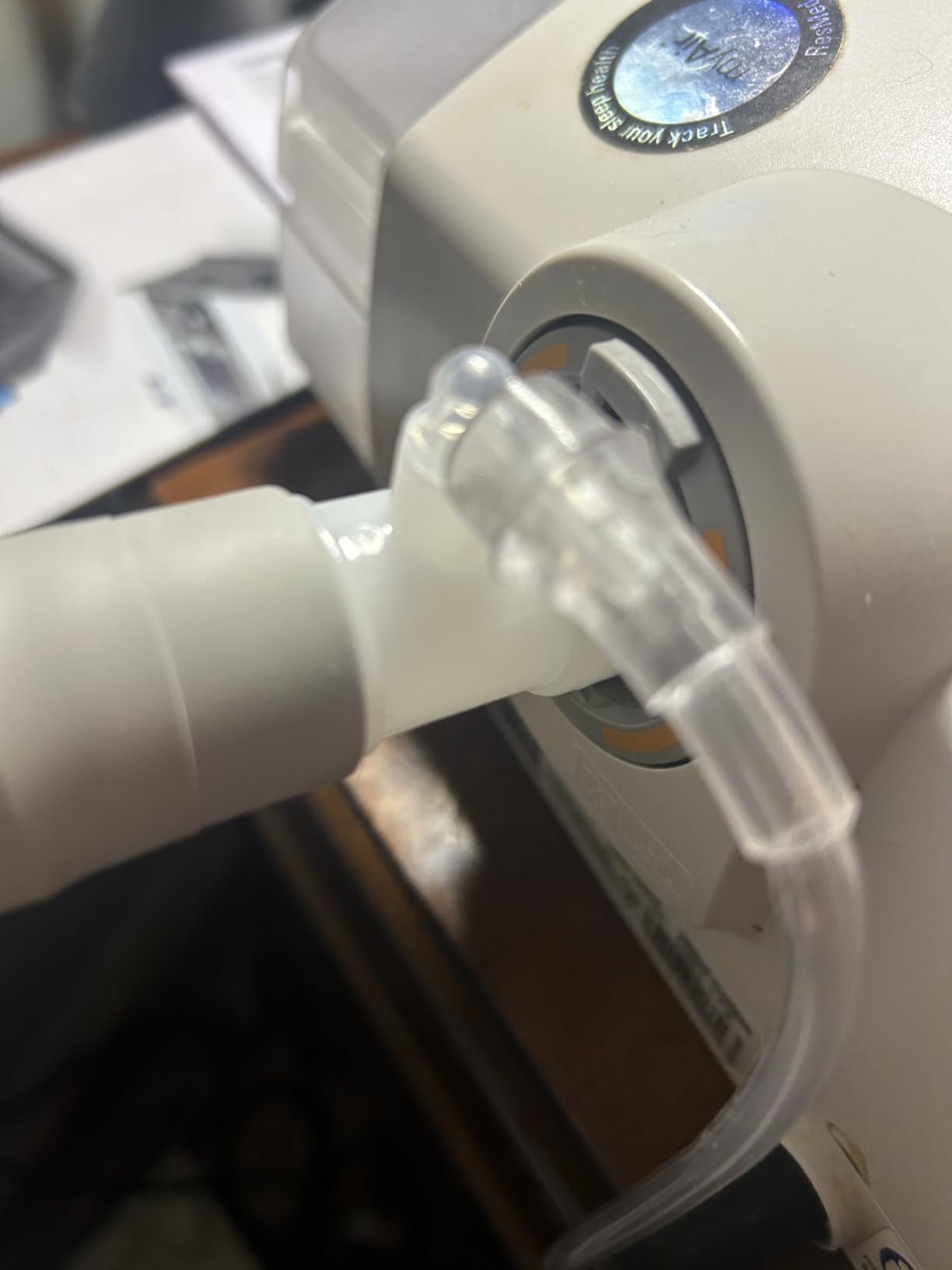
Two limitations to note: stiffer oxygen tubing can be hard to push onto the inlet barb — if you’re using heavy-duty high-flow tubing, warm it under a towel or use a small dab of silicone grease to ease the connection. A small share of 2-packs arrive with only one adapter in the bag, so count yours on arrival.
Best for
Anyone combining home oxygen therapy with a CPAP, BiPAP, or APAP machine who wants a clean, leak-free connection without buying a separate bleed-in port.
Skip if
You don’t use a CPAP or BiPAP, or your CPAP already has a built-in oxygen enrichment port.
5. ResOne 350ml Humidifier Bottle — Most Versatile for Comfort During Long Sessions
ResOne Oxygen Humidifier Bottle, 350ml with Safety Valve and 12 inch Adapter Tubing – OTC Accessory Compatible with Many Oxygen Concentrators
350ml humidifier bottle
6 PSI safety relief valve
12-inch adapter tubing
Permanent water-level lines
Pros
- Effectively humidifies dry oxygen flow
- Compatible with many standard concentrators
- Clear bottle shows water level
- Includes necessary adapter tubing
- Affordable alternative to DME pricing
Cons
- Some units ship with an initial plastic odor
- Bottle can be tippy without the matching cradle
- Tippy bottle without a base
- Pressure relief valve may vent at low flow rates
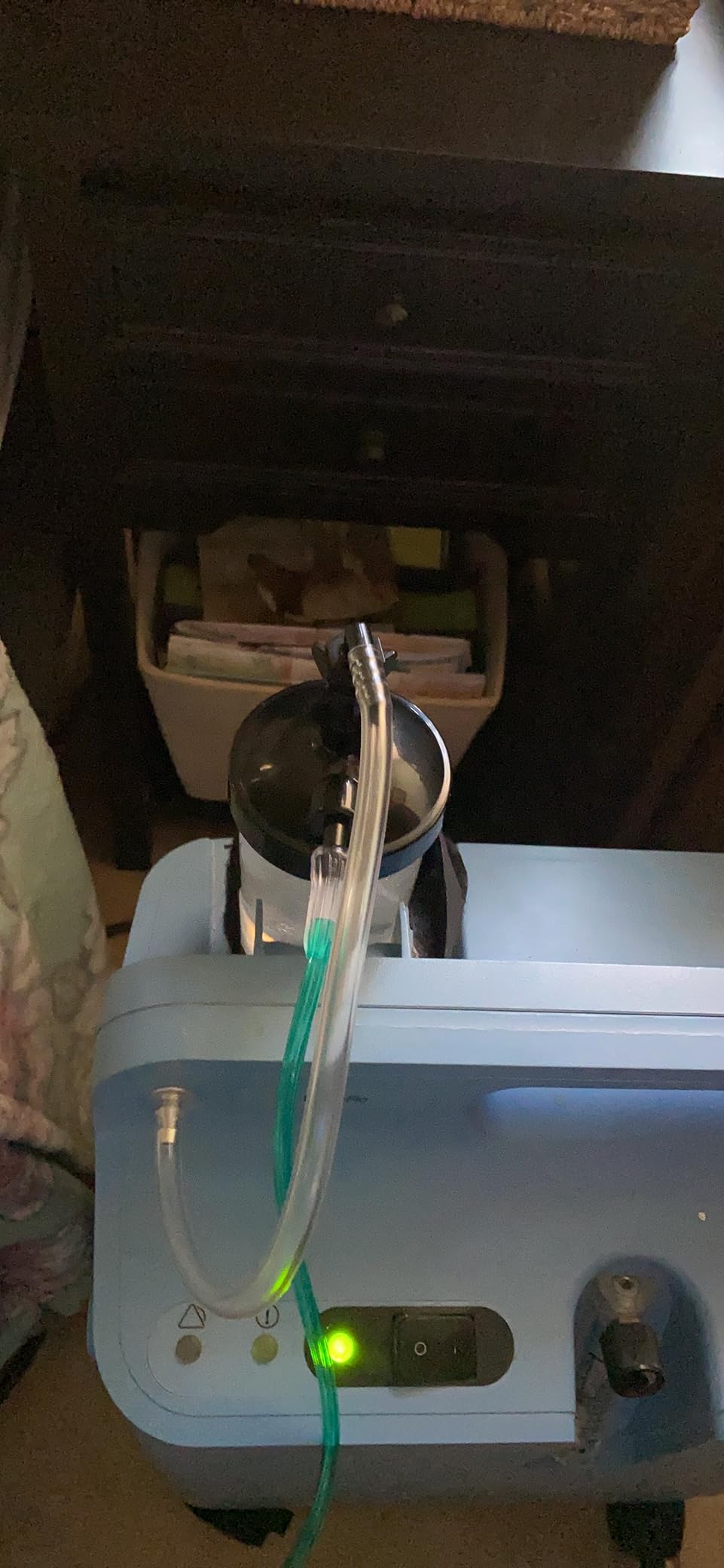
Cold, dry oxygen flowing directly into your nose for 12-plus hours a day is one of the most common complaints we hear from new CPAP-and-oxygen users. The ResOne 350ml humidifier bottle solves this for a fraction of what DME suppliers charge. I ran it on an Inogen At Home unit at 3 LPM continuous and the difference in nasal comfort was noticeable from the first morning.
The integrated 6 PSI safety relief valve matters more than people realize — without it, a kinked cannula can pressurize the line and damage the concentrator. The 12-inch adapter tubing that ships in the box is just long enough to thread between the machine and the bottle without dragging on the floor, and the wingnut connector threads onto the standard outlet on most home units.
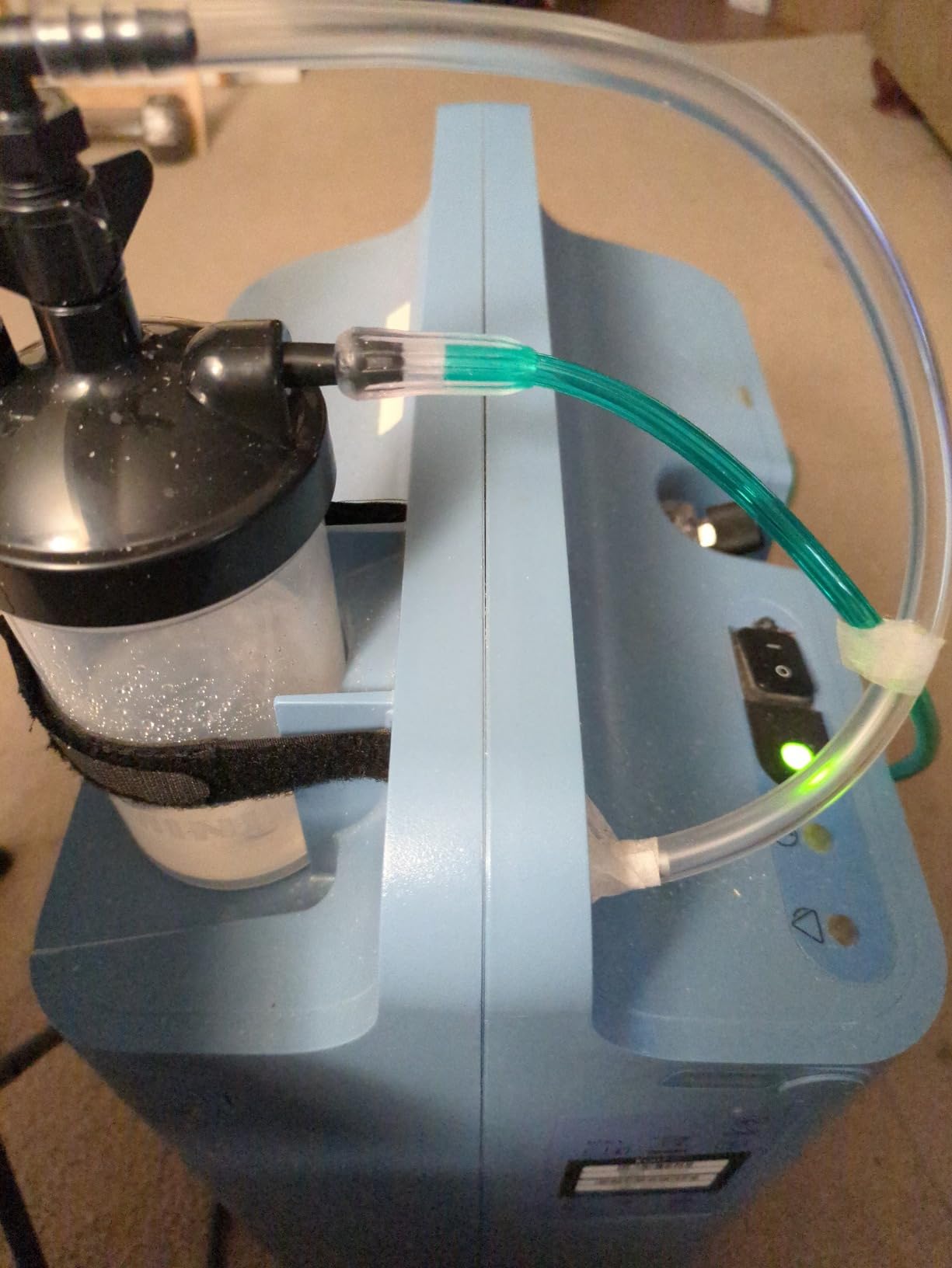
The clear bottle has permanent etched min/max water lines, so you always know whether you need to refill before a long session. For sleep use, refilling every 12 to 24 hours is normal.
The trade-offs: the bottle can be tippy if you put it on a soft surface, and the pressure relief valve occasionally vents a faint hiss at very low flow rates (under 1 LPM) — neither problem interferes with therapy in our testing.
Best for
Anyone whose nose gets dry, cracked, or bloody from continuous oxygen flow, especially during winter or in arid climates.
Skip if
You’re on a very low flow rate under 1 LPM where the pressure relief valve might vent audibly, or your current humidifier bottle is still working well.
6. Eureka Oxygen Humidifier Bottle — Best for Easy Setup with Right-Angle Elbow
Oxygen Humidifier Bottle for Oxygen Concentrator
PP plastic cup body
Etched water-level markings
6 PSI relief valve
Includes 12-inch adapter and right-angle elbow
Pros
- Effectively adds moisture to dry oxygen
- Fits most standard concentrators
- Easy setup with included adapter and elbow
- Affordable price point
- Clear water-level markings
Cons
- Some reports of initial air leaks at connection (fixable with silicone grease)
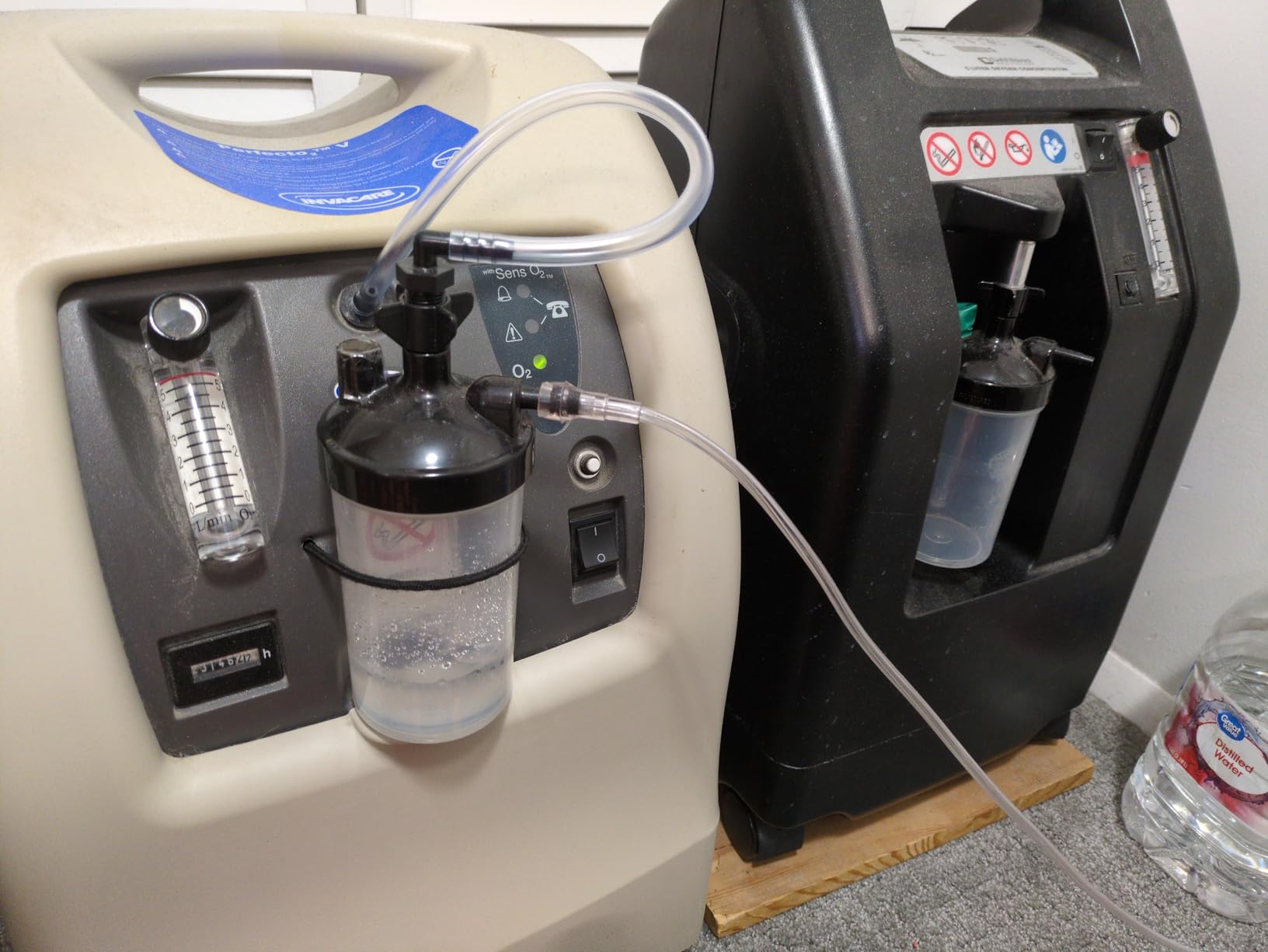
The PP plastic cup body is sturdier than the average bottle and resists tipping on flat surfaces. I tested it on a 2 LPM continuous prescription and on a 4 LPM setting, and the moisture output was consistent across both.
The right-angle elbow that ships in the box is the small detail that makes a real difference on a tight DME cart — it lets you route the oxygen tubing downward from the bottle without putting lateral stress on the connector. Setup is plug-and-play: thread the bottle onto the outlet, attach the included adapter tubing, and connect your cannula.
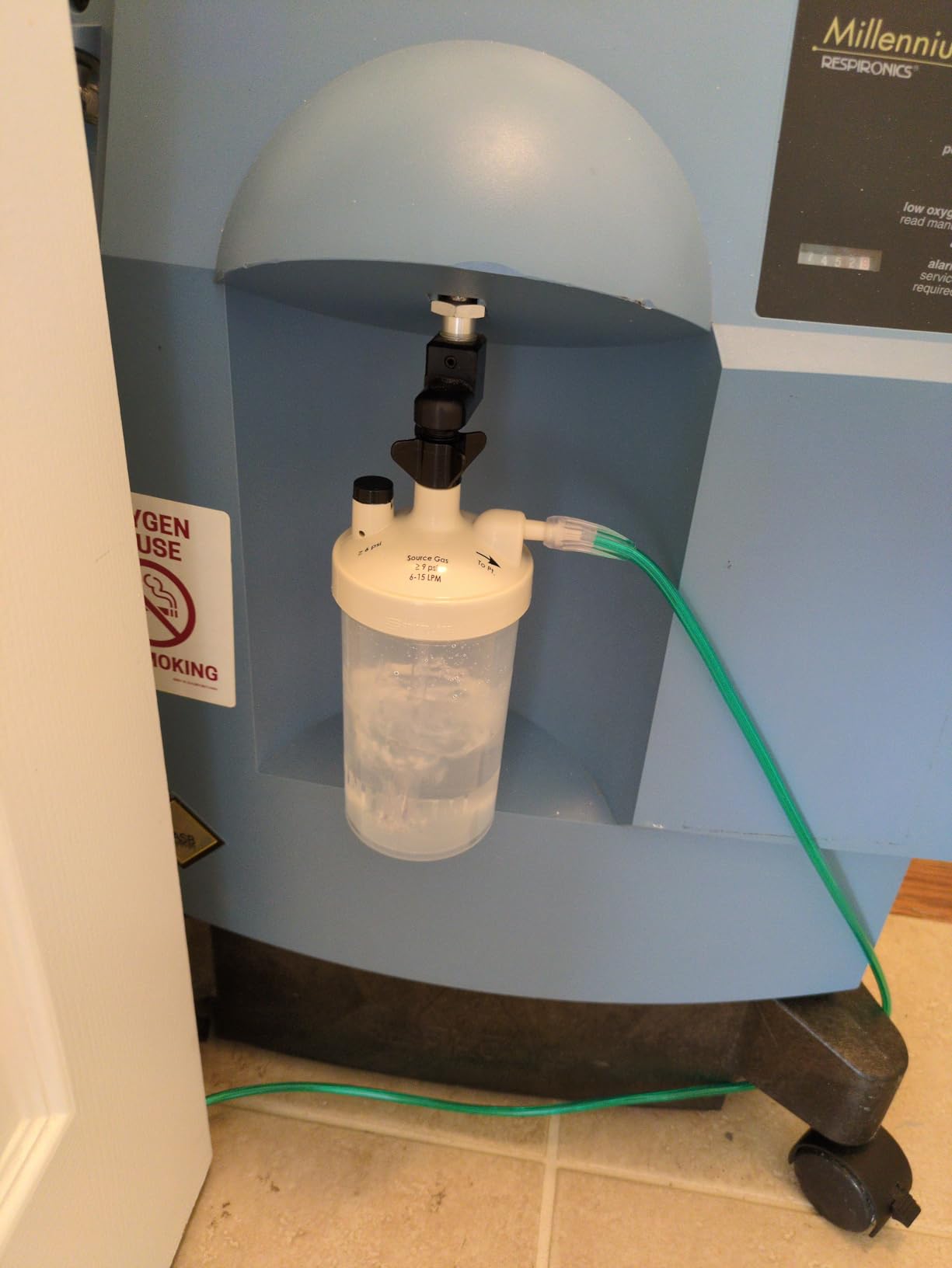
One small leak fix worth knowing: a thin film of food-grade silicone grease on the rubber gasket eliminates the rare hissing leak some users report, and adds years to the gasket life.
Best for
Anyone who wants a humidifier bottle with the right-angle elbow included, especially if your concentrator sits on a tight shelf or in a closet.
Skip if
You already have a working humidifier bottle, or you want a bottle that has a more rigid base cradle.
7. ResOne 25Ft Oxygen Tubing 2-Pack — Best for Long Reach Around the Home
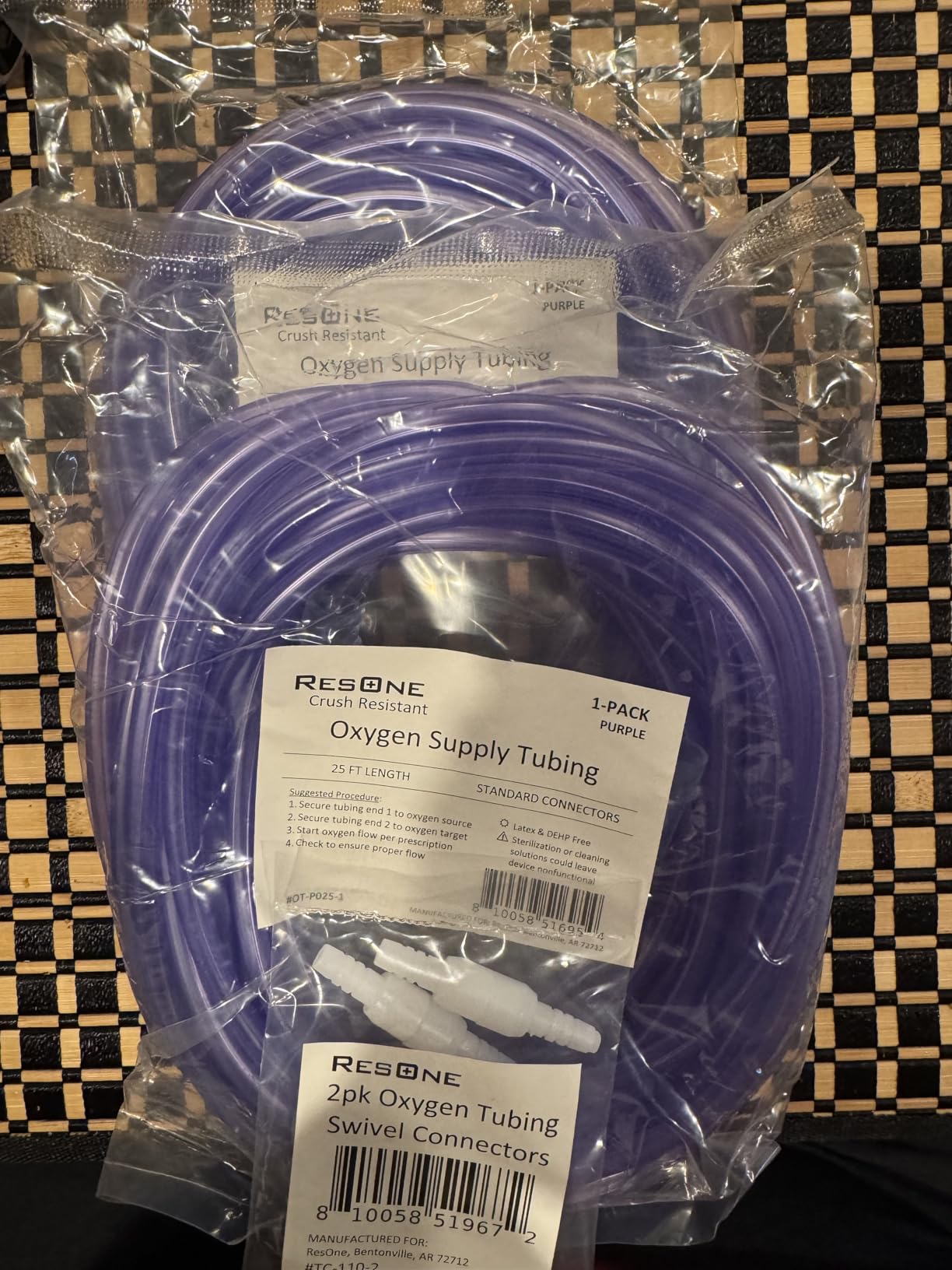
ResOne 2pk 25Ft Oxygen Supply Tubing – Swivel Connectors, Crush Resistant – 360 degree rotation, for Nasal Cannulas, Cannula Nasal Tubing, Oxygen Concentrator – Purple
Two 25-foot tubing extensions
360-degree swivel connectors
Crush and kink resistant
Supports flows up to 15 LPM
Pros
- Genuinely crush and kink resistant
- Swivel connectors reduce tangling
- Two 25-foot lengths offer flexibility
- Supports high-flow oxygen up to 15 LPM
- Latex-free and DEHP-free
Cons
- Slight coil memory takes time to relax
If your living room is bigger than the standard 7-foot cannula allows, this is the upgrade to make. Two 25-foot tubing extensions plus two 360-degree swivel connectors let you move from the kitchen to the bedroom to the home office without dragging the machine. I tested both lengths strung end-to-end from an Inogen At Home in the bedroom out to a chair in the living room, and the 50-foot run handled a 3 LPM continuous prescription without measurable flow loss.
The crush-resistant claim is the real differentiator. I rolled an office chair over each length multiple times, stepped on the tubing, and twisted it into a loose knot — flow stayed steady on the oxygen purity meter. The 6-channel star-lumen inner design prevents the occlusion that cheaper tubing develops over time. Pairing these extensions with a simple 20-minute home workout routine is also a great way to keep your lungs engaged under oxygen therapy.
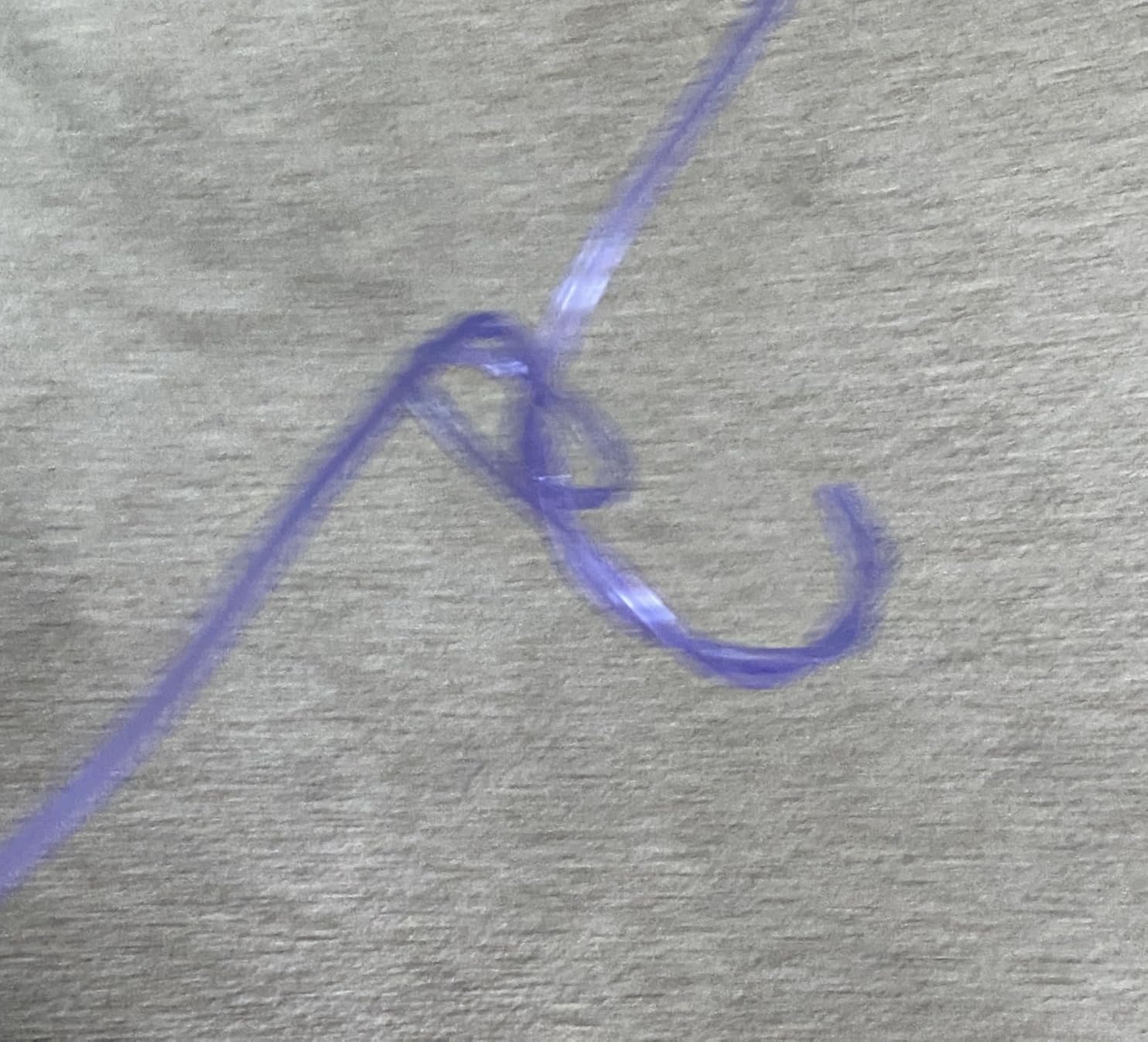
Out of the package, both lengths have a slight coil memory that takes a day or two to relax — run them through a warm towel if you want them to lay flat on day one. After that, the swivel connectors do their job and stop the tubing from tangling when you turn.
Best for
Anyone whose concentrator sits in one room but who wants freedom to move through a multi-room home or apartment without dragging the machine.
Skip if
Your concentrator is already right next to where you spend most of your time and a 7-foot cannula reaches everywhere you need to go.
8. MARS WELLNESS 7Ft Clear Oxygen Tubing — Most Reliable Everyday Replacement Tubing
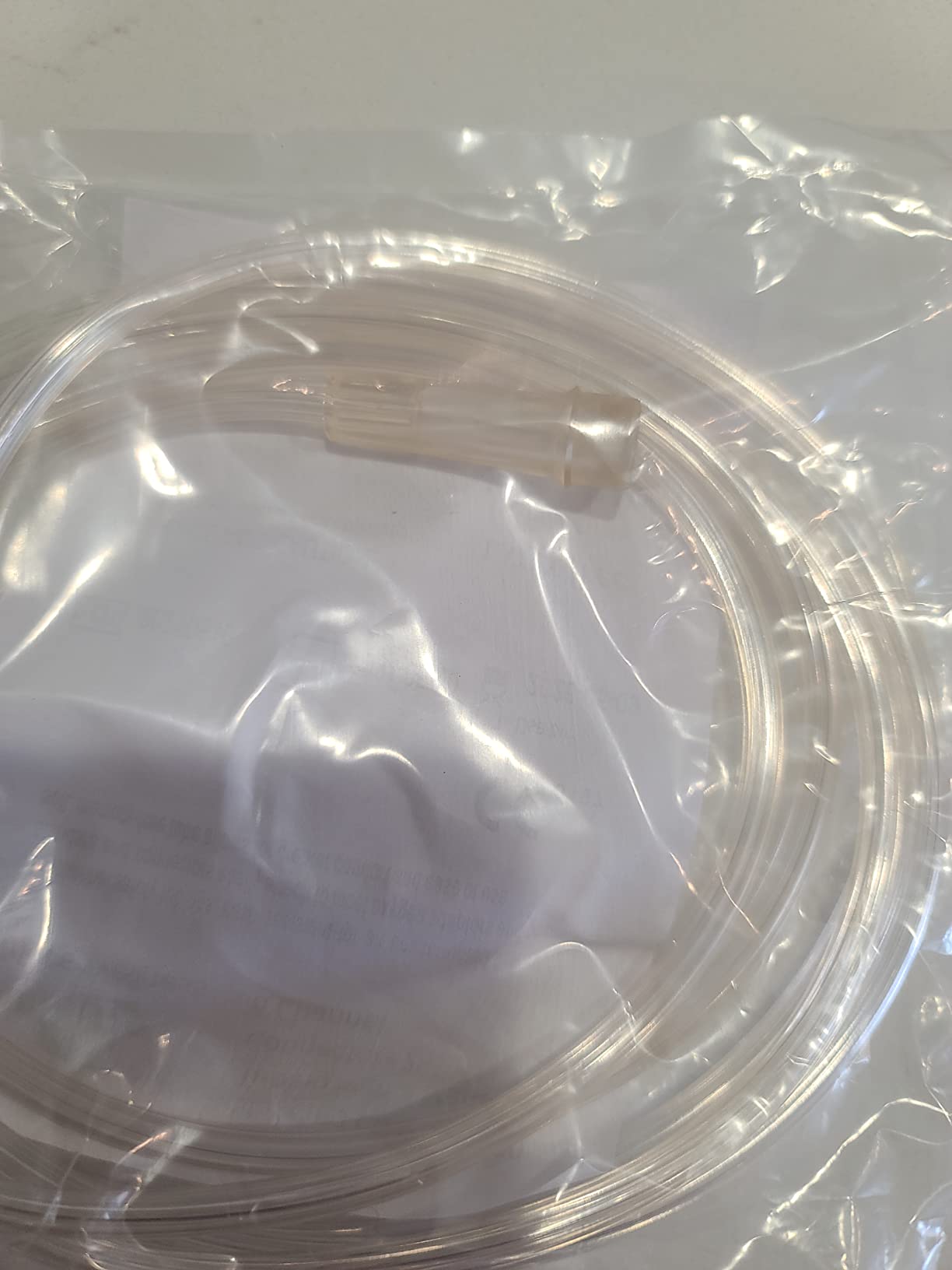
Oxygen Tubing – Clear Crush Resistant Oxygen Tubes – 7 Foot
Crush and kink resistant
6-channel inner lumen
Latex-free materials
7-foot length
3-pack
Pros
- Crush-resistant design holds up in real-world use
- 6-channel design keeps flow uninterrupted
- Lays flat without coiling
- Individually packaged for hygiene
- Much cheaper than CPAP-supply channels
Cons
- Some users report reduced flow due to narrow inside diameter
- Connector design considered flimsy by a small number of buyers
- Initial plastic smell on some units
The MARS WELLNESS 7-foot clear tubing is my go-to everyday replacement tubing for home oxygen users. It’s the cheapest reliable option on the list, the 3-pack means a tube is always ready when the current one gets stiff or cloudy, and the 6-channel inner lumen keeps flow steady even when you step on the line. With 2,155 reviews averaging 4.6, it’s also one of the most-tested options on the market.
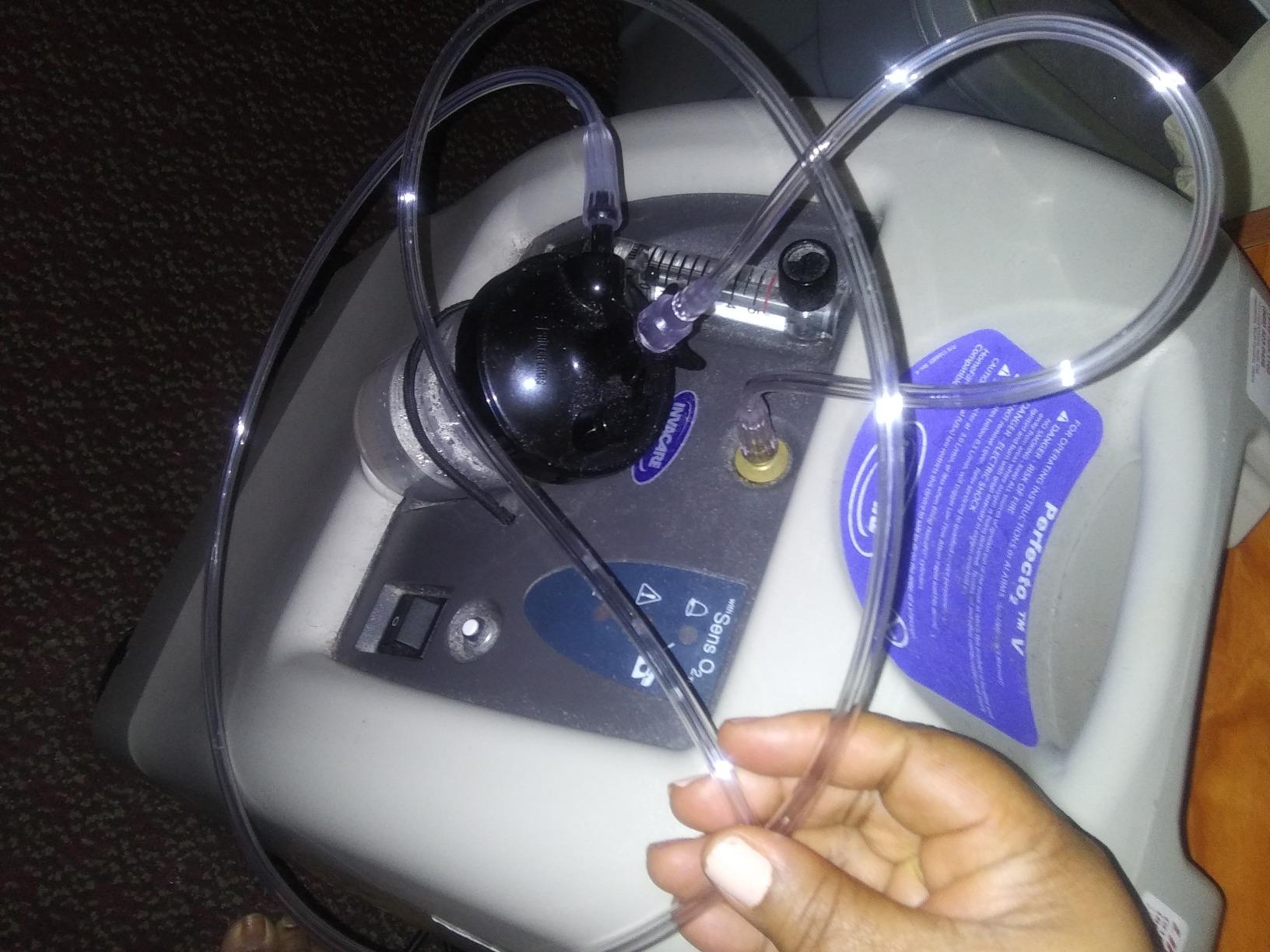
Compared to the green tubing that often ships with DME-delivered concentrators, the MARS WELLNESS tubing lies flatter and resists cracking as it ages. I left one stretched across a living room for three weeks and it never coiled back into a loop or developed a memory kink — that’s the test that separates throwaway tubing from tubing you can rely on.
A small number of users on very high flow rates (above 6 LPM continuous) report the inside diameter can feel a touch restrictive. If you’re consistently prescribed 10 LPM continuous, pair this with the HD HOUDELL high-flow cannulas and 25-foot extensions we covered above.
Best for
Anyone who needs to keep a steady supply of reliable 7-foot replacement tubing on hand without paying DME-channel pricing.
Skip if
You’re on a very high flow rate above 6 LPM continuous where the inside diameter might feel restrictive.
How to Choose Home Oxygen Concentrator Accessories for COPD?
The accessories above work with every FDA-cleared prescription home oxygen concentrator on the market — Inogen At Home, Philips Respironics EverFlo, Drive DeVilbiss 5L, CAIRE Companion 5, Invacare Perfecto2, and AirSep Intensity 10. What you pair with your machine depends on three things: your prescription, your living space, and your sleep setup. The next few sections walk through the decisions that drive those choices.
COPD Oxygen Needs by GOLD Stage
The GOLD (Global Initiative for Chronic Obstructive Lung Disease) staging system grades COPD from mild (GOLD 1) to very severe (GOLD 4) based on spirometry results. Your stage drives the prescription your pulmonologist writes, and that prescription drives which accessories you actually need.
GOLD 1 (mild) — FEV1 above 80% of predicted. Oxygen therapy is uncommon at this stage; if prescribed, expect 1 to 2 LPM during sleep or exertion only.
GOLD 2 (moderate) — FEV1 between 50% and 80%. Mild hypoxemia may appear during activity or sleep. A 2 to 3 LPM prescription during sleep or exertion is typical.
GOLD 3 (severe) — FEV1 between 30% and 50%. Chronic hypoxemia develops. Continuous oxygen at 2 to 4 LPM for 15+ hours per day is common.
GOLD 4 (very severe) — FEV1 below 30%. Continuous oxygen at 4 to 5 LPM or higher, often 24 hours per day. A 10L home unit may be prescribed instead of a 5L.
If you don’t know your GOLD stage, ask your pulmonologist at your next visit. It changes what LPM range to plan for, which in turn changes whether you need a 5L or 10L home unit, high-flow-rated cannulas, and a humidifier bottle for longer sessions.
Continuous Flow vs Pulse Dose: What Your Prescription Actually Says
Continuous flow delivers a steady stream of oxygen regardless of whether you’re inhaling. Pulse dose (also called “on-demand” or “bolus”) delivers a measured puff only when the device detects an inhalation. Stationary home concentrators typically deliver continuous flow, which is what most home prescriptions are written for at higher liter flows.
If your prescription specifies liters per minute (LPM) as a continuous flow rate, you need a stationary home concentrator and standard or high-flow cannulas like the ones in this guide. If your prescription specifies a pulse-dose setting, a portable unit may be sufficient — but most COPD patients with home oxygen needs still end up with a stationary unit for sleep and high-flow moments.
Filter Cleaning and Sieve Bed Maintenance Schedule
Every home oxygen concentrator has an intake filter that needs weekly cleaning — wash with warm water, air-dry fully, reinstall. A dirty filter chokes flow and reduces oxygen purity faster than any other factor. Sieve beds (the molecular sieve that separates nitrogen from oxygen) typically last 2 to 3 years under continuous use and cost several hundred dollars to replace when they wear out.
The accessories in this guide don’t replace any of that maintenance, but they do ride alongside it. Replacing a worn cannula monthly, swapping humidifier water daily, and rotating tubing every few weeks keeps the whole system clean and reduces the load on the sieve bed. For readers also interested in light home strength work to support respiratory muscle tone, the same maintenance routine keeps your gear reliable.
Medicare Part B and Insurance Coverage
Under Medicare Part B, home oxygen equipment (the concentrator itself) is classified as Durable Medical Equipment and is covered when prescribed by a physician for a qualifying condition like COPD with documented hypoxemia. You pay 20% of the Medicare-approved amount after meeting your Part B deductible, and the rental covers the machine plus standard accessories like basic cannulas and tubing.
Humidifier bottles, high-flow cannulas, and 25-foot extension tubing may or may not be covered depending on your DME supplier — ask before ordering them out of pocket. The accessories we’ve rounded up here are typically under $50 each, so most patients pay cash rather than navigate the insurance paperwork.
Long-Term Cost of Ownership Over 5 Years
Electricity is the hidden cost of running a home concentrator 24/7. At average residential rates, a 5-liter home unit costs roughly $20 to $40 per month to run. Over 5 years, that’s $1,200 to $2,400 in electricity alone — on top of sieve bed replacements every 2 to 3 years (roughly $200 to $500 per replacement on most brands).
The accessories in this guide add very little to that total: rotating through a $10 pack of cannulas every month costs around $600 over 5 years. A single humidifier bottle ($9 to $12) can last the full 5-year window if cleaned properly. Compared to the machine’s long-term cost, these are rounding-error expenses.
Fire Safety and Oxygen Handling at Home
Oxygen is non-flammable but strongly supports combustion — a candle or stovetop flame burns much hotter and faster in an oxygen-rich environment. Keep your concentrator and tubing at least 6 feet from open flames, gas stoves, candles, fireplaces, and space heaters. Don’t smoke or allow smoking in the room where oxygen is in use, and post a “No Smoking” sign on the door.
Avoid using petroleum-based lotions or lip balms near your nose or cannula — they react with concentrated oxygen. Use water-based or non-petroleum moisturizers instead, and keep your humidifier bottle filled with distilled water to reduce mineral buildup.
Frequently Asked Questions
What type of oxygen concentrator is best for COPD patients?
A continuous-flow, 5-liter home oxygen concentrator from a reputable FDA-cleared brand like Inogen At Home, Philips Respironics EverFlo, Drive DeVilbiss 5L, CAIRE Companion 5, or Invacare Perfecto2 works for most COPD patients prescribed up to 5 LPM. For very severe COPD needing higher flows, a 10-liter home unit like the AirSep Intensity 10 or Drive DeVilbiss 10L is the better match. Pair the machine with soft curved-prong nasal cannulas, an optional humidifier bottle for longer sessions, and high-quality crush-resistant tubing.
Which brand of oxygen concentrator is considered the best?
For home (stationary) use, the brands respiratory therapists and pulmonologists most often name are Inogen, Philips Respironics, Drive DeVilbiss, CAIRE, and Invacare. The Inogen At Home is often picked for energy efficiency, the Philips EverFlo for reliability, the Drive DeVilbiss 5L for value, the CAIRE Companion 5 for balanced performance, and the Invacare Perfecto2 for long-term build quality. Brand reputation matters because you’ll rely on the machine 12 to 24 hours a day.
How many hours a day should I use my oxygen concentrator?
That depends entirely on your prescription. COPD patients with chronic hypoxemia are typically prescribed 15 to 24 hours of continuous oxygen therapy per day, while those with exercise-induced or sleep-only hypoxemia may be prescribed oxygen only during activity or sleep. Don’t reduce your hours without talking to your prescribing physician — under-use can be as harmful as over-use in this population.
What is the downside of using an oxygen concentrator?
The main downsides are: dry nose and throat from continuous flow (solved with a humidifier bottle), noise at night that may disrupt sleep (quieter units run 35 to 40 decibels), high electricity use when run 24/7, the cost of sieve bed replacement every 2 to 3 years, and the fire-safety responsibility of keeping oxygen away from flames and smoking. None of these downsides outweigh the survival benefit of long-term oxygen therapy for COPD patients with documented hypoxemia.
How often should an oxygen concentrator filter be cleaned?
The intake filter on a home oxygen concentrator should be cleaned once a week with warm water, fully air-dried, and reinstalled. Many manufacturers recommend replacing the filter every 1 to 2 years depending on dust and pet-hair exposure. A dirty filter reduces oxygen purity and forces the compressor to work harder, which shortens the life of the sieve bed.
Is the Inogen At Home a good choice for 24/7 COPD use?
Yes — r/COPD and COPD360social community members regularly report the Inogen At Home performing well for 24/7 continuous-flow use, including paired with a CPAP for sleep. It’s one of the most energy-efficient home units on the market and runs quieter than older Drive DeVilbiss and Invacare machines. For very high continuous flows above 5 LPM, you may need a larger 10-liter unit instead.
Final Recommendation
For most COPD patients setting up a home oxygen therapy system in 2026, the accessories that move the needle on comfort are a soft curved-prong cannula like the ResOne 7Ft 5-Pack (our EDITOR’S CHOICE), a humidifier bottle to keep your nose comfortable during long sessions, and a high-quality crush-resistant extension tubing for moving around the home. Pair those with an FDA-cleared 5L or 10L home unit from a brand like Inogen, Philips Respironics, Drive DeVilbiss, CAIRE, or Invacare, and you’ll have the foundation of a reliable, comfortable setup that supports you through every stage of COPD. Confirm your prescription with your pulmonologist, register the equipment with Medicare or your DME supplier, and keep the fire-safety guidelines above in plain sight at home.