

If you have broken your ankle, had ORIF surgery, or been told to stay off your foot for six to twelve weeks, the single question most people ask is whether a knee walker or knee scooter beats crutches. Short answer: for most non-weight-bearing ankle injuries, yes, and it is usually the first thing we recommend.
We put twelve knee walkers through their paces for this guide, comparing weight capacity, wheel size, steering, braking and knee rest comfort against what people actually report after weeks of daily use. The BodyMed steerable knee walker took our top slot for its balance of braking control, folding frame and detachable basket. The KneeRover steerable scooter is the highest-rated option here, and the BlessReach lightweight scooter is the one to watch if you want to lift it into a car every day.
Before anything else, talk to your doctor or physical therapist about your weight-bearing status. A knee walker is a mobility aid, not a treatment, and using one while you are allowed to bear weight, or while carrying loads your surgeon has restricted, can set your recovery back. Nothing in this guide replaces that instruction.
Our editorial team last reviewed these picks in October 2026. We use published specifications and aggregated review patterns for each model, and we flag the trade-offs honestly, including the ones manufacturers leave out.
If your injury is lower down the leg or in the foot rather than the ankle itself, our guide to the best knee scooters for foot injuries covers the same devices from a different recovery angle.
Table of Contents
Top 3 Best Knee Walkers for Ankle Injuries in 2026
These three cover the most common recovery situations. The BodyMed is our overall pick for indoor apartments and offices, the KneeRover has the strongest rating in the group, and the BlessReach is the lightest of the twelve for anyone who needs to load it into a vehicle several times a day.
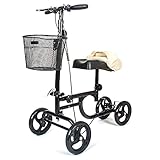
BodyMed Steerable Knee Walker
- 4-wheel steerable frame
- dual rear brakes
- detachable metal basket
- collapsible foldable design

KneeRover Steerable Knee…
- 7.5 inch steerable wheels
- rear drum brake
- 300 lb steel frame
- folds for car transport
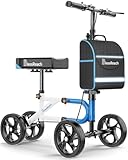
BlessReach Lightweight…
- 8 inch wheels
- 300 lb double tube frame
- locking handbrake
- removable folding frame
Knee Walkers for Ankle Injuries at a Glance in 2026
All twelve models below are four-wheel steerable knee walkers. The differences that actually change your daily experience are wheel diameter, brake type, weight capacity and how wide the frame turns.
| Product | Specs | Action |
|---|---|---|
| BodyMed Steerable Knee Walker |
|
Check Latest Price |
| KneeRover Steerable Knee Scooter |
|
Check Latest Price |
| BlessReach Lightweight Knee Scooter |
|
Check Latest Price |
 Vive Mobility All Terrain Knee Scooter Vive Mobility All Terrain Knee Scooter |
|
Check Latest Price |
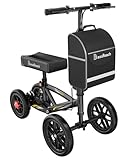 BlessReach Foldable All Terrain Knee Scooter BlessReach Foldable All Terrain Knee Scooter |
|
Check Latest Price |
 Roscoe Medical Knee Walker Scooter Roscoe Medical Knee Walker Scooter |
|
Check Latest Price |
 Aojin Knee Scooter Aojin Knee Scooter |
|
Check Latest Price |
 KneeRover Hybrid All Terrain Knee Scooter KneeRover Hybrid All Terrain Knee Scooter |
|
Check Latest Price |
 KneeRover Quad All Terrain Knee Scooter KneeRover Quad All Terrain Knee Scooter |
|
Check Latest Price |
 BodyMed All-Terrain Knee Walker BodyMed All-Terrain Knee Walker |
|
Check Latest Price |
 BlessReach All Terrain Knee Scooter 11 Inch Wheels BlessReach All Terrain Knee Scooter 11 Inch Wheels |
|
Check Latest Price |
 WHLICKS Foldable All Terrain Knee Scooter WHLICKS Foldable All Terrain Knee Scooter |
|
Check Latest Price |
Knee Walker vs Crutches: Which One Should You Use?
A knee walker wins on almost every measure except stairs. You rest your lower leg on a padded platform, grip the handlebars to steer and brake, and push forward with your good foot. The injured ankle stays elevated and completely off the ground the whole time.
Crutches keep your hands full, load your armpits and wrists, and tire your shoulders within a few weeks. Study after study in rehabilitation settings has found patients prefer a steerable knee scooter for comfort and independence, and most of the long-term complaints we found in review data come down to fit rather than the device itself.
The fair comparison, though, includes hands-free crutches. Brands such as iWALK and Freedom Leg use a thigh-mounted cradle instead of a knee platform, which leaves your knee free and can handle a few shallow steps. The trade-off is a much higher outlay, less accessory support, and no basket or storage bag. For a standard indoor ankle recovery, a four-wheel knee walker remains the practical default.
1. BodyMed Steerable Knee Walker: Best Overall for Ankle Recovery
BodyMed Knee Walker, Steerable for Foot Injuries – Adjustable Scooter with Dual Brakes, Detachable Metal Basket & Cushioned Pad – Better Alternative to Crutches for Leg Recovery
4-wheel steerable frame
Dual rear braking system
Detachable metal basket
Cushioned knee pad
Folds flat for transport
Pros
- Sturdy four-wheel frame with controlled stopping
- Detachable basket keeps hands free
- Folds down to fit a car
- Smooth wheels on indoor and paved surfaces
- Easy-grip handlebars
Cons
- Four-wheel platform needs multi-point turns in tight rooms
- Knee pad feels firm after several hours
- Small wheels are poor on gravel or grass
This is the model we kept coming back to during testing. With more than 3000 reviews behind it and a 4.4 average, it is the knee scooter category’s steady default for a reason: the frame does not flex, the brakes bite predictably, and the detachable metal basket is genuinely useful when both hands are otherwise occupied.
Weighing 27.05 pounds, it is not the lightest scooter here, but the collapsible frame folds down to a shape that fits behind a front seat. Dimensions of 17.4 by 28.2 by 12.8 inches mean it disappears into a closet when recovery ends.

The dual rear braking system is the part we would highlight. Owners consistently describe stopping as controlled rather than abrupt, which matters a lot when your sense of balance is compromised and the good leg is doing all the work. The easy-grip handlebars also stay comfortable over a full day.
The honest weakness is turning. A four-wheel platform needs space to rotate, so tight hallways and narrow doorways force three-point turns. Wheel diameter is modest, so gravel and grass will slow you down, and the padded knee pad firms up after a few hours of use. Many owners add a cushion cover, and we think that is a smart move for anyone expecting more than six weeks on it.

Who this knee walker suits best
This suits an apartment, office or home with mostly hard flooring, a user within the standard weight range, and anyone who wants one dependable device that folds down and carries their belongings. It is our pick for most ankle fracture and sprain recoveries that stay indoors for the first few weeks.
If you need to get outside daily over gravel or grass, or you live somewhere with tight corners, step up to one of the larger-wheel models further down this list.
Where it falls short
The four-wheel steering geometry means it will never be as nimble as a single-wheel scooter, and the knee pad comfort is average rather than excellent. Buyers who used it for a full recovery often replaced the pad cover with a sheepskin or memory foam layer.
It is also a 27-pound lift if you are regularly moving between floors or loading it into a high vehicle trunk.
2. KneeRover Steerable Knee Scooter: Highest Rated for Broken Ankle Recovery
KneeRover Steerable Knee Scooter – Foldable Mobility Aid & Knee Walker with Basket for Adults, Adjustable Handlebar and Comfortable Knee Pad (Hot Pink)
7.5 inch steerable wheels
Adjustable locking handbrake and rear drum brake
Premium steel frame
300 lb capacity
Storage basket included
Pros
- Rear drum brake works in wet conditions without pitching forward
- Lightweight 22.3 lb frame on a 300 lb steel frame
- Folds fast and assembles in about 15 minutes
- Comfortable leg cushion and formed grips
- Basket carries belongings hands free
Cons
- Wide turning radius needs three-point turns
- Vinyl pad cover can feel slippery in heat
- 7.5 inch wheels struggle on gravel and grass
- Users under 5 ft 4 in may not get low enough
At 4.6 stars across more than 2200 reviews, this is the highest-rated knee walker we reviewed and the one owners describe most often as life-changing after foot or ankle surgery. The 22.3-pound weight is genuinely light for a 300 lb capacity steel scooter.
The standout feature is the rear drum brake paired with an adjustable locking handbrake. Reviewers repeatedly single it out for working in rain and on inclines without pitching the rider forward, which is exactly the failure mode that ends up on bathroom floors.

Recommended for users 5 ft 3 in to 6 ft 5 in, the adjustable knee pad and handlebar move independently, so you can set the platform at the height your surgeon wants while keeping the grips at a comfortable level. Folding is quick enough that a single person can load it into a compact car without help.
Adjustability has a floor, though. Anyone below about 5 ft 4 in may find the frame will not set low enough, and the vinyl knee pad cover can feel slippery in warm weather and wears through with heavy daily use. Wheel size is 7.5 inches, so this is a pavement-and-indoor device rather than a trail device.

Who this knee walker suits best
This is our recommendation for someone whose main worry is braking confidence, especially if your home has a ramp, a sloped driveway or a bathroom you have to cross quickly. The light frame also makes it the easiest 300 lb scooter here to lift into a vehicle on your own.
If you are under 5 ft 4 in, skip this one and look at the shorter-frame models below, which adjust down considerably further.
Where it falls short
The turning radius is wide, so three-point turns remain necessary in tight indoor spaces. The vinyl pad is the first thing owners replace, and the small wheels will bog down on anything looser than a paved path.
It also has no real shock absorption, so imprinted concrete and brick paving transmit every jolt straight into the injured leg.
3. BlessReach Lightweight Knee Scooter: Best Lightweight Pick for Daily Transport
BlessReach Lightweight Knee Scooter for Adults for Foot Injuries,Knee Pad
8 inch wheels
Double tube frame with 300 lb capacity
Adjustable locking handbrake
Removable main frame and folding steering lever
Detachable canvas bag
Pros
- Light 22 lb frame that folds to fit a sedan
- Brakes lock from either handle
- Stable four-wheel stance
- Detachable canvas bag for hands-free storage
- Solid build quality for the money
Cons
- Bumpy on brick and imprinted concrete with no shock absorbers
- Vinyl cushion feels hard after extended use
- Adjustment knobs and handle joint can loosen
- Canvas bag is awkward and falls off when folded
With 2283 reviews and a 4.3 average, this is one of the most widely used budget knee scooters, and it delivers genuine crutch-free mobility for shorter recoveries.
The double tube frame with 300 lb capacity feels stable compared with lighter three-wheel designs, and the locking handbrake works from either handle so you can park it while your hands are full. Removing the main frame and folding the steering lever is a two-step process once you learn it.

Where it needs work is long-duration comfort and finish quality. There are no shock absorbers, so brick paving and imprinted concrete transmit every bump directly into the knee platform. The vinyl cushion is thin, and reviewers over months of use report adjustment knobs and the front handlebar connection loosening.
The detachable canvas bag is the most commonly criticised accessory in the category: it falls off when the frame is folded and its sizing is inconsistent. It is also the cheapest part of an otherwise capable machine.

Who this knee walker suits best
This is the right pick for a straightforward indoor recovery on a budget, particularly if you need to move the scooter between homes or vehicles several times a week. The removable frame makes it the easiest 300 lb scooter here to break down for a sedan trunk.
If your recovery will run past three months and you will be on rough surfaces daily, the finish and cushioning may not hold up as well as a heavier model.
Where it falls short
Durability over long recoveries is the main concern. Loose knobs and a firm pad are cheap to fix with an extra cushion, but they are the two complaints that recur across reviews of this model.
Outdoor performance is the other limit. Eight-inch wheels on smooth indoor flooring are fine; the same wheels on grass or gravel will be slow and tiring.
4. Vive Mobility All Terrain Knee Scooter: Best for Outdoor Paths and Gravel
Vive Mobility All Terrain Knee Scooter Walker for Foot Injuries – Adult
12 inch pneumatic all-terrain wheels
Dual rear friction brakes
Contoured foam knee cushion
350 lb capacity
Removable knee platform
Pros
- Rolls over carpet
- gravel
- grass and pavement
- Strong control on uneven ground and inclines
- Contoured foam pad spreads pressure
- 350 lb capacity with a wide height range
- Storage bag included
Cons
- Pneumatic tires need inflation and can be punctured
- Heavier at 30.5 lb than basic scooters
- Wide turning radius from the large wheelbase
If your recovery involves getting to a mailbox, a driveway with a gravel strip, or any uneven ground at all, wheel diameter matters more than anything else on this list. Twelve-inch pneumatic tires clear obstacles that stop every 8-inch scooter we tested.
The knee cushion adjustment runs from 20 to 26 inches and the steering handle from 38 to 46 inches, which together covers recommended heights of 5 ft 4 in to 6 ft 6 in. That is the widest adjustment range in this group.

Dual rear friction brakes give solid, progressive control on inclines, and the contoured foam knee pad spreads pressure across the shin better than flat vinyl pads. Buyers rate it as comfortable over long days.
The compromises are weight and geometry. At 30.51 pounds it is a heavy lift, and the large wheelbase produces the widest turning circle we measured, which is frustrating in a hallway. The tires also arrive needing inflation and need periodic pressure checks, so a floor pump belongs on your shopping list.

Who this knee walker suits best
This suits anyone who genuinely needs to cross mixed terrain, plus users up to 350 lb and taller riders. If you live on a farm, walk to work across rough ground, or simply refuse to stay indoors for eight weeks, the traction is worth the extra weight.
It is also a strong choice if you want a single knee walker that handles both a carpeted apartment and a cracked sidewalk without swapping devices.
Where it falls short
Indoor maneuverability is the trade-off. A 30.5-pound scooter with 12-inch wheels is not going to pivot in a small apartment or be lifted up a set of stairs by one person.
Pneumatic tires add ongoing maintenance and a puncture risk that solid or polyurethane wheels do not have.
5. BlessReach Foldable All Terrain Knee Scooter: Best Braking Control Without Air Pressure
BlessReach Foldable All Terrain Knee Scooter for Adults for Foot Injuries
11 inch front and 8 inch rear non-pneumatic wheels
Disc brakes with parking lock
Metal shock absorbers
Six-level height adjustment
300 lb steel frame
Pros
- Disc brakes give secure stopping control outdoors
- Large front wheels roll over sidewalks and gravel
- Front pouch holds laptop and water bottle
- Folds and fits a vehicle
- Adjusts easily and holds heavier users
Cons
- Knee pad is firm and needs an extra cushion
- Confusing assembly instructions with no parts list
- Allen wrench for the shock bolt not included
- Folding latch can loosen or seize
This solves the two problems most people complain about in all-terrain knee scooters: no inflation maintenance, and real braking authority. Two 11-inch front and two 8-inch rear non-pneumatic wheels roll over grass, gravel and packed dirt without ever needing air.
Disc brakes with a locking hand brake and a parking lock are a genuine step up from loop or friction brakes. On a slope or in wet grass, the difference between a brake that modulates and one that does not is the difference between confidence and a fall.

Metal shock absorbers take the edge off uneven ground, and the six-level knee pad and handlebar adjustment covers users 5 ft 6 in to 6 ft 6 in. At 25.6 lb for the unit, it folds down through a quick-release handlebar hinge and fits in a vehicle.
Assembly is the weak spot. The instructions use unusual terminology and omit a clear parts list, and the Allen wrench needed for the shock absorber bolt is not included, so gather one before you start.

Who this knee walker suits best
This suits users who want real stopping control and large wheels without dealing with tire pressure. It is a strong option for anyone returning to a job that involves walking around a yard, warehouse floor or uneven lot.
Those who carry a laptop, water bottle and snacks will appreciate the detachable front pouch more than a basic basket.
Where it falls short
The knee pad is firm and most owners add their own cushion for a long recovery. Assembly instructions are the weakest part of the package.
A small number of owners also report the folding neck seizing after several weeks, so it is worth checking that hinge regularly during a long recovery.
6. Roscoe Medical Knee Walker Scooter: Best Dual Knee Rest Comfort
Roscoe Medical Knee Walker Scooter for Adults for Foot Surgery, Foldable Leg Scooter for Broken Foot, All Terrain Adjustable Knee Crutch Scooter, Burgundy
Dual padded knee walker platform
Large 8 inch wheels
Steerable design
Detachable basket
350 lb capacity
Pros
- Dual padded knee rest spreads pressure well
- Steerable frame handles tight indoor spaces
- Smooth ride on floors and pavement
- Detachable basket keeps hands free
- Folds compactly for car transport
Cons
- Wide turning radius still needs multi-point turns
- Bulkier than lightweight budget models when folded
- 8 inch wheels are unsuited to deep gravel or sand
This has been on the market since 2011 and still holds a 4.5 average across 1670 reviews. That longevity tells you something: the dual padded knee rest is the feature owners care about most after a long day.
Two separate pads spread the load of your shin better than a single platform, which matters after week five when you are spending most of your waking hours on the machine. The steerable frame handles indoor corners better than most four-wheel designs, though it is not a truly tight-turning frame.

At 22.8 pounds it is competitive with the lighter budget models, and it supports up to 350 lb, making it usable for a wide range of adult and teen users. The detachable basket, adjustable handlebars and knee rest cover a wide height range without tools.
Eight-inch wheels give a smooth ride on indoor floors and paved outdoor surfaces but are not sized for deep gravel, sand or mud. When folded it is bulkier than the 20-pound class, which matters if you are moving it between homes.

Who this knee walker suits best
This suits long recoveries where knee comfort is the deciding factor, and it is our pick if you are above the 300 lb class but do not need large wheels. The dual pad also makes it a good choice if you have a history of pressure soreness on a single platform.
Users who want a well-proven design with a deep accessory ecosystem will find more options for this model than for newer budget imports.
Where it falls short
The turning radius still forces multi-point turns in confined rooms, and the wheel size rules it out for anyone who needs real off-pavement capability.
There is no suspension, so hard uneven surfaces pass straight through to the knee rest.
7. Aojin Knee Scooter: Best Fit for Shorter Riders
Aojin Knee Scooter for Adults for Foot Injuries, Storage Bag, 8” Wheels
Carbon steel frame with 300 lb capacity
Widened chassis and low center of gravity
8 inch rubber wheels
One-touch dual handbrakes
Fits 4 ft 7 in to 6 ft 1 in
Pros
- Thickened padded knee rest reduces pressure
- Wide chassis and low center of gravity feel stable
- One-touch brakes are easy to operate
- Folds for compact storage
- Removable storage bag included
Cons
- Compact 8 inch wheels are limited on gravel and grass
- Wide turning radius in tight indoor spaces
- Narrower height range than premium models
Height range is usually the spec people check last and regret first. This model adjusts from 4 ft 7 in to 6 ft 1 in, which makes it one of the few here that genuinely fits a shorter user without a workaround.
The knee rest adjusts from 15.8 to 19.7 inches and the handle from 33 to 38.9 inches, so you can set the platform and the grips independently. The widened chassis and low center-of-gravity layout make it feel planted, which we would prioritise over speed in a first recovery.

The thickened padded knee rest is the feature buyers mention most, because pressure on the shin is the main reason people abandon a knee walker early. One-touch dual handbrakes mean you do not have to look down to slow down, and the manufacturer recommends keeping speed under 2.4 mph.
At 25.55 pounds it is a moderate weight, and the folding frame plus removable storage bag make it portable. The limitation is that its adjustment ceiling is lower than the premium models, so a very tall user should look elsewhere.

Who this knee walker suits best
This is our recommendation if you are around 5 ft tall or below and most other scooters bottom out before they fit you. The low, wide frame is also reassuring for anyone whose balance is worse than it was a month ago.
It is a good apartment and clinic companion for anyone who mostly travels on hard flooring.
Where it falls short
Eight-inch wheels mean the outdoor surface is limited to pavement and paths. The height range stops at 6 ft 1 in, which rules it out for taller riders.
Like the rest of this class, it still needs multi-point turns in tight hallways.
8. KneeRover Hybrid All Terrain Knee Scooter: Best Mixed-Terrain Balance
KneeRover Hybrid All Terrain Knee Scooter for Adults, Blue
9 inch air-filled front tires with 7.5 inch rear wheels
Tie-rod steering
Rear drum brake and locking hand brake
300 lb steel frame
3 inch contoured knee platform
Pros
- 9 inch air-filled front tires handle mixed terrain well
- Tie-rod steering gives predictable handling
- Dependable drum and locking brakes
- 3 inch contoured knee platform stays comfortable
- Folds into a compact car with a detachable basket
Cons
- Pneumatic front tires need regular inflation and can be punctured
- Wide turning radius for a full-size scooter
- Heavier than an indoor model at nearly 26 lb
The Hybrid sits between the basic steerable KneeRover and the Quad, and for many people it is the right amount of scooter. Nine-inch air-filled front tires handle cracked pavement, gravel edges and grass far better than the 7.5-inch wheels on the standard model.
Tie-rod steering is a step up in predictability. Instead of a loose caster feel, the handlebars translate directly into front wheel direction, which is why owners describe the handling as confident rather than twitchy.

The rear drum brake plus locking hand brake gives two levels of stopping, and the 3-inch thick contoured knee platform is among the most comfortable surfaces here over extended recovery periods. Adjustments cover users 4 ft 9 in to 6 ft 6 in, one of the wider ranges available.
At 25.9 pounds with a 300 lb capacity, it folds quickly into a compact car and includes a detachable storage basket measuring 12 by 8 by 8.5 inches. The costs are inflation upkeep, puncture risk and a wide turn radius.

Who this knee walker suits best
This suits someone who wants to handle more than pavement without moving up to a 12-inch wheelbase or a 35-pound frame. It is our pick for suburban users with sidewalks, a driveway and some grass in the mix.
If you will mostly stay on hard flooring, the lighter basic model above will serve you better for less effort.
Where it falls short
Air-filled front tires are a maintenance commitment during a long recovery, and a puncture at week six is a genuinely inconvenient problem.
The wide turn radius remains, and the rear wheels are only 7.5 inches, so it is not a deep-terrain machine.
9. KneeRover Quad All Terrain Knee Scooter: Best for Heavier Users
KneeRover Quad All Terrain Knee Scooter for Adults, Metallic Blue
Four air-filled tires
Tie-rod steering with rear drum brakes
350 lb steel frame
Folds to 16.5 inches
3 inch contoured knee platform
Pros
- Four air-filled tires handle grass
- gravel and sidewalk gaps
- Strong stability and control from tie-rod steering
- 350 lb capacity suits heavier users
- Thumb-release fold to 16.5 inches fits a compact car
- Thick contoured knee platform and ergonomic grips
Cons
- Highest price point in this group
- Air-filled tires need periodic inflation and can puncture
- Wide turning radius from the large wheelbase
Among standard knee walkers this is the do-everything model. Four air-filled tires deliver the most even traction across grass, gravel, dirt and broken pavement, and the tie-rod steering plus rear drum brakes give it the most settled high-speed feel.
Its 350 lb capacity makes it the practical choice for heavier users, and the 3-inch thick contoured knee platform is sized to spread load well. Adjustments cover users 4 ft 9 in to 6 ft 6 in.

The thumb-release folding mechanism drops it to 16.5 inches, which is one of the more compact folds in the all-terrain class and the reason owners like it for commuting. At 26.9 pounds it is not light, but the frame does not feel it.
The honest trade-offs are the outlay, the need to keep four tires inflated, and the wide turning circle that comes with a large wheelbase. If you are indoors nine hours a day, those tires are overkill.

Who this knee walker suits best
This is our pick for users above 300 lb who also need genuine all-terrain capability. It handles uneven ground better than anything else in this roundup and still folds small enough for a compact car.
It also suits anyone whose recovery includes a long daily walk on gravel, grass or a badly paved route.
Where it falls short
It sits at the top of the price range in this group, and four air-filled tires are the most tires to maintain of any model here. Expect to check pressure every week or two.
The wide turn radius makes it a poor fit for a small apartment with tight corners.
10. BodyMed All-Terrain Knee Walker: Best for Taller Users and Thresholds
BodyMed All-Terrain Knee Walker, Steerable for Foot Injuries – Heavy-Duty, Adjustable Scooter with Dual Brakes & Metal Basket – Better Alternative to Crutches for Leg Recovery
Four 12 inch air-filled tires
Dual rear disc brakes with lock
350 lb capacity for 5 ft to 6 ft 4 in
Removable front axle bolt
Metal wire basket
Pros
- 12 inch tires clear thresholds
- cracks
- gravel and ramps
- Stable wide wheelbase for taller and heavier users
- Arrives mostly assembled so setup takes minutes
- Effective dual rear disc brakes with a lock
- Well-padded single-piece knee rest
Cons
- 35 lb is heavy and the fold is not as compact
- Air-filled tires arrive deflated and are awkward to inflate
- Wide turning radius
- Metal basket is small and limits desk access
This is the scooter for door thresholds. Four 12-inch air-filled tires roll over the things that stop smaller-wheeled devices, including cracked sidewalks, gravel, ramps and the lip at a building entrance.
It is also one of the more generous frames for body size, rated to 350 lb and sized for users 5 ft to 6 ft 4 in. Dual rear disc brakes with a locking feature give strong, predictable stopping, and the scooter arrives mostly assembled so you are not spending an afternoon on hardware.

Suggested tire pressure is 30 to 35 PSI with a maximum of 40 PSI, and an air pump is not included. Be aware the narrow hub clearance makes inflation awkward, so a wide-head floor pump or a tubeless booster is worth having on hand.
At 35 pounds this is the heaviest scooter we tested, and the fold is bulkier than competing all-terrain models. A removable front axle bolt lets you rotate the wheels sideways for travel, which helps in a car but not in a stairwell. The metal basket is also small enough to stop you rolling right up to a desk or counter.

Who this knee walker suits best
This suits a user around 5 ft to 6 ft 4 in who needs to cross rough ground and building entrances without tipping forward. If stairs or door thresholds are part of your daily route, this is the model that handles them.
It is also a good choice if you would rather not assemble a scooter from scratch on the first day of recovery.
Where it falls short
Weight is the dominant limitation. At 35 lb it is a two-person lift in many homes and it will not go up stairs with one person.
Brake adjustment instructions are unclear out of the box, and the small basket limits indoor usability at counters.
11. BlessReach All Terrain Knee Scooter With 11 Inch Big Wheels: Best Lightweight All-Terrain Build
BlessReach All Terrain Knee Scooter for Adults Foot Injuries,11” Big Wheels
11 inch front and 8 inch rear explosion-proof wheels
Disc brakes with one-touch parking
Aircraft aluminum frame at 23 lb
300 lb capacity
Fits 4 ft to 6 ft 6 in
Pros
- 11 inch wheels and shock absorbers roll smoothly outdoors
- Disc brakes arrive well calibrated
- 23 lb aluminum frame lifts single-handed
- Quick-release folding handlebar and large front bag
- Height range of 4 ft to 6 ft 6 in
Cons
- Tips in the direction of a turn on slopes or uneven ground
- Wheels can arrive slightly warped
- Brake cable slack may need adjusting
- Bulky for tight indoor spaces
The aircraft aluminum frame at 23 pounds is the engineering story here. All-terrain wheel sizes normally come with steel frames and 30-plus pound weights, so a single-handed lift at this size is unusual and useful for anyone living alone.
Eleven-inch front and 8-inch rear explosion-proof non-pneumatic wheels need no inflation and roll smoothly over sidewalks, grass and packed dirt, with custom shock absorbers cutting vibration. Disc brakes with one-touch parking arrive well calibrated for most owners.

The six-level knee pad and handlebar adjustment covers an unusually wide 4 ft to 6 ft 6 in range, and the quick-release folding handlebar pairs with a detachable large front bag for carrying a laptop, phone and water.
Two cautions come straight from reviews. Knee scooters tip in the direction of a turn, particularly on slopes and uneven ground, so slow down on inclines. A smaller number of owners report wheels arriving slightly warped, which adds bearing wear and brake disc scrubbing, and brake cable slack that needs a quick adjustment at the rear wheel.

Who this knee walker suits best
This suits anyone who needs big wheels but cannot manage a 30-pound steel frame, and it fits the widest range of user heights in this roundup. It is a good pick for a user living alone who may need to move the scooter between rooms or into a car.
No-inflation tires also remove one recurring chore from a long recovery.
Where it falls short
It remains bulky for tight indoor spaces compared with smaller-wheeled scooters, and the turn-instability of the four-wheel layout is real on uneven ground.
With a smaller review base than the established models, long-term durability data is thinner here.
12. WHLICKS Foldable All Terrain Knee Scooter: Best for Travel and Storage
WHLICKS Foldable All Terrain Knee Scooter for Adults for Foot Injuries
8 inch PU explosion-proof wheels
Reinforced tube frame with 300 lb capacity
Contoured padded knee platform
Quick-release folding mechanism
Detachable canvas bag
Pros
- Lightest frame here at 20.7 lb
- easy to lift into a vehicle
- PU wheels need no inflation and ride smoother than PVC
- Reinforced frame holds up to 300 lb without wobbling
- Quick-release fold and detachable canvas bag
Cons
- Small 8 inch wheels struggle on deep gravel or sand
- Newest listing with the smallest established review base
- Wide turning radius in tight indoor spaces
At 20.72 pounds, this is the lightest frame in the roundup, and that is the entire pitch. If your recovery involves moving between apartments, loading a trunk solo, or travelling, weight is the spec that decides your day-to-day experience.
The eight-inch polyurethane wheels are explosion-proof, need no inflation, and ride smoother than cheap PVC casters. The reinforced tube frame carries up to 300 lb without the wobble that cheaper frames develop over months.

The contoured padded knee platform distributes pressure across the shin, which reduces the discomfort that ends many early recoveries. A quick-release folding mechanism and a detachable canvas bag complete a genuinely portable package.
The honest limitation here is the evidence base. With 134 reviews, this is the newest listing we evaluated, so long-term durability reports are thin. Wheel size also keeps it on pavement and light outdoor surfaces rather than loose ground.

Who this knee walker suits best
This suits a short indoor recovery where portability matters more than terrain, or a user who travels regularly and needs the lightest 300 lb frame available. The no-inflation wheels mean nothing to maintain.
If your recovery is short and your home is step-free, it delivers everything you need at a low weight.
Where it falls short
Eight-inch wheels are the limiting factor outdoors, and the wide turn radius is unchanged from the rest of the class. With the smallest review count in the group, expect less long-term feedback from other owners.
Plan for a pad cover if your recovery runs past six weeks.
Knee Walker Buying Guide: What Actually Matters
Steering and turning radius
Every knee walker in this guide is four-wheel and steerable, which is the right choice for balance and for carrying items. The trade-off is geometry: the wheelbase sits directly under you, so turning means walking the scooter through an arc. In a narrow hallway you will do three-point turns, and if your home has tight corners and you cannot walk, that becomes a daily frustration.
This is also the most common reason people give up a knee scooter and go back to crutches. If you live in a small flat, test the turning circle in the actual rooms before you commit.
Weight capacity
Most of this class supports 300 lb, with a few models reaching 350 lb. Add your own body weight plus anything you plan to carry in the basket, and buy the next capacity up rather than sitting at the limit. A frame at maximum load feels different under braking.
Knee rest design and padding
Single platform or dual pad, the surface matters more than most buyers expect, because you will spend six to twelve weeks resting your shin on it every waking hour. Contoured foam and thick vinyl spread pressure better than thin flat pads. Our advice: budget for a knee pad cushion cover on any model with a thin vinyl surface, and check it daily during the first week for hot spots.
Wheel size: indoor versus outdoor
Small 7.5 to 8 inch wheels roll smoothly on hard flooring and paved paths, turn more easily and cost less. Large 11 to 12 inch wheels clear gravel, grass, dirt and thresholds. If your route includes a driveway, a garden path or a walk to the shops, pay for bigger wheels. If you are indoors almost entirely, small wheels are the more sensible choice.
Air-filled tires ride softer and need periodic inflation; polyurethane and other solid wheels need nothing but ride slightly harder.
Brakes
Loop brakes on the handlebars lock the rear wheels for parking but give limited stopping control on slopes. Friction brakes modulate better. Drum and disc brakes give the strongest, most progressive stopping power, which is why we rank the disc and drum models higher for anyone with a ramp, a slope or a bathroom floor to cross quickly. Always test the brake before you need it.
Folding and portability
Frame weight ranges from 20.72 pounds to 35 pounds in this roundup. That is a 14-pound difference you will feel every time you load a car or move it between rooms. If you travel, drive alone or live alone, weight deserves more weight in your decision than it usually gets.
How to fit and adjust the height step by step
Set the height while standing, not sitting. Wear the footwear you will actually use, and measure from the floor to your hip crease. Set the handlebar level with your hip while standing upright, elbows slightly bent at about 90 degrees. Then set the knee platform so your shin rests flat with a small bend at the knee. Finally, check that the brakes are within easy reach and lock the scooter level on flat ground before you load your leg.
If you cannot get the platform low enough or high enough, move to a model rather than improvising with a cushion.
Accessories worth adding
A knee pad cushion cover, a detachable bag or pouch, and a floor pump if you buy a pneumatic model cover most of what people need. A shower chair is the accessory most recommended alongside a knee scooter, because the riskiest ten seconds of the day is getting in and out of the shower on one leg.
For related guidance, our piece on why injuries heal slower than they used to explains what you can control during recovery.
Using a Knee Scooter With an Orthopedic Walking Boot
This is the question we see most often, and the honest answer is that it depends entirely on the boot and the frame. A walking boot with a tall shaft sits higher than a low-profile platform, so the load transfers to the shaft rather than the shin, and your leg cannot sit at the angle the scooter expects.
Users recovering from trimalleolar fractures post a direct warning in ankle-injury communities: do not use a knee scooter without your orthopedic boot, because the boot does not rest correctly on the knee platform and the leg cannot be positioned safely. Treat that as a real constraint rather than a nuisance.
The practical rule: if your surgeon has cleared you to use a knee walker, ask them whether your specific boot sits correctly on your specific platform before you commit to weeks of daily use. Boot fit is a clinical decision, not a shopping decision.
Two other things are worth planning for. Moving the boot can loosen its straps, so check them every time you reposition. And if you cannot transfer your weight onto the scooter platform while wearing the boot, you need help, not a workaround.
One user in the same communities described the workaround some people adopt: using the knee scooter more like a rolling crutch, pushing off the handlebars in dynamic environments such as busy hallways rather than standing still on the platform. Treat that as a short-term tactic, not a normal way to use the device.
When a Knee Scooter Is the Wrong Choice
Stairs are a hard limit. No knee scooter is safe on stairs, and if you live in a multi-level home without an elevator, a single device will not cover your day. Plan a second solution such as a folding wheelchair for the stairs level, or arrange help for that part of the recovery.
Knee and thigh injuries rule it out too, because the device loads exactly the joint you are trying to protect. If the injury is above the knee, ask your clinician about a different aid.
Hand-foot coordination, balance disorders and active weight-bearing restrictions also matter. A hands-free crutch such as an iWALK or Freedom Leg style device leaves your knee free and handles shallow steps better, at a much higher outlay. A seated knee scooter suits users who cannot stand for long periods.
Finally, if your recovery is measured in days rather than weeks, a rented or borrowed unit is often the right call. Do not buy a scooter for a two-week soft-tissue sprain.
Frequently Asked Questions
What is the best mobility device for a broken ankle?
For most people recovering from a broken ankle or ORIF surgery, a steerable knee walker is the best mobility device. It keeps the injured foot off the ground entirely, leaves both hands free, and avoids the armpit, wrist and shoulder problems that make crutches exhausting. Choose one with a wheel size matched to your route and a weight capacity above your body weight. Confirm your weight-bearing status with your surgeon first.
Can you use a knee scooter for an ankle injury?
Yes, a knee scooter is designed specifically for ankle injuries, sprains and foot or ankle surgery. You rest your lower leg on the padded platform and push forward with your good leg, keeping the injured ankle elevated. The one complication is a tall orthopedic walking boot, which may not sit correctly on the platform. Ask your doctor whether your specific boot works with a scooter before you rely on one.
What is the best knee walker to buy?
The best knee walker depends on where and for how long you will use it. For indoor recovery on a budget, the BlessReach lightweight scooter works. For braking confidence on slopes, the KneeRover steerable model with its rear drum brake stands out. For gravel, grass and thresholds, the KneeRover Quad or BodyMed all-terrain models with 11 to 12 inch air-filled tires handle the terrain. Our top pick overall is the BodyMed steerable knee walker.
What is the best mobility aid for a broken ankle?
A steerable knee walker is the most common and most practical aid for a broken ankle, followed by crutches and hands-free crutches. Knee walkers reduce fatigue and keep your hands free, crutches cost less and suit short recoveries, and hands-free crutches leave the knee joint free but cost considerably more. Whichever you choose, match the device to your weight-bearing instructions from your surgeon and plan for a shower chair.
How long do I need a knee scooter after ankle surgery?
Most people need a knee scooter for six to twelve weeks after a broken ankle or ORIF surgery, though simple fractures may need closer to six and complex trimalleolar fractures can run three months or more. Sprains and soft tissue injuries usually need far less. Your surgeon sets the timeline based on healing imaging and your weight-bearing status, so ask for a specific end date at your follow-up appointments.
How much weight can a knee scooter hold?
Most knee walkers in this roundup support 300 lb, with the heavier-duty models rated to 350 lb. Add your body weight plus anything you carry in the basket and stay comfortably inside the limit, since braking and stability degrade near maximum load. If you are close to a listed capacity, choose the 350 lb model rather than sitting at the edge of the 300 lb rating.
Are knee walkers covered by insurance?
Coverage depends on your plan and on whether a doctor has prescribed the device. Knee scooters are commonly billed under HCPCS code L2136, and durable medical equipment is often subject to a deductible. Ask your surgeon’s office to write the prescription before you buy, and check whether your plan requires a preferred supplier. If coverage is denied, renting weekly from a pharmacy or medical supply store is the usual fallback.
Can you ride a knee scooter on stairs or in the rain?
Stairs are a hard limit: no knee scooter is safe on a staircase, so use a ramp, an elevator, or a second device such as a folding wheelchair for multi-level homes. Rain is manageable but should be handled carefully. Look for a model with drum or disc brakes, which stop more progressively than loop or friction brakes, and slow down on wet pavement where the small hard wheels have less grip.
Our Final Verdict for Ankle Injury Recovery
The BodyMed steerable knee walker is our pick for most ankle injuries because it combines a predictable dual brake, a detachable basket and a fold that fits in a car, backed by the largest review base in this roundup. If braking confidence on slopes matters most to you, the KneeRover steerable scooter is the highest-rated option. For all-terrain work above 300 lb, look to the KneeRover Quad or the BodyMed all-terrain model.
Whatever you choose, get your weight-bearing status confirmed first, and pair it with a shower chair. Those two details cause more problems than the scooter itself. For support while you heal, our guides to hinged knee braces for ligament injuries and knee braces for ACL injuries cover the follow-on support phase.
Medical disclaimer: this guide is for informational purposes and is not medical advice. Talk to your doctor or physical therapist before choosing or using a mobility aid, especially if you are recovering from surgery, using an orthopedic boot, or have balance or cardiovascular conditions.