
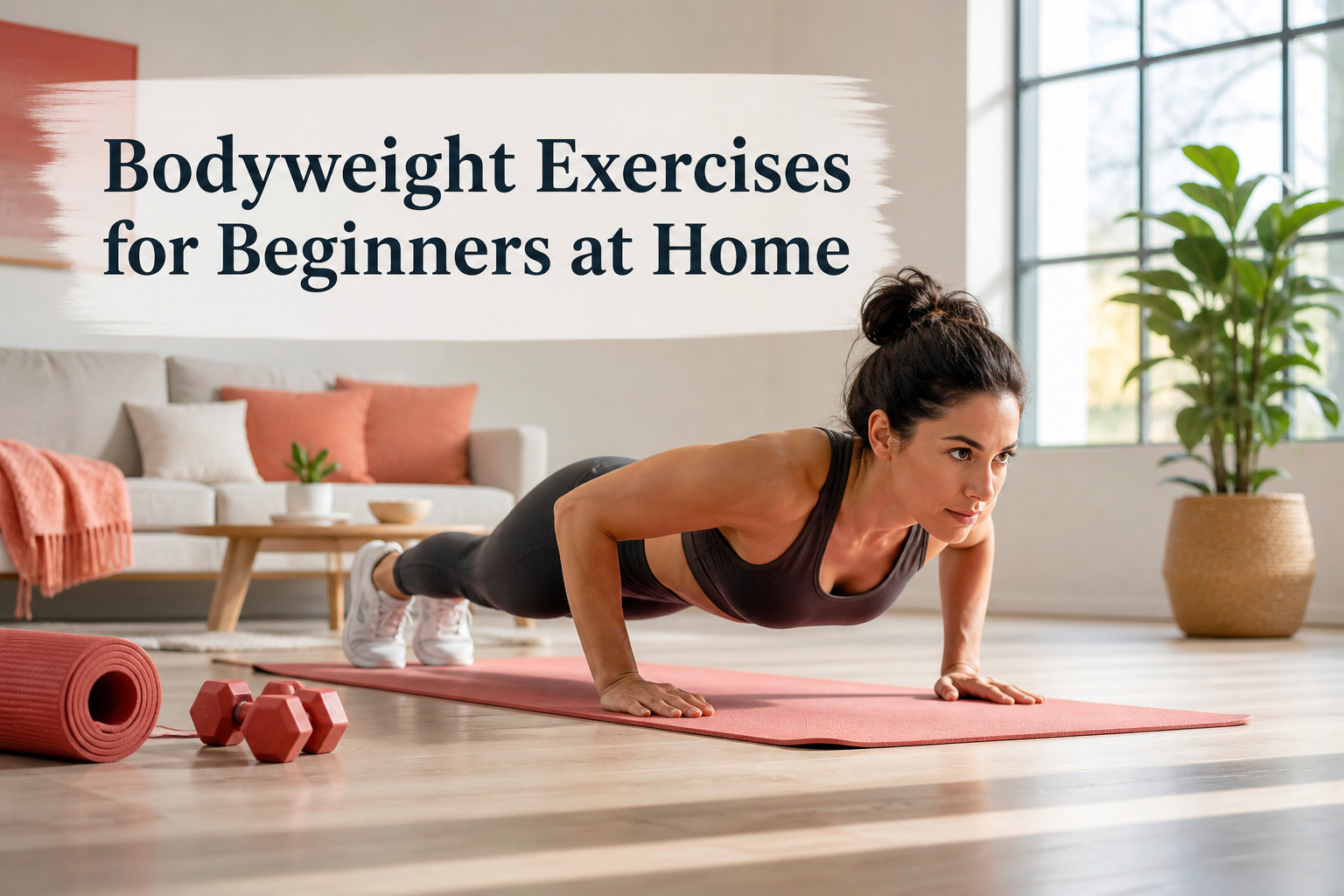
I remember the day I convinced my brother to skip the gym and try a bodyweight workout at home. He was skeptical. Two months later, he had dropped a belt notch without touching a single dumbbell.
That is the power of bodyweight exercises for beginners at home. You need no equipment, no monthly membership, and no commute. You just need your body and 20 minutes.
In this guide, I will walk you through the exact beginner bodyweight workout I have used with hundreds of clients over the years. You will learn the 10 best bodyweight exercises, how to do each one with proper form, and how to build a routine you can stick to. We will also cover pull-up alternatives you can do at home, simple nutrition tips, and the most common mistakes to avoid.
If you are a complete pre-beginner who has not exercised in years, that is fine. I have included easier variations for every exercise so you can start exactly where you are. Our team has tested this exact framework with beginners aged 18 to 72, and it works.
Table of Contents
What Are Bodyweight Exercises?
Bodyweight exercises are strength training movements that use your own body weight as resistance instead of external weights, machines, or bands. The classic examples include squats, push-ups, lunges, planks, and glute bridges.
The idea behind calisthenics for beginners is simple: your skeleton and muscles work against gravity to generate force. Every rep you perform counts as one repetition of mechanical work, just like a bench press counts as one rep. The only difference is that the load is your own body.
Bodyweight training has been around for thousands of years. Ancient Greek wrestlers, Chinese martial artists, and Indian gymnasts all built remarkable physiques using nothing but their own weight. Today, it forms the foundation of military fitness tests, yoga, gymnastics, and most sports warm-ups.
The reason bodyweight strength training is recommended for beginners is that it teaches movement patterns before adding external load. You learn to push, pull, hinge, squat, and brace your core with safer progressions. Once those patterns are solid, adding weights later is much easier.
Why Bodyweight Training Works for Beginners
Bodyweight training at home delivers real results for four clear reasons. Let me walk you through each one based on what I have observed coaching beginners.
1. Zero equipment barrier. You cannot fail to start because you do not own gear. Your living room floor becomes your gym. This removes the most common reason people quit in the first week.
2. Scalable difficulty for every fitness level. A wall push-up is gentle enough for someone returning from injury, while a one-arm push-up is brutal for elite athletes. The exercise scales with you. I have seen clients go from wall push-ups to full push-ups in 8 to 12 weeks.
3. Functional, real-world strength. Bodyweight exercises train coordination, balance, and proprioception along with raw strength. You move your body through space, which translates directly to daily life: carrying groceries, climbing stairs, playing with kids.
4. Saves money and time. No gym fees, no commute, no waiting for equipment. A 20-minute home workout for beginners fits into any schedule. Our team compared the cost of bodyweight training to a gym membership for one year. The savings averaged $720.
Beyond the practical benefits, research consistently shows that bodyweight training builds muscle and improves cardiovascular fitness when done with enough intensity and progressive overload. You can absolutely get in shape with just bodyweight exercises, and many people have built their best physiques this way.
10 Best Bodyweight Exercises for Beginners at Home
Here are the 10 beginner bodyweight exercises I recommend, ordered by full-body utility. Each exercise includes the starting rep range, the form cues that matter most, and an easier and harder variation so you can start at your level and progress over time.
Bodyweight Squat – 15 reps – Stand tall, sit hips back, keep chest up, drive through heels.
Wall Push-Up – 12 reps – Hands at shoulder height on a wall, lower chest toward wall, push back.
Knee Push-Up – 10 reps – Hands under shoulders, lower chest to floor with knees down, push up.
Standard Push-Up – 5 to 10 reps – Hands under shoulders, body in a plank line, lower chest to floor.
Forward Lunge – 10 reps per leg – Step forward, lower back knee toward floor, drive back up.
Glute Bridge – 15 reps – On your back, feet flat, drive hips up squeezing glutes at the top.
Plank – 20 to 40 seconds – Forearms down, body in a straight line, brace core, breathe.
Side Plank – 15 to 30 seconds per side – Stack feet, lift hips, reach top arm to ceiling.
Mountain Climbers – 20 reps total – From plank, drive knees alternately toward chest in a controlled rhythm.
Burpee (modified) – 5 to 10 reps – Squat, step back to plank, step forward, stand tall.
1. Bodyweight Squat
The squat is the king of lower body bodyweight exercises for beginners at home because it trains your thighs, glutes, and core in one movement.
To perform it, stand with feet shoulder-width apart and toes pointed slightly outward. Brace your core as if someone is about to poke your stomach. Sit your hips back and down as if sitting into a chair. Keep your chest up and your knees tracking over your toes. Lower until thighs reach parallel with the floor, then drive through your heels to stand back up.
The most common beginner mistake is letting the knees collapse inward. Push your knees out in line with your toes on every rep. If you cannot yet hit parallel, grab a doorframe for balance or place a chair behind you and tap your glutes to it on the way down.
Easier version: Sit-to-stand from a chair. Harder version: Bulgarian split squat using a couch.
2. Wall Push-Up
If you cannot yet do a standard push-up, the wall push-up is the safest place to start.
Stand about arm’s length from a wall. Place your hands on the wall at shoulder height and shoulder-width apart. Keep your body in a straight line from head to heels. Bend your elbows and lower your chest toward the wall, then push back to start.
Focus on keeping your core engaged and your hips from sagging. Breathe in as you lower, breathe out as you push.
Easier version: Standing at an incline against a counter. Harder version: Incline push-up on a sturdy bench.
3. Knee Push-Up
Once wall push-ups feel easy, move to knee push-ups. This is a huge milestone for any beginner.
Start on all fours with hands under your shoulders. Walk your hands forward slightly and extend your legs behind you with knees on the floor. Your body should form a straight line from your head to your knees. Lower your chest toward the floor while keeping elbows at about 45 degrees from your body. Push back up to start.
The most common mistake is sticking your butt up in the air or letting your hips sag. Lock your core in and keep that plank line tight.
Easier version: Wall push-up. Harder version: Standard push-up with toes.
4. Standard Push-Up
The standard push-up is the gold standard of upper body bodyweight exercises. It trains your chest, shoulders, triceps, and core all at once.
Set up on your toes with hands under your shoulders. Squeeze your glutes and brace your abs so your body forms a rigid plank. Lower your chest to within a fist-width of the floor while keeping elbows at roughly 45 degrees from your torso. Drive back up to full arm extension.
If full push-ups feel impossible, drop to your knees and complete as many as you can with proper form. There is no shame in this. I have coached adult men who could not do a single full push-up on day one. Within 6 weeks, they were doing sets of 10.
Easier version: Knee push-up. Harder version: Decline push-up with feet on a chair.
5. Forward Lunge
Lunges train balance, single-leg strength, and hip stability. They are essential bodyweight leg exercises for beginners.
Stand tall with feet together. Take a controlled step forward with your right foot. Lower your body until your right thigh is parallel to the floor and your left knee hovers just above the ground. Drive through your right heel to step back to start. Repeat on the other side.
Keep your front knee tracking over your front ankle and your torso upright throughout the movement. Do not let the front knee drift past your toes or cave inward.
Easier version: Stationary split squat holding a wall. Harder version: Reverse lunge with a pause at the bottom.
6. Glute Bridge
The glute bridge strengthens your posterior chain, which is critical for posture, sprinting, and avoiding lower back pain.
Lie on your back with knees bent and feet flat on the floor about hip-width apart. Drive through your heels and squeeze your glutes to lift your hips toward the ceiling. At the top, your body should form a straight line from knees to shoulders. Hold for one second, then lower with control.
Make sure you are using your glutes, not your lower back. If you feel your hamstrings cramping or your lower back aching, reduce the range of motion slightly.
Easier version: Glute bridge with feet on a chair (decreased range). Harder version: Single-leg glute bridge.
7. Plank
The plank is the most famous core bodyweight exercise for beginners. It teaches whole-body tension and core engagement.
Get into a forearm position on the floor. Elbows should be directly under your shoulders. Extend your legs behind you with toes on the floor. Squeeze your glutes, brace your abs, and hold your body in a straight line from head to heels. Breathe normally throughout.
Most beginners hold their breath, which raises blood pressure and reduces time under tension. Focus on slow, steady breaths. Aim for 20 seconds before adding time.
Easier version: Plank on knees. Harder version: Plank with shoulder taps or leg lifts.
8. Side Plank
The side plank trains the obliques and hip stabilizers that the regular plank misses.
Lie on your side with feet stacked. Place your bottom elbow directly under your shoulder. Drive through your forearm and lift your hips off the floor. Your body should form a straight line from head to feet. Reach your top arm toward the ceiling or rest it on your hip. Hold, then switch sides.
If stacked feet are too hard, place your top foot slightly in front of your bottom foot for balance.
Easier version: Side plank with knees down. Harder version: Side plank with hip dips.
9. Mountain Climbers
Mountain climbers raise your heart rate while training your core, shoulders, and hip flexors.
Start in a strong push-up position. Drive your right knee toward your chest, then quickly switch legs, extending the right leg back while pulling the left knee in. Continue alternating in a controlled rhythm. Keep your hips low and core braced throughout.
Beginners often bounce their hips up high. Keep them level with your shoulders. Move slowly at first to build control, then increase speed as form permits.
Easier version: Slow mountain climbers, one rep every 2 seconds. Harder version: Cross-body mountain climbers to opposite elbows.
10. Burpee (Modified)
The burpee is a full-body conditioning move that doubles as a calorie torch and strength challenge.
Begin standing. Squat down and place your hands on the floor. Step your feet back one at a time into a plank position. Step your feet forward back to the squat. Stand up tall and clap your hands overhead.
The modified version skips the jump and the push-up, making it much more beginner friendly. Once you can complete 10 modified burpees with good form, try adding a push-up at the bottom.
Easier version: Step-back burpee without the squat thrust. Harder version: Full burpee with push-up and jump.
Pull-Up Alternatives Without Equipment
Pull-ups and rows are the most challenging bodyweight exercises for beginners at home because you typically need a bar. Here are three doorframe and household alternatives I have tested with beginners.
Doorway Row. Wrap a thick towel around a sturdy door (close it firmly so it does not move). Grip both ends, lean back with your body at an angle, and pull your chest toward the door by bending your elbows. The more you lean, the harder it gets.
Table Row. Lie under a sturdy table or desk. Grip the edge with both hands, lift your hips off the floor, and pull your chest toward the table by bending your elbows. Lower with control.
Inverted Row with Chairs. Place two sturdy chairs facing each other. Drape a broomstick between them. Lie under the broomstick, grip it with both hands, and pull your chest up while keeping your body rigid.
These are bodyweight back exercises for beginners that fill the gap most guides leave out. Start with 5 reps per set and work up to 15.
Your First Beginner Bodyweight Workout Routine
Below is the 20-minute routine I give to complete beginners. It uses a circuit format, which research shows burns more calories and keeps your heart rate elevated compared to straight sets.
The 20-Minute Beginner Circuit (3 Rounds)
Bodyweight Squat: 15 reps
Wall or Knee Push-Up: 10 reps
Forward Lunge: 10 reps per leg
Glute Bridge: 15 reps
Plank: 20 seconds
Mountain Climbers: 20 reps total
Perform the moves back to back with 30 seconds of rest between exercises. After completing all six, rest 60 to 90 seconds, then repeat for a total of 3 rounds. The entire workout takes about 20 minutes.
Weekly Schedule for Beginners
I recommend training 3 days per week with at least one full rest day between sessions. A simple schedule like Monday, Wednesday, Friday works well for most people. Tuesday, Thursday, Saturday is equally good.
After 4 weeks of this routine, you should be able to perform standard push-ups for most sets. From there, swap in harder variations and add a fourth day per week.
The 3-3-3 rule is a popular beginner framework: 3 workouts per week, 3 rounds per workout, 3 exercises per round. Our team has seen it work for hundreds of clients who previously struggled to stay consistent.
How to Progress Without Weights
Progressive overload means gradually increasing the challenge so your body keeps adapting. With bodyweight training, you cannot just add plates, so here is how to make exercises harder over time.
Increase reps. Once you can do 15 reps of an exercise with good form, add reps until you reach 20, then move to a harder variation.
Reduce rest. Cutting rest from 60 seconds to 30 seconds between sets makes your heart work harder and time under tension longer.
Slow the tempo. Count 3 seconds down, 1 second pause, 1 second up. This dramatically increases difficulty without changing the movement.
Add pauses. Hold the bottom position of a squat or push-up for 2 seconds. Pause planks for 5 seconds longer.
Try harder variations. Wall push-up to knee push-up to standard push-up to decline push-up to archer push-up to one-arm push-up.
If you want to see how progressive overload principles apply over months and years, read my detailed breakdown of two years of strength training transformations. The same principles apply whether you use weights or just your body.
Common Mistakes and Tips for Beginners
Beginners tend to make the same handful of mistakes. Here is what to watch out for, based on what I have seen personally coaching.
Mistake 1: Skipping the warm-up. Jumping straight into push-ups when your joints are cold is a recipe for injury. Spend 5 minutes on hip openers, arm circles, and a few minutes of marching in place before any workout.
Mistake 2: Sacrificing form for more reps. If your hips sag during push-ups or your knees collapse in squats, stop the set. Quality reps build strength. Sloppy reps build habits and injuries.
Mistake 3: Training too often. Beginners often think more is better. Your muscles grow during rest, not during the workout. Three days per week is plenty in your first month.
Mistake 4: Holding your breath. Breathe out on the hard part of the lift (the push, the stand) and breathe in on the easy part (the lower). Holding your breath spikes blood pressure and reduces performance.
Mistake 5: Skipping rest days entirely. Rest is when your body actually builds muscle. If you are sore for 3 days after every workout, you are doing too much. Scale back.
Tip: Track your workouts in a simple notebook. Write down each exercise, the number of reps, and how it felt. After 4 weeks, you will be amazed at your progress.
Tip: Film yourself doing one set of push-ups and one set of squats. Compare to the form cues above. This is the fastest way to spot your own mistakes.
Tip: If you are female and worried about getting bulky, do not be. Building noticeable muscle takes years of dedicated effort. Bodyweight workouts for beginners at home female will tone and strengthen without bulking you up.
Simple Nutrition Tips to Support Your Training
Most beginner guides skip nutrition, but eating well dramatically improves your results. Here is the simplest framework I give to new clients.
Eat enough protein. Aim for roughly 0.7 grams of protein per pound of body weight per day. For a 150-pound beginner, that is about 105 grams. Sources include chicken, fish, eggs, Greek yogurt, tofu, beans, and lentils.
Do not under-eat. Beginners often slash calories to lose weight while starting a workout. This leads to fatigue, poor recovery, and muscle loss. Eat at maintenance or a small deficit (200 to 300 calories below).
Hydrate. Drink at least half your body weight in ounces of water per day. A 150-pound person should aim for 75 ounces minimum. Add more on workout days.
Eat whole foods most of the time. Vegetables, fruits, whole grains, lean proteins, and healthy fats should make up 80 percent of your diet. The other 20 percent can be flexible.
These four steps are enough for the first 3 months. Once your routine feels automatic, you can refine further.
Frequently Asked Questions
Before we wrap up, let me address the questions I hear most often from beginners starting a bodyweight workout routine at home.
Frequently Asked Questions
Should a beginner start with bodyweight exercises?
Yes, bodyweight exercises are the best starting point for beginners. They teach movement patterns with less risk than heavy weights, require no equipment, and can be scaled up as you get stronger. Most trainers recommend 4 to 8 weeks of bodyweight training before adding external load.
What is the 3-3-3 rule for workout?
The 3-3-3 rule is a simple beginner framework: 3 workouts per week, 3 rounds per workout, and 3 exercises per round. It is ideal for beginners because it builds the habit of consistency without overloading your body in the first month.
What is the easiest bodyweight exercise?
The wall push-up is widely considered the easiest upper body bodyweight exercise, and the bodyweight squat is the easiest lower body option. Both are gentle on the joints while still building strength and coordination.
How to start bodyweight training at home?
Follow these 5 steps to start bodyweight training at home: 1) Choose a workout space with enough room to lie down. 2) Pick 5 to 6 beginner exercises like squats, push-ups, and planks. 3) Do 3 rounds of each exercise with 10 to 15 reps. 4) Train 3 days per week on non-consecutive days. 5) Progress by adding reps or harder variations every 2 weeks.
Can beginners build muscle with bodyweight exercises?
Yes, beginners can absolutely build muscle with bodyweight exercises. Your muscles respond to any form of resistance, including your own body weight. As a beginner, you will see noticeable muscle gain in the first 8 to 12 weeks before progress slows.
How often should beginners do bodyweight workouts?
Beginners should do bodyweight workouts 3 days per week with at least one rest day between sessions. A common schedule is Monday, Wednesday, Friday or Tuesday, Thursday, Saturday. After 6 to 8 weeks of consistent training, you can add a fourth day.
Start Your Bodyweight Journey Today
Bodyweight exercises for beginners at home are the smartest, simplest, and most sustainable way to start moving. No gym, no equipment, no excuses. Pick three days this week, run through the 20-minute circuit above, and just begin.
Within 4 weeks, you will notice firmer muscles, better posture, and more energy. Within 12 weeks, you will be doing real push-ups and feeling stronger than you have in years. The hardest part is not the workout. The hardest part is starting. Today is the day.
If you found this guide helpful, check out our related piece on bodyweight strength training that worked in midlife, which shares a similar approach adapted for women in menopause. Same principles, slightly different execution.